
Decade 80s · Rhythm progresivo
The Alan Parsons Project
Designed to have no star
By Rebobinados · Published on September 16, 2026
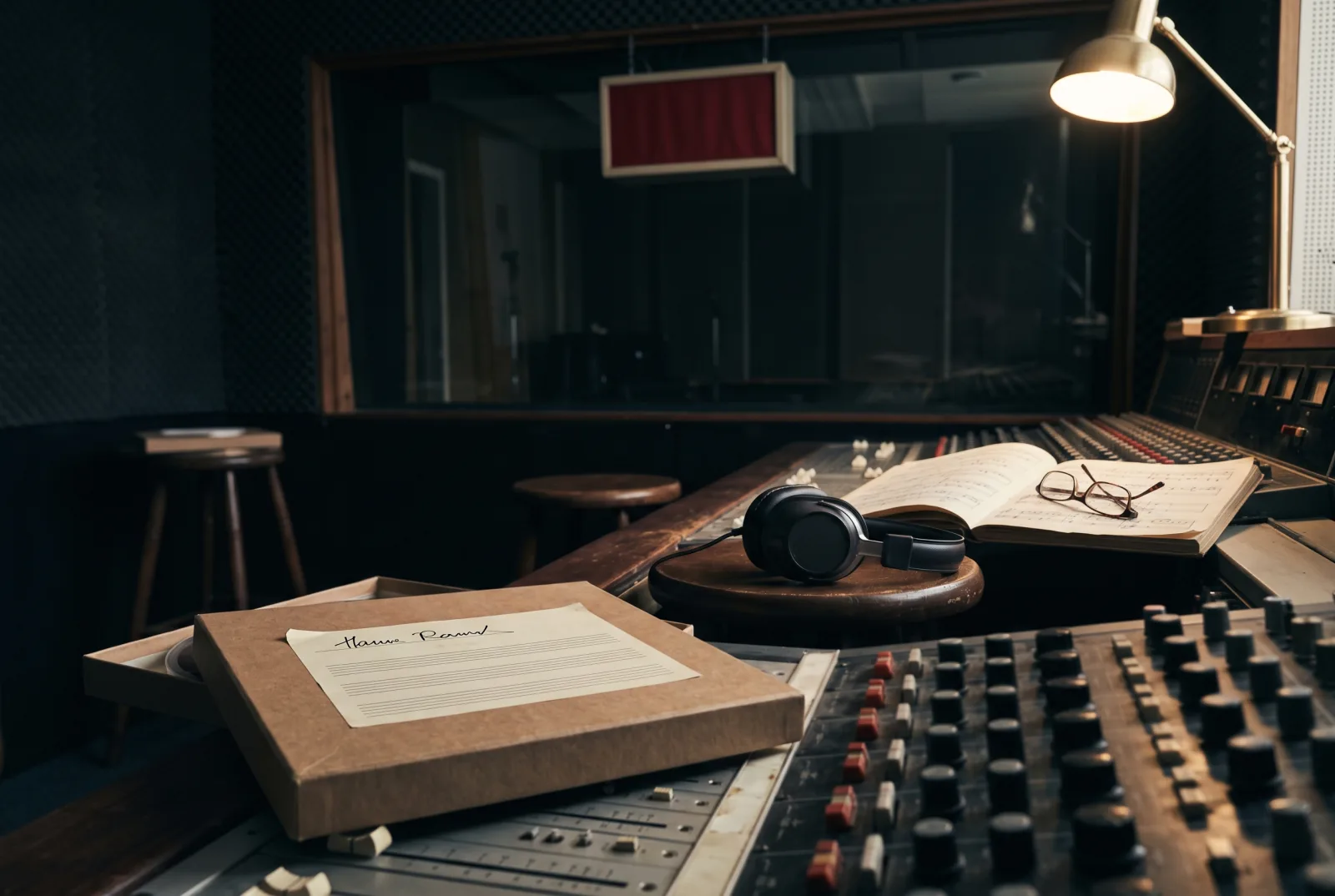
Ilustración: Rebobinados
Almost every band is named after its leader or after an image that sounds good. The Alan Parsons Project is named after an idea, and that is where it gets interesting. The man who dreamt it up did not put his own name on the door: he put his partner's. Not out of modesty, but because he had a theory about how music ought to be made, and he followed it all the way through. It was one of the most elegant conceptual moves in seventies rock, and it worked for forty years.
The man with the idea was called Eric Woolfson, and he is the place to start.
The idea
Woolfson had been Alan Parsons's manager. They met in the canteen at Abbey Road studios in 1974, when Parsons was already a respected name in the industry for his work as an engineer. And Woolfson had an idea that almost nobody in music had tried: to make records the way auteur films are made, where what rules is the production and the overall vision, not the star on the cover. Hence "Project": something designed, not a band of blokes with charisma.
For that idea to work he needed a name that sounded like a studio signature, like technical prestige. His own did not. Parsons's did. So he put his partner's name on it, started out using it as a working title to pitch to a record company, and that provisional title stayed for four decades. The brand turned out to be so good that it became permanent.
The two talents
The credit is worth sharing out carefully, because both extreme versions get it wrong. Woolfson wrote the music, wrote the lyrics, played keyboards on nearly everything, ran the business and sang the hits. "Time", "Eye in the Sky", "Don't Answer Me", "Prime Time": that warm, restrained voice is his. In practice he was the creative heart and the engine of the entire project.
And there is one detail that says a great deal about the kind of man he was: Parsons resisted letting Woolfson sing, and it was the record company that insisted on giving him the spotlight. So the man who had handed his brand over to someone else's name had to fight even to sing inside his own house. He took himself off the poster out of conviction, and very nearly off the microphone too.
But Parsons's prestige was not decorative, and that is the other half. Very young, he worked as assistant engineer on the Beatles' "Abbey Road" and "Let It Be". And he was the sound engineer on Pink Floyd's "The Dark Side of the Moon" — precision matters here: he did not produce it, Pink Floyd produced themselves; he was the studio engineer, and his work on that record was monumental. He was offered Pink Floyd's next album and said no, because he wanted to build something of his own. This was it. Two people at the top of two different trades, composing a single thing.
The song that plays everywhere
There is an instrumental of under two minutes, "Sirius", that opens the 1982 album "Eye in the Sky". It is, in all likelihood, the piece of music that has been played in a basketball arena more often than any other in history.
The Chicago Bulls' announcer picked it after hearing it as background music in a cinema. And here is the fact almost everyone gets wrong: it is not from the nineties. It debuted on 26 October 1984, at Michael Jordan's first NBA game. Millions of people associate it with that mythical Bulls entrance without knowing whose it is. Parsons found out late that his music was an entire team's anthem, and he has explained with some humour how little of that reaches him: arenas pay a blanket licence, and the writer gets a minuscule fraction.
This year "Sirius" rang out around the world again: it was the walk-out music for the opening round of matches at the football World Cup. More than forty years after it was recorded, it is still the universal fanfare of anticipation, of that second before something important begins.
The awards that never came, and the one that did
The Alan Parsons Project gathered thirteen Grammy nominations over its active career. It won none. Four decades making records that sounded better than almost everything else, and the recognition never showed up. Parsons's only Grammy arrived as recently as 2019, and in a technical surround-sound category, for remixing an old album. The industry rewarded the engineering half a century late, which is a very Parsons way of arriving.
The end
The partnership broke up in the early nineties, after a musical Woolfson premiered in Vienna that ended in litigation. He carried on writing musical theatre until the end, and his last album, from 2009, has the most melancholy and most honest title possible: "The Alan Parsons Project That Never Was". They are songs Parsons had rejected at the time, rescued by the man who had invented the brand. He died that same year, aged sixty-four. Parsons is still touring, and in October 2026 he plays Mexico.
What to remember
The Alan Parsons Project was not Alan Parsons's group. It was Eric Woolfson's idea: a band conceived as an auteur film, with no star out front, and his partner's name on the marquee because it sounded better. Woolfson wrote nearly all of it, sang the parts people hum, ran the business and chose to stay in the background. And on the other side, an engineer who had touched the sky with the Beatles and with Pink Floyd and preferred to build something of his own rather than inherit somebody else's crown.
There was no con: it was an idea, and it came out perfectly. Remember it this way: Eric Woolfson's finest invention was taking himself off the poster, and it suited him so well that it is still going.
Sources
The Alan Parsons Project, a British musical project active between 1975 and 1990, formed by the engineer and producer Alan Parsons (London, 20 December 1948) and the composer, lyricist, keyboard player and singer Eric Woolfson (Glasgow, 18 March 1945). The two met at Abbey Road in 1974, when Woolfson was representing Parsons. The group's name was proposed by Woolfson on commercial grounds, inspired by the idea of auteur cinema, and was kept despite having begun as a working title. According to the project's official website, Woolfson wrote around ninety-five per cent of the music and all of the lyrics; the album credits attribute most of the compositions jointly to both men. Woolfson sang lead on "Time", "Eye in the Sky", "Don't Answer Me" and "Prime Time", despite Parsons's initial resistance to his singing, which was overcome at the record company's instruction. Alan Parsons worked as assistant engineer on The Beatles' "Abbey Road" and "Let It Be" and as sound engineer on Pink Floyd's "The Dark Side of the Moon", a record the band produced themselves; he turned down work on "Wish You Were Here" in order to develop his own project. "Eye in the Sky" (1982) reached number seven on the Billboard 200 and number one in Austria, Germany and Spain, and its title single reached number three on the Billboard Hot 100. The instrumental "Sirius", which opens that album, was adopted as the Chicago Bulls' entrance music by the announcer Tommy Edwards and debuted on 26 October 1984, at Michael Jordan's first NBA game; in 2026 it was used as walk-out music on the opening day of the football World Cup group stage. The project received thirteen Grammy nominations without a single win during its active period; Alan Parsons won his only Grammy in 2019, in the best immersive audio album category, for the thirty-fifth anniversary reissue of "Eye in the Sky". The partnership dissolved in the early nineteen-nineties after the premiere of the musical "Freudiana" in Vienna and the litigation that followed. Eric Woolfson died on 2 December 2009 in London, aged sixty-four, of kidney cancer; his last album, "The Alan Parsons Project That Never Was", was released on 6 April 2009. Alan Parsons remains active and has concerts scheduled in Mexico in October 2026. A Rebobinados rewrite of previously verified research; interpretations are offered as the author's reading. No song lyrics are reproduced, for copyright reasons. Information drawn from Wikipedia, Billboard, RIAA, CBC News, The Scotsman, ESPN, American Songwriter, VintageRock and other coverage.
Keep rewinding
70s
progresivo
Jean-Michel Jarre
Twenty-five times in his whole life
His father was Maurice Jarre, three Oscars for "Lawrence of Arabia", "Doctor Zhivago" and "A Passage to India", and he left home when the son was 5: "we saw each other twenty or twenty-five times in our whole lives". *Oxygène* came out in December 1976, recorded in the former kitchen of his flat with a broken Mellotron, and sold some 18 million. Of his father's inheritance he received nothing: the European Court of Human Rights dismissed the case on 15 February 2024.

70s
progresivo
Roger Hodgson
The two wrists and the broken pact
"Dreamer" and "Breakfast in America" are his, written at nineteen, even though they are attributed to Rick Davies. In 1983 he left Supertramp with a verbal pact that Davies broke five years later, and in 1987 he fell from a loft and broke both wrists: he was told he would never play again. Davies died on 6 September 2025, at the age of 81.

70s
progresivo
Yes
The cathedrals and the borrowed name
The only American number one credited to Yes, "Owner of a Lonely Heart", was strictly speaking recorded by a different band: Chris Squire, Alan White, Tony Kaye and guitarist Trevor Rabin had put together a group called Cinema, and in June 1983 Atlantic executives suggested they call it Yes. Jon Anderson joined once the album was well under way.
Rewind with us
Comments · 0
No one has commented yet. Open the conversation.