
Billie Eilish
She made the future of pop in one bedroom, and swept the Grammys at 18
By Rebobinados · Published on September 21, 2026
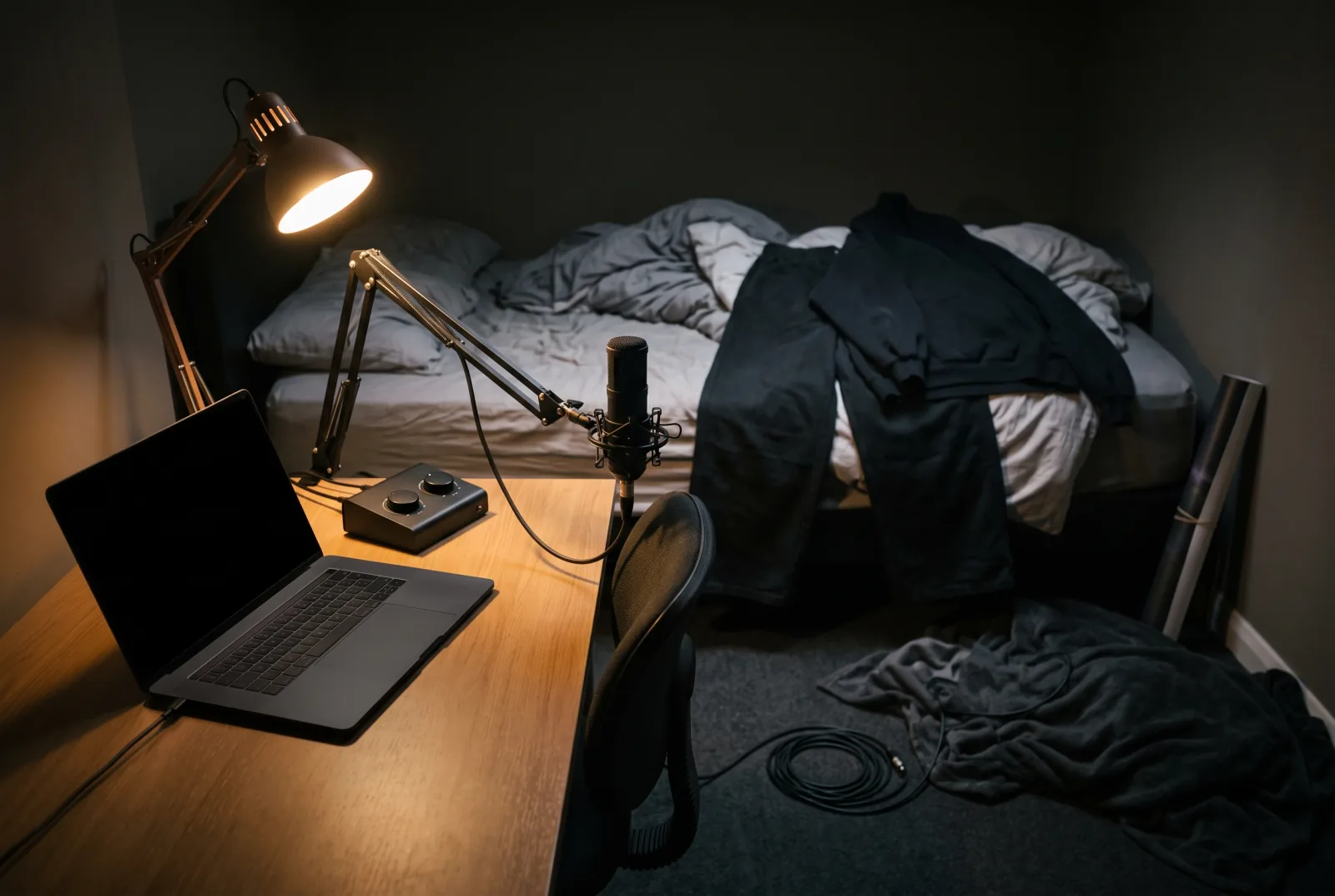
Ilustración: Rebobinados
In 2020, an eighteen-year-old girl stood on the Grammy stage and took away, one after another, the four biggest categories of the night: album, record and song of the year, and best new artist. Nobody so young had ever won all four at a single ceremony. And the most incredible thing was not her age: it was how she had made that music. Billie Eilish did not come out of a star factory or an army of producers. She recorded her revolutionary music in the bedroom of her parents' house, alongside her brother Finneas, with minimal equipment. Two siblings, one bedroom and a computer defeated the entire machinery of the industry.
The whisper against the shout
To understand why she was revolutionary you have to listen to how she sounds. At a time when pop was measured by vocal power, by who sang loudest and highest, Billie Eilish did the opposite: she sang in whispers. Her voice is intimate, close, barely breathed, as if she were telling you a secret in the dark. And her songs were strange, dark, minimalist, with silences and odd sounds where others put explosions.
"Bad Guy", "Ocean Eyes", "Everything I Wanted": they sounded like nothing else on the radio. And yet they connected with millions of young people who felt, at last, represented by someone who was not pretending to be perfect or happy, who talked about anxiety, about darkness, about feeling strange, with a disarming honesty. Billie did not follow the pop fashion: she changed it. After her, whispering stopped being a weakness.
Redefining the star
And she also changed what a female pop star was allowed to look like. In a world that demanded young singers dress a certain way, show their bodies, fit into a mould of prefabricated sensuality, Billie turned up in enormous, baggy clothes that covered everything, and explained that she did it precisely so that nobody would have the right to have an opinion about her body. She took control of her own image from day one.
It was an immensely powerful gesture for the girls watching her: you can be one of the biggest stars in the world without handing your body over to other people's gaze, without meeting the mould. And her talent kept growing: she won two Academy Awards for songs written for the screen, including one for a James Bond film and another for "Barbie", confirming that she was not a passing phenomenon but one of the great artists.
What to remember
Billie Eilish made, together with her brother Finneas, revolutionary music in a bedroom, and with it she swept the 2020 Grammys at eighteen, the youngest person ever to win the four main categories in one night. She sang in whispers when pop rewarded shouting, spoke honestly about inner darkness, and took control of her image by refusing the moulds the industry imposed on young women. She also won two Oscars.
Remember it like this: two siblings in one bedroom beat the whole industry, and along the way changed how a pop star sounds and how one looks. Sometimes the future is not manufactured in a big studio with a million-dollar budget. Sometimes it is made in a bedroom, in a low voice, between siblings.
Sources
Billie Eilish (Billie Eilish Pirate Baird O'Connell), American singer and songwriter born on 18 December 2001 in Los Angeles; still living. She writes and records alongside her brother Finneas O'Connell, initially in the bedroom of their family home. Her song "Ocean Eyes" (2015) brought her to public attention, and her debut album "When We All Fall Asleep, Where Do We Go?" (2019) included "Bad Guy". At the 2020 Grammy ceremony she won the four main awards —album, record and song of the year and best new artist— becoming the youngest person to achieve this in a single edition. She won the Academy Award for best original song in 2022 for "No Time to Die" (the theme of the James Bond film, 2021) and in 2024 for "What Was I Made For?" (from "Barbie", 2023). Profile compiled for Rebobinados with fact-checking; interpretations of the meaning of the work are offered as the author's reading. No song lyrics are reproduced, for copyright reasons. Information drawn from Wikipedia, Britannica, Grammy.com, Biography and other coverage.
Keep rewinding

10s
pop
Bruno Mars
Eleven names in the credits
"Uptown Funk" came out on 10 November 2014 with six writers and today it has eleven. In February 2015 The Gap Band's publisher filed a claim over "Oops Up Side Your Head" in YouTube's copyright system —there was never a lawsuit— and on 28 April five names were added, with 17 % of the publishing. It happened weeks after the "Blurred Lines" verdict, and the song had been fourteen weeks at number one.

00s
pop
André Rieu
It was not from the jazz suite
The waltz with which André Rieu reached half the world is not from Shostakovich's Suite for Jazz Orchestra No. 2: it is from the Suite for Variety Orchestra, which the composer did not assemble, and it was born in 1956 as music for a Soviet film about settlers in Kazakhstan. The error comes from a misprint in volume 10 of the complete works (Muzyka, Moscow, 1984), corrected only in 2001. And the title "The Second Waltz" was invented by his wife, because the real one did not sell.

90s
pop
Daniela Mercury
She took the neighbourhood out of the song
"O Canto da Cidade" was written by Tote Gira, a composer from Nordeste de Amaralina who recorded the demo on a borrowed cassette, marking the beat on the door of a refrigerator; Mercury's team almost threw the tape away. She shares the credit because she deleted the references to the Pelourinho so that the song would serve all of Brazil. The album, from 20 September 1992, sold more than 2 million copies and nationalised axé. But she did not invent it: the name was a journalist's insult in 1987.
Rewind with us
Comments · 0
No one has commented yet. Open the conversation.