
Chester Bennington
So that no one would be alone
By Rebobinados · Published on September 14, 2026
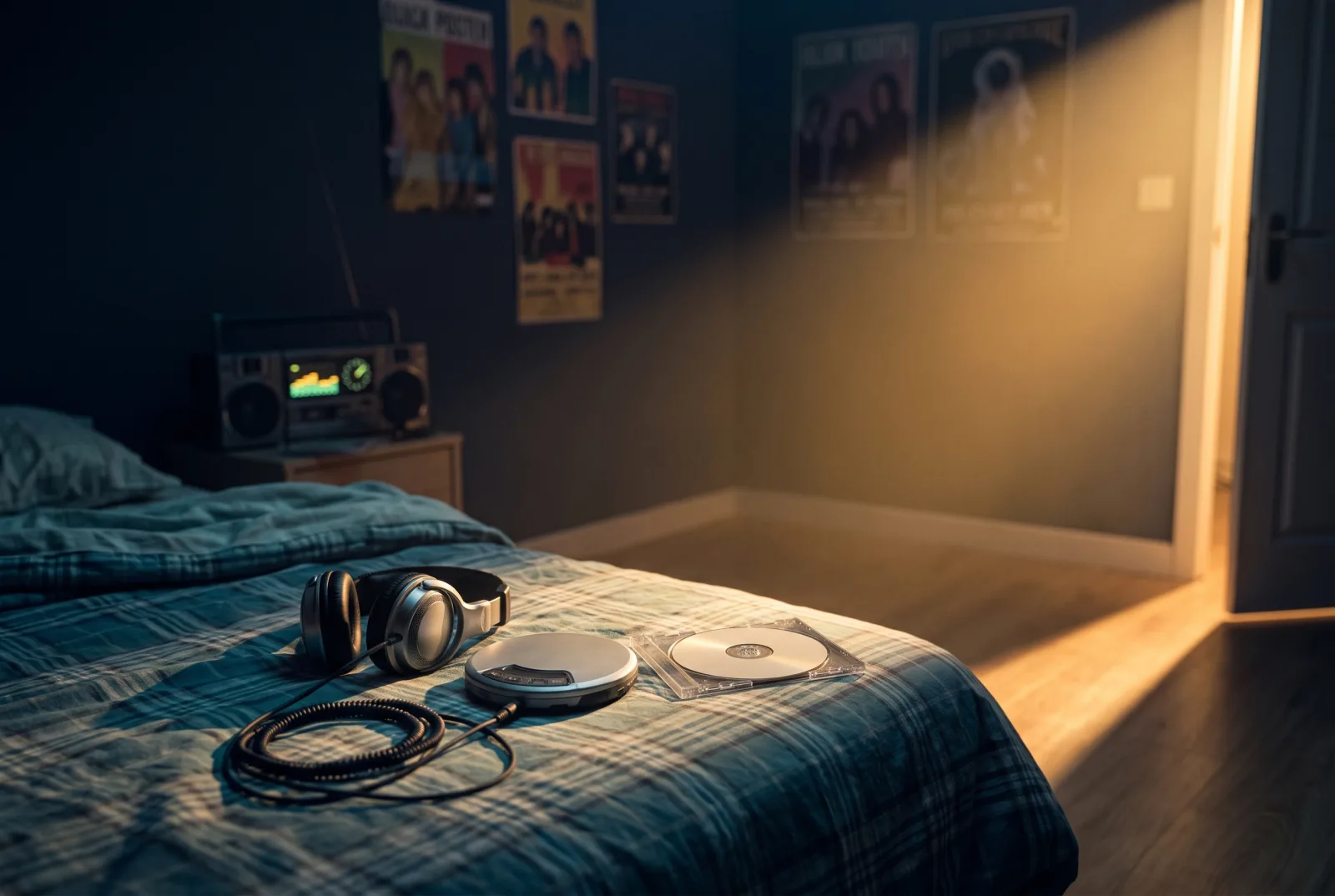
Ilustración: Rebobinados
When Linkin Park appeared, in 2000, millions of boys and girls who were going through a hard time — depressed, abused, lonely, numb — heard something they had never heard before.
A man screaming his pain out loud. And then, in the same song, whispering it.
Chester Bennington did not sing about suffering from the outside. He sang it from the inside, because he had lived it. That is why an entire generation felt, perhaps for the first time, that somebody understood them. This story has to be told with all the care it deserves.
What lay behind the voice
Behind that voice lay a childhood of real harm.
Chester said that an older friend sexually abused him from around the age of seven until he was thirteen, and that it haunted him for the rest of his life. His parents split up when he was eleven, and he felt alone, with nobody to turn to. He started taking drugs very young, to numb what he did not know how to put into words.
There is one detail that says a great deal about the person he became. When he finally revealed who it had been, he decided not to press charges: he had learned that the man had also been abused as a child. "I didn't need revenge," he said. Carrying that wound, he refused to pass the pain on.
Making pain audible
With him, Linkin Park became one of the biggest bands of the century. "Hybrid Theory" is one of the best-selling debuts of its era, and the band went on to pass a hundred million records.
But the numbers miss what matters. In "Crawling", in "Numb", in "In the End", in "Breaking the Habit", Chester poured unbearable feelings — self-loathing, addiction, the numbness of depression, trauma — into a voice that millions of teenagers recognised as their own.
His scream was a catharsis. For a kid shut away in his bedroom, convinced that nobody in the world felt what he felt, Chester was proof that somebody did, and that something could be made of it. He made pain audible, and by making it audible, he made it more bearable for the people listening.
Without armour
And he was honest about all of this, out loud, at a time and in a genre where men did not talk about depression or abuse.
He spoke about his mental health, his addiction and his childhood without armour. That honesty was a gift in itself: it gave a great many men permission to admit they were not all right, something almost nobody dared to say.
The friend
There is a final part that is devastating, and it cannot be glossed over.
Chris Cornell, the singer of Soundgarden — one of the voices of the Seattle that changed rock in the early nineties — was his friend and his hero, and carried a similar kind of pain. He died in May 2017. Chester was devastated: he wrote him an open letter and at the funeral sang Leonard Cohen's "Hallelujah", his voice breaking.
Two months later, on 20 July, the day Cornell would have turned fifty-three, Chester also took his own life. He was forty-one.
It is the hardest truth in his story, and it admits no embellishment: he helped so many others keep going, and could not do it for himself.
What remained
He left behind his wife, six children and a generation that grew up with his voice.
His death opened a conversation that was long overdue: about men and pain, about how the ones who seem strongest are often the ones carrying the most, about how saying "I'm not OK" is not weakness but courage. His widow, Talinda, has since devoted herself to promoting mental health.
If you ever screamed along to one of his songs because it said what you could not say, Chester has already done for you what he did for millions: he made you feel a little less alone in the dark.
Let us remember him not for how he left, but for what his voice did while he was here. It walked into countless darkened bedrooms and told a great many people who were suffering that they were not alone. That permission to say it hurts, out loud, is still being passed from hand to hand.
This piece discusses suicide, abuse and depression. If you are going through a difficult time or having thoughts of harming yourself, you are not alone and help is available. In Chile you can call *4141 free of charge, the Ministry of Health's suicide-prevention line, available 24 hours a day.
This text mentions sexual violence. If you or someone you know has been through something like this, you are not alone and help is available. In Chile, the SernamEG Gender Violence Helpline is 1455, from 08:00 to 00:00 every day, with a silent WhatsApp service at +56 9 9700 7000. For emergencies during the night there are Carabineros' 149, plus 133 and 134. And in the case of a recent sexual assault you can go directly to any emergency service, without needing to have filed a report: care is guaranteed within the first 72 hours. Seeking support is an act of strength.
Chester Charles Bennington (Phoenix, Arizona, 20 March 1976 – Palos Verdes Estates, California, 20 July 2017), lead singer of Linkin Park, and also of Dead by Sunrise and, between 2013 and 2015, of Stone Temple Pilots. He spoke publicly about having been sexually abused by an older friend from the age of seven until thirteen, and about deciding not to press charges on learning that his abuser had also been a victim; his parents divorced when he was eleven. Linkin Park's debut, "Hybrid Theory" (2000), is one of the best-selling debut albums of the 21st century, and the band has sold more than 100 million records; among its best-known songs are "One Step Closer", "Crawling", "In the End", "Numb" and "Breaking the Habit". He spoke openly about his struggles with depression and addiction. His friend Chris Cornell, singer of Soundgarden and Audioslave, died on 18 May 2017; Bennington wrote him an open letter and sang "Hallelujah" at his funeral. Bennington died by suicide on 20 July 2017, the date on which Cornell would have turned 53; he was survived by his wife, Talinda, and six children. After his death, Talinda Bennington championed suicide-prevention and mental-health initiatives. The *4141 line was set up by the Chilean Ministry of Health and answers calls free of charge 24 hours a day. Externally authored text, edited and verified for Rebobinados. Interpretations of the meaning of his work are offered as the author's reading. No song lyrics are reproduced, for copyright reasons. Information drawn from Billboard, Rolling Stone, Loudwire, Minsal and other press coverage.
Sources
Keep rewinding

10s
metal
Bring Me the Horizon
Twenty years to get back to the scream
Bring Me the Horizon started in 2006 with a deathcore record and their turn did not happen in 2013: the leap to metalcore was in September 2008 and the synthesisers and clean vocals arrived in October 2010. Jordan Fish, eleven years in the band, was the one who put in the electronics. On 10 July 2026 they re-recorded that first record for its twentieth anniversary, with Oli Sykes back on the guttural scream.
00s
metal
Staind
The sleeve that nearly cost them everything
In October 1997, Fred Durst tried to pull Staind off the bill at the Webster Theatre in Hartford over the sleeve of their home-made record; then he listened to them and signed them. In 2001, Break the Cycle debuted at number one on the Billboard 200 and "It's Been Awhile" spent sixteen weeks at number one on the Modern Rock. Jon Wysocki, founding drummer, died on 18 May 2024.

90s
metal
Marilyn Manson
The lawsuit he withdrew while paying
The triad of Antichrist Superstar, Mechanical Animals and Holy Wood, and a file that is still open: two out-of-court settlements, one sworn retraction, the prosecutor's office that ruled out charges in January 2025 on statute-of-limitations grounds, the defamation suit he withdrew while paying 327,000 dollars and a jury trial set for November 2027.
Rewind with us
Comments · 0
No one has commented yet. Open the conversation.