
Édith Piaf
The sparrow of Belleville
By Rebobinados · Published on October 1, 2026
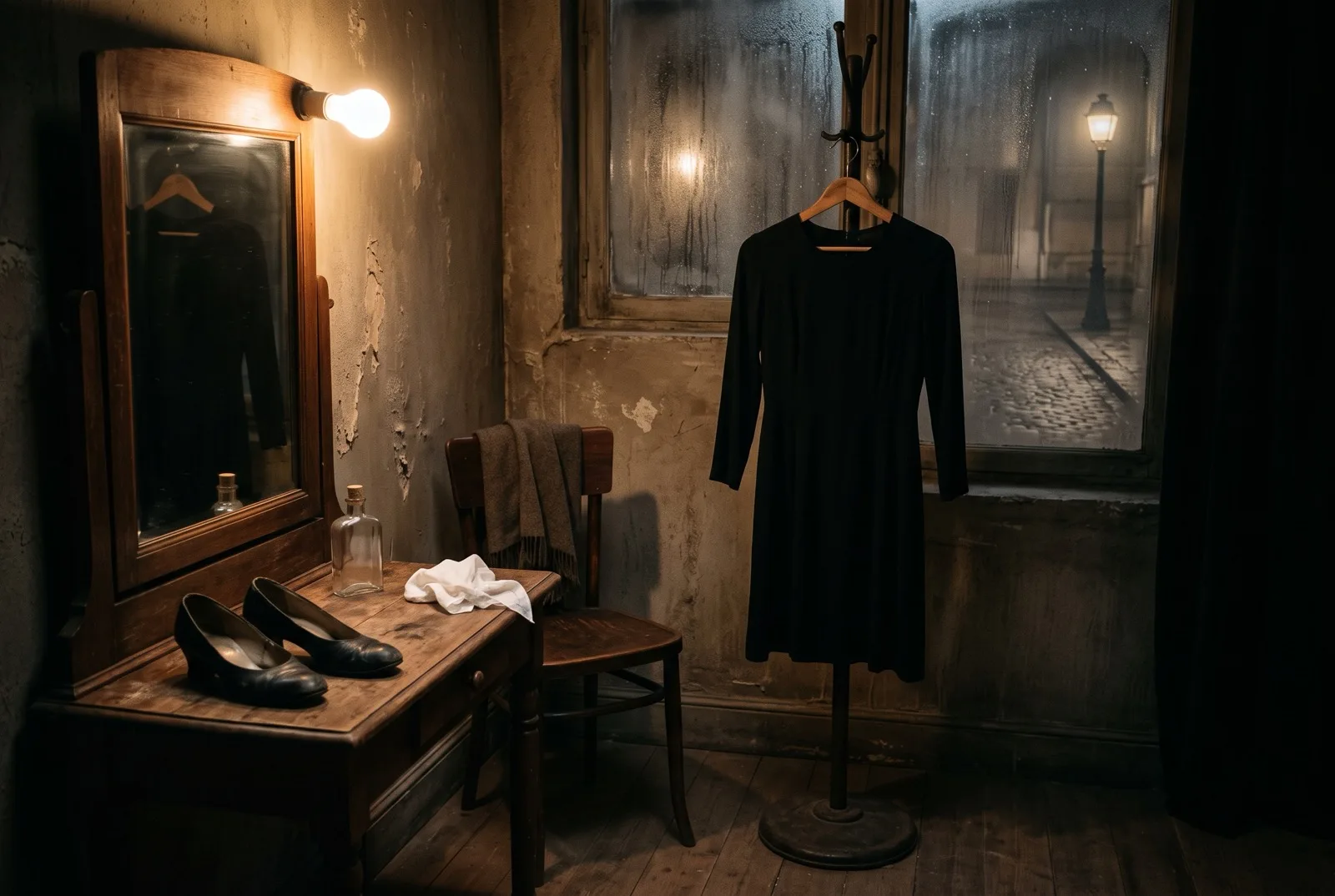
Ilustración: Rebobinados
She was not quite a metre fifty tall. She was thin, fragile, with the face of a frightened child. They called her "the sparrow", La Môme Piaf, because of that little bird's body. And out of that tiny body came one of the greatest voices humanity has produced: a torrent that trembled, that cracked, that seemed to carry all the suffering in the world and give it back turned into beauty. Édith Piaf did not sing songs; she bled into them. That is why, more than sixty years after her death, she is still the voice of France.
Born in the street
Her story starts in the harshest poverty. Édith Giovanna Gassion was born on 19 December 1915. The legend says she came into the world in the open street, on the steps of number 72 rue de Belleville, wrapped in a policeman's cape. It is a beautiful story and it is false: the birth certificate says she was born at the Tenon hospital, and her parents lived at that number 72 in Belleville. A journalist set the myth going, her mother and Piaf herself fed it in her memoirs, and biographers repeated it for decades. That she told it herself says a good deal about what kind of artist she was.
What is not legend is the misery. An absent mother, a father who was a street acrobat, spells living in the brothel her grandmother ran in Normandy. As a child she sang on street corners to scrape together a few coins. She did not study music, she had no teachers; her school was the pavement, hunger and the need to survive. That root never left her voice: when she sang, you knew there was someone there who had truly known pain.
In 1935 an impresario named Louis Leplée, owner of the cabaret Le Gerny's, discovered her singing in the street and put her on a stage. It was he who gave her the nickname. The neighbourhood sparrow became, within a few years, the biggest star in France.
The songs that are anthems
Piaf left behind a handful of songs that transcended everything. "La Vie en Rose" is probably the best-known French song on the planet; the lyric is hers, the music is credited to Louiguy. "Non, je ne regrette rien" — I regret nothing — is a manifesto for an entire life, the cry of someone who, after all that suffering, would change nothing; Charles Dumont and Michel Vaucaire wrote it, and she recorded it in 1960 like someone signing a will. "Hymne à l'amour", "Milord", "Padam Padam". Each one is a complete little drama, performed with absolute commitment.
Hers was not cold technique; it was emotional truth. Piaf understood suffering and love because she had lived them in her own flesh, and she put all of it into her voice.
A life marked by tragedy
Behind the shine, her life was a run of brutal blows. She had a daughter, Marcelle, at seventeen, and lost her at two to meningitis. The great love of her life, the boxer Marcel Cerdan, died in 1949 in a plane crash over the Azores: he was flying to New York to see her and to fight the rematch for the world title he had lost months earlier. She suffered several serious car crashes, which left her with chronic pain, and from there she fell into morphine and alcohol.
She lived fast and burned out fast. She died on 10 October 1963, at just forty-seven, of liver cancer, so worn out that she looked like an old woman. The Catholic Church denied her a funeral mass because of her private life. It did not matter: tens of thousands of people followed the cortège and Paris stopped to say goodbye.
And there is something lovely that tends to be forgotten: Piaf did not only shine, she also lit others. It was she who took Yves Montand under her wing, and a short young man many rejected for his odd voice, Charles Aznavour. She believed in him when nobody did. The queen of pain was also, in her own way, a generous godmother.
What to remember
Édith Piaf is proof that greatness has nothing to do with size or with fortune. A tiny woman, born into poverty, with no education, became the voice of a whole country because she knew how to turn her suffering into pure art. She did not sing to show off; she sang to survive, and in that brutal honesty lay her magic.
She even turned her own birth into a story, and that detail is her whole portrait: she understood before anyone that a life is also a performance. "Non, je ne regrette rien" stands as her perfect epitaph. Every time that trembling voice rises, there she still is, reminding us that the deepest pain can also produce the greatest beauty.
Sources
Édith Piaf (Édith Giovanna Gassion) was born on 19 December 1915 and died on 10 October 1963, aged 47, in Grasse, of liver cancer. She was between 1.42 and 1.47 m tall, depending on the source. The legend according to which she was born in the street, on the steps of number 72 rue de Belleville and wrapped in a policeman's cape, is contradicted by her birth certificate, which records the Tenon hospital; her parents were registered at that address in Belleville. The myth was spread by the press, by her mother and by Piaf herself in her memoirs. She had a childhood of extreme poverty, with a father who was a street acrobat and spells in the brothel her paternal grandmother ran in Normandy, and began by singing in the street. She was discovered in 1935 by Louis Leplée, owner of the cabaret Le Gerny's, who gave her the nickname "La Môme Piaf". Among her most celebrated songs: "La Vie en Rose" (her lyric, music credited to Louiguy; written in 1945 and released as a single in 1947), "Non, je ne regrette rien" (composed by Charles Dumont with a lyric by Michel Vaucaire, recorded by Piaf in 1960), "Hymne à l'amour", "Milord" and "Padam Padam". Her daughter Marcelle, born on 11 February 1933, died of meningitis in July 1935, aged two. The boxer Marcel Cerdan, her partner, died on 28 October 1949 in the crash of the Air France Paris–New York flight in the Azores. Piaf had several car accidents from 1951 onwards and developed a dependence on morphine and alcohol. The Catholic Church denied her a funeral mass; tens of thousands of people followed her cortège to the Père-Lachaise cemetery. She gave a push to the careers of Yves Montand and Charles Aznavour. Profile compiled for Rebobinados with fact-checking; interpretations of the meaning of the work are offered as the author's reading. No song lyrics are reproduced, for copyright reasons. Information drawn from the French and English Wikipedia and other coverage.
Keep rewinding

10s
pop
Bruno Mars
Eleven names in the credits
"Uptown Funk" came out on 10 November 2014 with six writers and today it has eleven. In February 2015 The Gap Band's publisher filed a claim over "Oops Up Side Your Head" in YouTube's copyright system —there was never a lawsuit— and on 28 April five names were added, with 17 % of the publishing. It happened weeks after the "Blurred Lines" verdict, and the song had been fourteen weeks at number one.

00s
pop
André Rieu
It was not from the jazz suite
The waltz with which André Rieu reached half the world is not from Shostakovich's Suite for Jazz Orchestra No. 2: it is from the Suite for Variety Orchestra, which the composer did not assemble, and it was born in 1956 as music for a Soviet film about settlers in Kazakhstan. The error comes from a misprint in volume 10 of the complete works (Muzyka, Moscow, 1984), corrected only in 2001. And the title "The Second Waltz" was invented by his wife, because the real one did not sell.

90s
pop
Daniela Mercury
She took the neighbourhood out of the song
"O Canto da Cidade" was written by Tote Gira, a composer from Nordeste de Amaralina who recorded the demo on a borrowed cassette, marking the beat on the door of a refrigerator; Mercury's team almost threw the tape away. She shares the credit because she deleted the references to the Pelourinho so that the song would serve all of Brazil. The album, from 20 September 1992, sold more than 2 million copies and nationalised axé. But she did not invent it: the name was a journalist's insult in 1987.
Rewind with us
Comments · 0
No one has commented yet. Open the conversation.