
El Macha
The Party and the Sorrow
By Rebobinados · Published on September 7, 2026
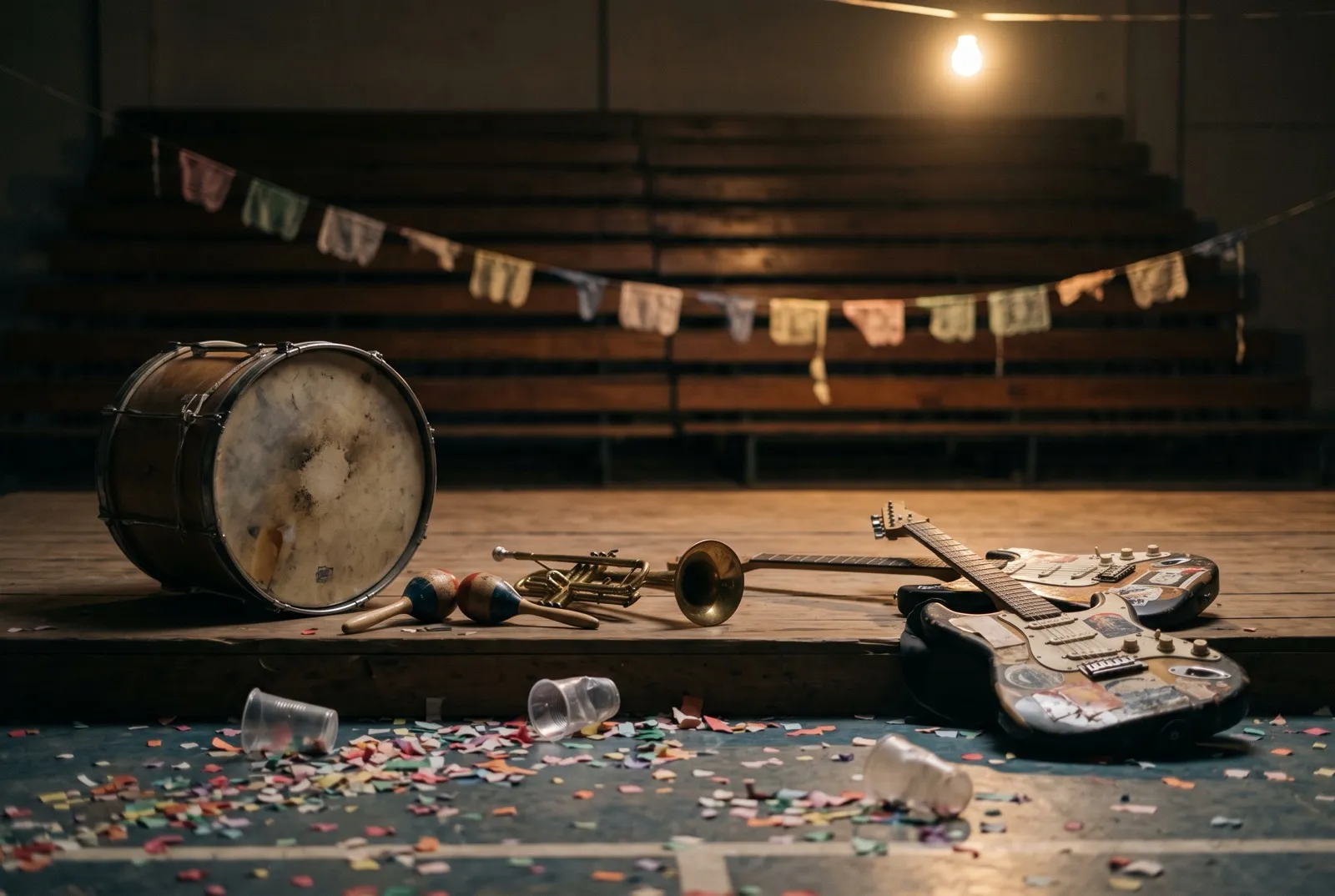
Ilustración: Rebobinados
Rebobinados is the memory of music, and memory almost always arrives late: you end up writing about the greats once they are gone. With Aldo "el Macha" Asenjo, luckily, we are in time. He is alive, and these days — with September just beginning and the fondas going up — he is most likely on a stage somewhere, in a municipal gym in some coastal town, with his captain's bearing, getting half a city dancing to a cumbia. This text is not a posthumous tribute: it is a celebration, and the kind that has to be made while the person being celebrated can hear it.
From punk to cumbia, out of homesickness
El Macha was born in Villa Alemana in 1968, and he started out as a punk. He led La Floripondio, a band of distorted guitars and rage, and at the end of 1998 they went on tour through Europe, dozens of concerts across Germany, the Netherlands and Austria. And there, in the loneliness and cold of that winter, far from everything, something happened that would change the course of Chilean music. To pass the time on the road, to liven up the parties in the places where they stayed, Macha and his bandmates began playing, half as a joke, half out of homesickness, the cumbias and boleros from back home: the music of the radio, of neighbourhood parties, of childhood. And they discovered that this music, the one they had left behind, gave them something rock did not: it took them back to Chile. Out of that longing, in the cold, Chico Trujillo was born in 1999, back in Villa Alemana. An entire country's party began as the homesickness of a punk who missed his own land.
The music the country was slightly ashamed of
What he did on his return is what makes him great. He brought that cumbia back and gave Chile something it had lost: the party, without shame. Because cumbia was, until then, "the cheap music", the music of the neighbourhood, of the wedding and the fifteenth birthday, the one serious radio stations looked down on. Macha, with Chico Trujillo, rehabilitated it: he gave it back its dignity and turned it into the heart beating beneath the whole country's celebration. He got everyone dancing to it together — punks and university students, workers and families — without anyone asking which tribe anyone else belonged to. He took the music people were slightly embarrassed by and turned it into the music that makes them proud. He gave a whole country back its right to have a good time.
Every September, without fail
And there is proof of that which repeats every year. September arrives, the fondas and ramadas go up, the whole country starts dancing with a glass in hand, and there is Chico Trujillo, playing in every backyard. "Loca", released in 2008 on the album "Plato único bailable" and written by him, stopped being one band's song and became part of the Dieciocho, like the kite, the empanada and the meat on the spit. It is no accident that one of their albums is called, with no modesty at all, "Reina de todas las fiestas". And that is the most a song can aspire to: to stop having an owner and become everyone's, new folklore, something people sing without remembering who made it, because they already feel it is theirs. Few living artists have slipped like that into a country's emotional calendar.
From below and from outside
And he did it his own way. No major labels, no television: his own label, Oveja Negra, and the road. His career is not explained from the studios of Santiago but from the tarmac connecting municipal gyms, town squares and coastal festivals from north to south. He turned his back on the capital's spotlight to play for the other Chile, the one in the regions, the working-class one, the one that beats hard far from the cameras. He became a kind of cartographer of that Chile nobody films: he rescued the sound of the provinces — the melancholy of the port, the cumbia of the barrio, the defiance of the small town — and handed it back its pride. Those who guard prestige will never put him on the list of the important ones; the people, who are the ones who know, made him their captain a long time ago.
The second Macha
And there is a second Macha, the mirror image of the first. With another of his projects, Bloque Depresivo, he does exactly the opposite of the party: bolero, ranchera, songs of sorrow. If Chico Trujillo gets an entire gym dancing, Bloque Depresivo gets it crying together, singing its sorrows at the top of its lungs, everyone arm in arm. Macha commands the two great emotions of the popular soul: joy and sadness, the party and the mourning. He makes you dance and he makes you cry, and you discover, through him, that the two are the same thing: ways of being alive, together, without shame about feeling.
Fifty thousand people singing boleros
And in case anyone thought this was a municipal-gym affair, on 19 January 2026 Macha filled the Estadio Nacional. Note the detail carefully, because it says everything: he did not fill it with the party, he filled it with the sorrow. It was Bloque Depresivo, the bolero project, that gathered some fifty thousand people in the country's biggest stadium to sing sad songs, all in chorus, like a giant karaoke. The man who started out playing punk in Villa Alemana and recording on his own label ended up filling the Nacional without ever going through television or a major label. And he filled it again afterwards. Few careers built from below reach that high without bending on the way.
Let us say it now
And there is the difference, and the reason for writing this now rather than later. Macha is not a memory: he is a present tense. He is still climbing onto stages, still making Chile dance and cry from one end to the other. If you have ever danced to a Chico Trujillo cumbia at a wedding, or sung a Bloque Depresivo bolero with a hoarse voice and a broken heart, then Macha is already part of your life. He is the one who gave us the party back and the one who taught us to sing our sorrow. And he is still here, doing it. Let us say it now, out loud, while he can hear it: thank you, captain.
Sources
Aldo Enrique Asenjo Cubillos, "El Macha" (Villa Alemana, 4 August 1968), is a Chilean singer-songwriter and guitarist, leader of Chico Trujillo, La Floripondio, Bloque Depresivo and Cabezas Rojas; he is one of the central figures of the so-called "nueva cumbia chilena". He began in punk with La Floripondio, formed in Villa Alemana in 1991, which between 1998 and 1999 undertook a European tour of dozens of concerts across Germany, the Netherlands, Austria and France; during that stay, playing cumbias and boleros out of nostalgia, the seed of Chico Trujillo appeared, founded in 1999 in Villa Alemana with Víctor Vargas on bass and Juan Gronemeyer on percussion. The band, whose first album was "Chico Trujillo y la Señora Imaginación" (2001), rehabilitated cumbia for a new generation and became a mass, cross-cutting phenomenon, released on the independent label Oveja Negra. Asenjo has built his career on self-management, with a strong presence in the regions and outside television. "Loca", included on the album "Plato único bailable" (2008) and registered as his own composition, is one of his most popular songs and a fixture of the Chilean national holidays; the group titled one of its albums "Reina de todas las fiestas". With Bloque Depresivo he develops a repertoire of boleros and melancholy song: on 19 January 2026, Macha y el Bloque Depresivo performed at the Estadio Nacional before some 50,000 people, according to press coverage, in a show described as a mass karaoke, and later announced a further concert at the same venue. He has been nicknamed "the cumbia caudillo" and "the captain". He remains fully active. No song lyrics are reproduced, for copyright reasons. Sourced from Wikipedia, MusicaPopular.cl, La Tercera, Ex-Ante, T13 and other press coverage.
Keep rewinding
80s
punk
Billy Idol
His two anthems failed when they came out
"Rebel Yell" came out on 12 January 1984 and reached no. 46 on the Hot 100 and no. 62 in the United Kingdom; "White Wedding" got no further than no. 36 and did not chart in the United Kingdom in 1982. The two of them only reached no. 6 in Britain in the 1985 reissues, and "Dancing with Myself" never entered the Hot 100. His only no. 1 was a live "Mony Mony" from 1987 that knocked off Tiffany, whose hit was another Tommy James cover.
90s
punk
Fiskales Ad-Hok
The world tour started with them
On 13 September 1992 the Ramones made their debut in Chile, at the Velódromo, the cycling arena inside the Estadio Nacional grounds, and that date was not just another stop: it was the first night of the Mondo Bizarro world tour. It was opened by Fiskales Ad-Hok, a band from the Santiago underground born in 1986 and still without a record. Then came their own label C.F.A. in 1997, "Fiesta" (November 1998) at number 42 in Rolling Stone Chile, and the indefinite hiatus of February 2025.

00s
punk
Avril Lavigne
Six years with no album
Between her 2013 album and Head Above Water, of 15 February 2019, Avril Lavigne released no records because she was seriously ill with Lyme disease: diagnosed in December 2014, she told it on the cover of People in April 2015. The comeback album is about that, and Love Sux (2022) returned her to pop-punk on Travis Barker's label.
Rewind with us
Comments · 0
No one has commented yet. Open the conversation.