
Evanescence
The voice the label imposed on her
By Rebobinados · Published on September 15, 2026
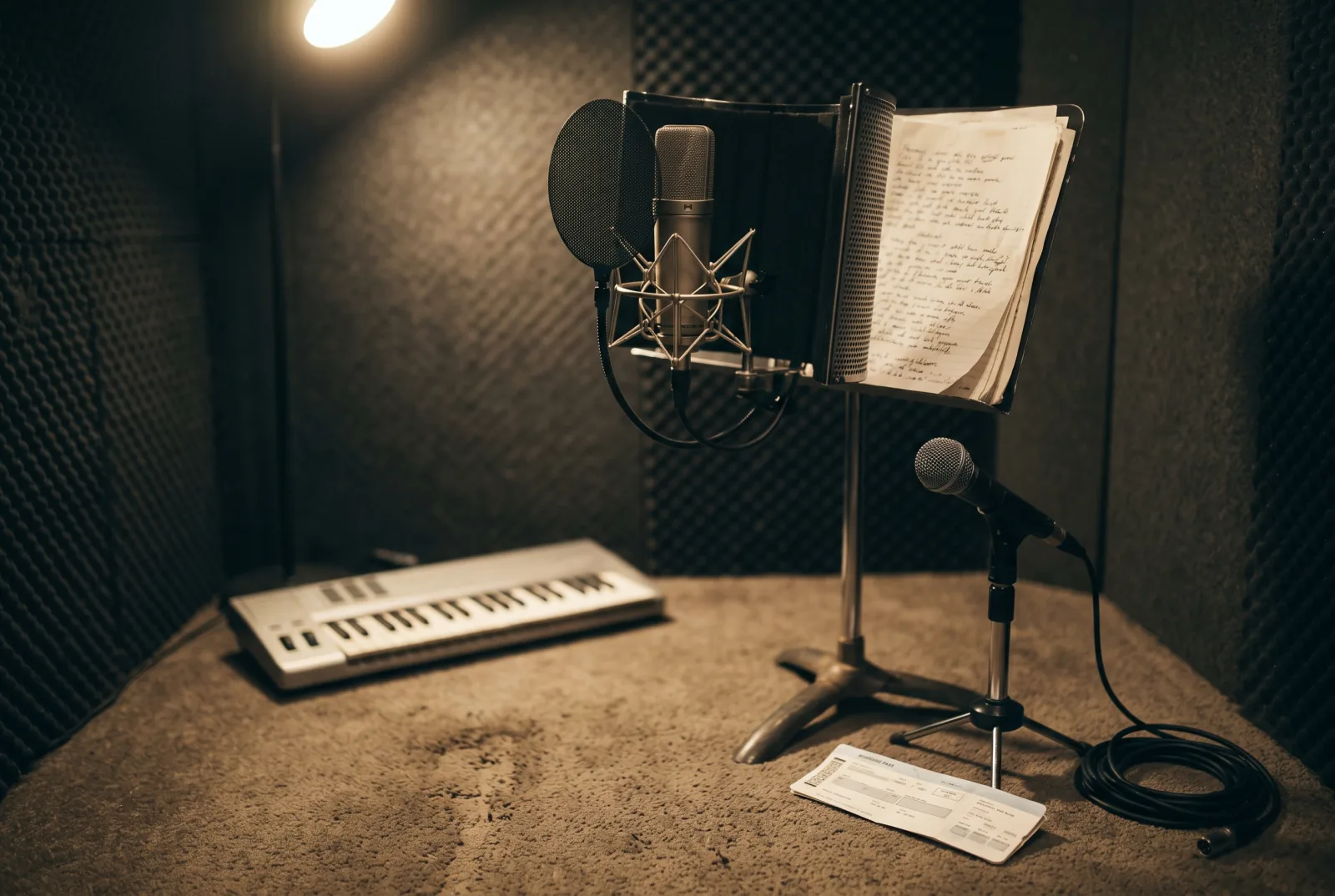
Ilustración: Rebobinados
Everybody sings the man's part. In "Bring Me to Life", the single that made Evanescence huge in 2003, a male voice bursts into the chorus: it's the one that gets sung in cars, at karaoke, in stadiums. It's Paul McCoy, from another band, who isn't credited as one of the song's writers. And the words he sings —every single one— were written by Amy Lee.
There it is, the whole story of this album condensed into one detail: a group of men making decisions about a woman who didn't need them, and that woman outlasting the lot of them. It's worth telling, because time proved her right and nobody else.
The voice the industry imposed
That male voice wasn't an artistic idea. It was a commercial condition, and Amy Lee has described the exact words used on her: that she was a girl singing in a rock band, that there was nothing like it out there, that nobody was going to listen to her, and that she needed a guy singing backing vocals for the thing to work. The label's opening request had been to put rap on eight of the album's songs. One male voice on one track was the reduction she managed to negotiate.
The label's president later said it without a filter, recalling how rock radio programmers reacted when he brought them the song: a woman and a piano, on rock radio, not a chance. That was the ceiling they set for her. What happened next was that she broke the ceiling and the whole building with it.
McCoy, by the way, recorded his part during a layover: he got off one plane, sang, got on another and played with his own band that same night. The most recognisable guest vocal in rock that year lasted about as long as a connecting flight. The song, on the other hand, was hers from top to bottom.
The teenage keyboard the label wouldn't let her touch
"My Immortal", the album's ballad, hides something similar. It isn't a studio recording: it's a demo from the year 2000. The piano is a MIDI keyboard, and the voice is that of a teenage Amy Lee, recorded at night at the radio station where her father worked because there was no money for a session. They laid strings over it and left it at that. Lee found that version hard to listen to, because it felt old to her, made two years earlier. The label wanted it exactly like that.
Read it alongside the rest and the pattern shows up: the voice of an eighteen-year-old girl, recorded for free in a borrowed radio studio, ended up being one of the most listened-to ballads of the decade. The makeshift conditions took nothing away from it. The emotion was all there from the start.
The ghost who won the Grammy
There's one fact that sounds like a misprint and isn't. David Hodges was a member of Evanescence between 2000 and 2002 and co-wrote eight of the eleven songs on "Fallen". He left the band before the album came out. And in February 2004, when Evanescence won the Grammy for best new artist, Hodges took one home too, as a credited contributor to the album. A best new band award for a group he had already left. The music Amy Lee pushed all the way to stardom handed out statuettes to people who were no longer there. She carried on.
The album the Christian shops sent back
And then the biggest misunderstanding of all, the one that says something about everyone except her. When "Fallen" came out, the label distributed it in ordinary shops and in the American Christian retail circuit at the same time, and there it reached number one on the religious albums chart. In April, Amy Lee and Ben Moody distanced themselves from the label with no diplomacy at all: they said what on earth were they doing up there, on a chart they didn't belong to. The label sent letters asking for the album to be pulled from those shops, and around ten thousand copies were collected.
The detail that puts the embarrassment in perspective: in that market the album had sold some three and a half thousand copies; in the ordinary one, half a million. The whole scandal was built on one per cent of the sales. And on the band's side, what there was was integrity: they refused to be sold as something they weren't, even when it was commercially convenient.
What was left
"Fallen" ended up going diamond: ten million copies. "Bring Me to Life" did too. Ben Moody walked out in the middle of the European tour in 2003, and the band finished the shows as a four-piece, with the guitarist covering both parts, rather than cancel on anyone. Amy Lee stayed out front, and she still is: she released a new album in June 2026. And there's one detail that outweighs everything above: this time, the songwriting credits go to the whole band. When the decision was genuinely hers, she shared it out.
What to remember
Amy Lee had a male voice imposed on her because nobody believed a woman on her own could carry a rock single. They left a teenage demo recorded at night in a radio station on her album. She watched a former bandmate who had already left win the Grammy for best new artist. And she put up with her record sneaking into a circuit that wasn't hers. Every one of those decisions was taken by somebody else.
Twenty-three years later, that album is diamond, those men are footnotes, and she's still on stage. Remember it like this: everything on "Fallen" that looked like an imposition ended up as proof that she never needed it. The songs were always hers.
Sources
Evanescence, an American band formed in Little Rock, Arkansas, in 1994 by Amy Lee and Ben Moody. "Bring Me to Life", the first single from the album "Fallen" (4 March 2003), is credited to Amy Lee, Ben Moody and David Hodges; the guest male vocal is by Paul McCoy, of 12 Stones, who is not credited as a writer, and the words he performs were written by Amy Lee. Lee has stated that the label Wind-up Records imposed that male voice, arguing that a female singer on her own would not be viable on rock radio, and that the label's initial request involved including rap on eight of the album's songs. According to her account in 2003, McCoy recorded his part during a layover between two flights. The single reached number five on the Billboard Hot 100 and number one in the United Kingdom, and was certified diamond by the RIAA on 25 June 2026. David Hodges was a member of the group between 2000 and 2002, left the band before the release of "Fallen" and co-wrote eight of its eleven songs; as a credited contributor to the album he received the Grammy awards for best hard rock performance and best new artist in February 2004. "My Immortal", included on the album, is a demo recorded in 2000 with a MIDI keyboard, kept by decision of the label despite Lee's objections, with string arrangements added later; Amy Lee, born on 13 December 1981, was eighteen when it was recorded. Wind-up Records also distributed "Fallen" through the American Christian retail and radio circuit, where it reached number one on its albums chart; after statements by Lee and Moody in April 2003 distancing themselves from that label, the company's president, Alan Meltzer, sent letters requesting the album's withdrawal from those channels. Around ten thousand copies were collected; the album had sold some 3,500 units in that market against close to half a million in the general one. "Fallen" was certified diamond in November 2022. Ben Moody left the group in October 2003 during the European tour; sources disagree on the exact date and city. Amy Lee, Ben Moody, David Hodges, Paul McCoy and Terry Balsamo are alive; Alan Meltzer died on 31 October 2011. Evanescence's sixth album, "Sanctuary", was released on 5 June 2026 with songwriting credits shared by the entire line-up. A Rebobinados rewrite of previously verified research; interpretations of the meaning of their work are offered as the author's reading. No song lyrics are reproduced, for copyright reasons. Information drawn from Wikipedia, Billboard, the RIAA, Rolling Stone, MTV News, VH1, Dazed, NPR and other coverage.
Keep rewinding
10s
metal
Bring Me the Horizon
Twenty years to get back to the scream
Bring Me the Horizon started in 2006 with a deathcore record and their turn did not happen in 2013: the leap to metalcore was in September 2008 and the synthesisers and clean vocals arrived in October 2010. Jordan Fish, eleven years in the band, was the one who put in the electronics. On 10 July 2026 they re-recorded that first record for its twentieth anniversary, with Oli Sykes back on the guttural scream.
00s
metal
Staind
The sleeve that nearly cost them everything
In October 1997, Fred Durst tried to pull Staind off the bill at the Webster Theatre in Hartford over the sleeve of their home-made record; then he listened to them and signed them. In 2001, Break the Cycle debuted at number one on the Billboard 200 and "It's Been Awhile" spent sixteen weeks at number one on the Modern Rock. Jon Wysocki, founding drummer, died on 18 May 2024.

90s
metal
Marilyn Manson
The lawsuit he withdrew while paying
The triad of Antichrist Superstar, Mechanical Animals and Holy Wood, and a file that is still open: two out-of-court settlements, one sworn retraction, the prosecutor's office that ruled out charges in January 2025 on statute-of-limitations grounds, the defamation suit he withdrew while paying 327,000 dollars and a jury trial set for November 2027.
Rewind with us
Comments · 0
No one has commented yet. Open the conversation.