
Gorillaz
The band that doesn't exist
By Rebobinados · Published on September 17, 2026
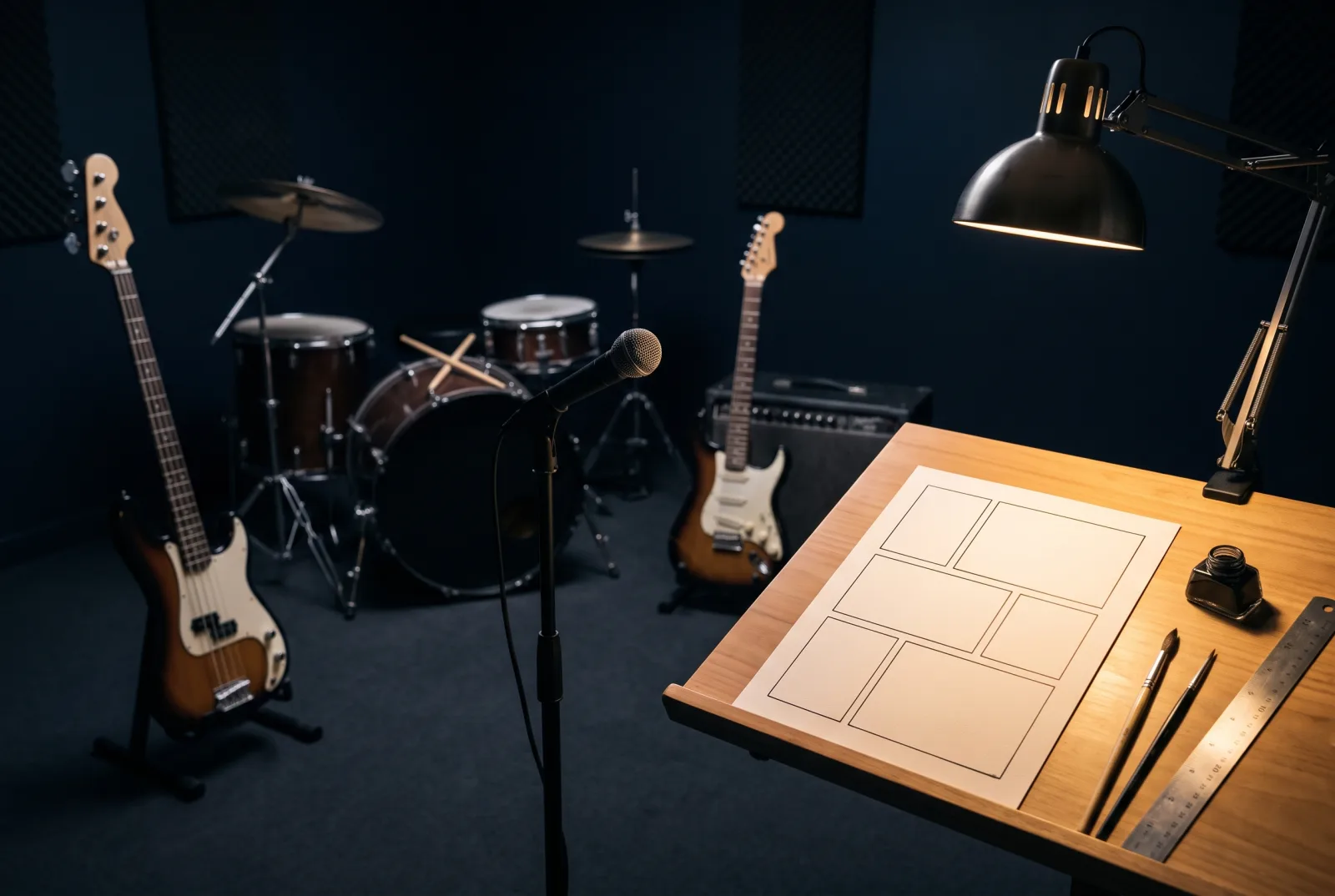
Ilustración: Rebobinados
Gorillaz are easy to see as a curiosity: a cartoon band, four little characters who "play" in the videos.
That reading misses the essential thing. Behind the cartoon there is one of the most serious and most free ideas modern pop has produced.
Gorillaz are not a visual joke: they are the mask that let one musician do anything, with anyone, without the chains of image and genre.
Two men sick of the same thing
The band was born in 1998, when Damon Albarn was sharing a flat with Jamie Hewlett, a comics illustrator, the creator of "Tank Girl".
The two of them were sick of the same thing: the shallowness of the music industry, the obsession with the artist's face, with the look, with the persona.
And they came up with a brilliant move: to invent a band with no real face. A fictional band, made of animated characters—2-D, the singer; Murdoc, the bassist; Noodle, the guitarist; Russel, the drummer—with its own story and its own universe of videos and comics.
With no human face out front, that band could be anything. There was the trick: the animated mask as the key to total freedom.
Every genre at once
And with that freedom, Albarn did what he could not do with Blur.
Gorillaz do not have a genre: they have all of them. Hip-hop, dub, electronica, rock, world music, all mixed together without asking permission.
The first record, from 2001, had its big hit in "Clint Eastwood", and that track already showed the whole move. The sung vocal is 2-D's—that is, Albarn's—but the rap, that unforgettable part, is put there by a guest: Del the Funky Homosapien, an underground rapper from Oakland who came to the project through the producer Dan the Automator.
Del wrote his part at the last minute and almost reluctantly. He told the story, laughing his head off, that he leaned on a manual titled "How to Write a Hit Song" that he had bought with a coupon his mother gave him.
The song was a worldwide phenomenon, and along the way it carried the name of a cult rapper, unknown to the general public, to millions of ears.
There are Gorillaz in a single song: a machine for making people who would never have crossed paths sound together.
Who it managed to bring together
The success earned them the Guinness record for the best-selling virtual band in history.
"Demon Days", from 2005, with "Feel Good Inc."—recorded with the rap group De La Soul, and winner of the Grammy for best pop collaboration in 2006—turned them into a global phenomenon and ended up on the lists of the greatest albums of all time.
But the most astonishing thing is who it managed to bring together under that mask.
On "Plastic Beach", from 2010, the collaborators included Snoop Dogg, Lou Reed, Bobby Womack, members of The Clash and even the Syrian National Orchestra for Arabic Music. On "Song Machine", more recently, up came Elton John, Beck, Robert Smith of The Cure and an endless list.
Rap legends, punk icons, orchestras from the other side of the world: they all fitted into Gorillaz, because Gorillaz was not a person with an ego to protect. It was an open space anyone could walk into.
The paradox
There is the beautiful thing about this make-believe band: the mask did not hide the artist, it freed him.
By putting a drawn face on the music, Albarn made the music—and not the star—the thing standing out front.
A Britpop frontman turned, behind those little cartoons, into a kind of curator of the music of the whole planet, able to call up anyone and to jump from one continent to another without anyone finding it strange, because the one "singing" was a fictional character.
Live, for years, the animated characters "played" on screens, until the real musicians started appearing too. And the idea was so powerful that it opened the way for a whole lot of virtual and animated projects that came afterwards.
The most real thing about a virtual band
Gorillaz are still going, putting out records and reinventing themselves, like everything Damon Albarn touches.
If you know them only from "Feel Good Inc." playing somewhere, get properly into it: listen to "Demon Days" all the way through, look at the guest lists of "Plastic Beach" and of "Song Machine", and take in the colossal ambition underneath the cartoons.
The most real thing about this virtual band is that, behind the caricatures, there is no trick and no joke. There is pure curiosity with no borders: one musician's urge to make all the music in the world with all the people in the world.
He put four drawn characters in front of him, not to hide, but to be able to be, at last, completely free.
The band that does not exist turned out to be one of the truest of them all.
Sources
Gorillaz, British virtual band created in 1998 in London by the musician Damon Albarn (of Blur) and the illustrator Jamie Hewlett (co-creator of the comic "Tank Girl"), while they were sharing a flat; it came out of their rejection of the shallowness of the music industry. It is made up of four animated characters—2-D (vocals), Murdoc Niccals (bass), Noodle (guitar) and Russel Hobbs (drums)—with an extensive fictional universe. Albarn is the only permanent musical contributor; the music is built with a rotating cast of collaborators. Their debut album "Gorillaz" (2001) included "Clint Eastwood", where the sung vocal is Albarn as the character 2-D and the rapped parts are by the American Del the Funky Homosapien (Teren Delvon Jones), a collaboration arranged by the producer Dan the Automator; Del recounted in 2023 that he had written his part leaning on a manual titled "How to Write a Hit Song", bought with a coupon from his mother. They hold the Guinness record for the best-selling virtual band ("biggest-selling virtual band", awarded in 2013). "Demon Days" (2005) included "Feel Good Inc.", recorded with De La Soul, which won the Grammy for best pop collaboration with vocals at the ceremony in February 2006, and appears on Rolling Stone's list of the 500 greatest albums. "Plastic Beach" (2010) featured Snoop Dogg, Lou Reed, Bobby Womack, Mick Jones and Paul Simonon of The Clash, and the Syrian National Orchestra for Arabic Music; it was followed by "Humanz" (2017), "The Now Now" (2018) and the "Song Machine" project (2020), with guests such as Elton John, Beck and Robert Smith. Externally authored text, edited and verified for Rebobinados. Readings of the meaning of their work are offered as the author's interpretation. No song lyrics are reproduced, for copyright reasons. Information drawn from Wikipedia, Guinness World Records, SPIN, AllMusic and other press coverage.
Keep rewinding
90s
indie
Portishead
A short film got them the record deal
Before the record they shot *To Kill a Dead Man*, eleven minutes of film noir written by the three of them: Geoff Barrow plays a sniper and Beth Gibbons a widow. That soundtrack got them the record deal, and the cover of *Dummy* is a still from the short. The rest is told wrong too: *Dummy* sold 3,600,000 copies and won the 1995 Mercury ahead of Oasis, Tricky and PJ Harvey. Three records in fourteen years, and eighteen without a fourth.
00s
indie
Peter Bjorn and John
The whistle was provisional
Björn Yttling whistled the melody of "Young Folks" as a placeholder, only so as not to forget it, and they decided to keep it. The single came out on 7 August 2006, with Victoria Bergsman as guest, and it was not no. 1 anywhere: no. 13 in the United Kingdom, no. 9 in Finland. Live it is whistled by Peter Morén, and the trio never broke up: nine albums.
00s
indie
Florence + the Machine
The catharsis had a name
The band formed in London in 2007 and "the Machine" comes from the keyboard player Isabella Summers. Florence Welch has said that she stopped eating at seventeen and that she stopped drinking around 2014: the catharsis in her music has a concrete content. She has five British number ones, the last with Everybody Scream (31 October 2025), nominated for the 2026 Mercury.
Rewind with us
Comments · 0
No one has commented yet. Open the conversation.