
Limp Bizkit
The barrier the band asked for and was refused
By Rebobinados · Published on September 17, 2026
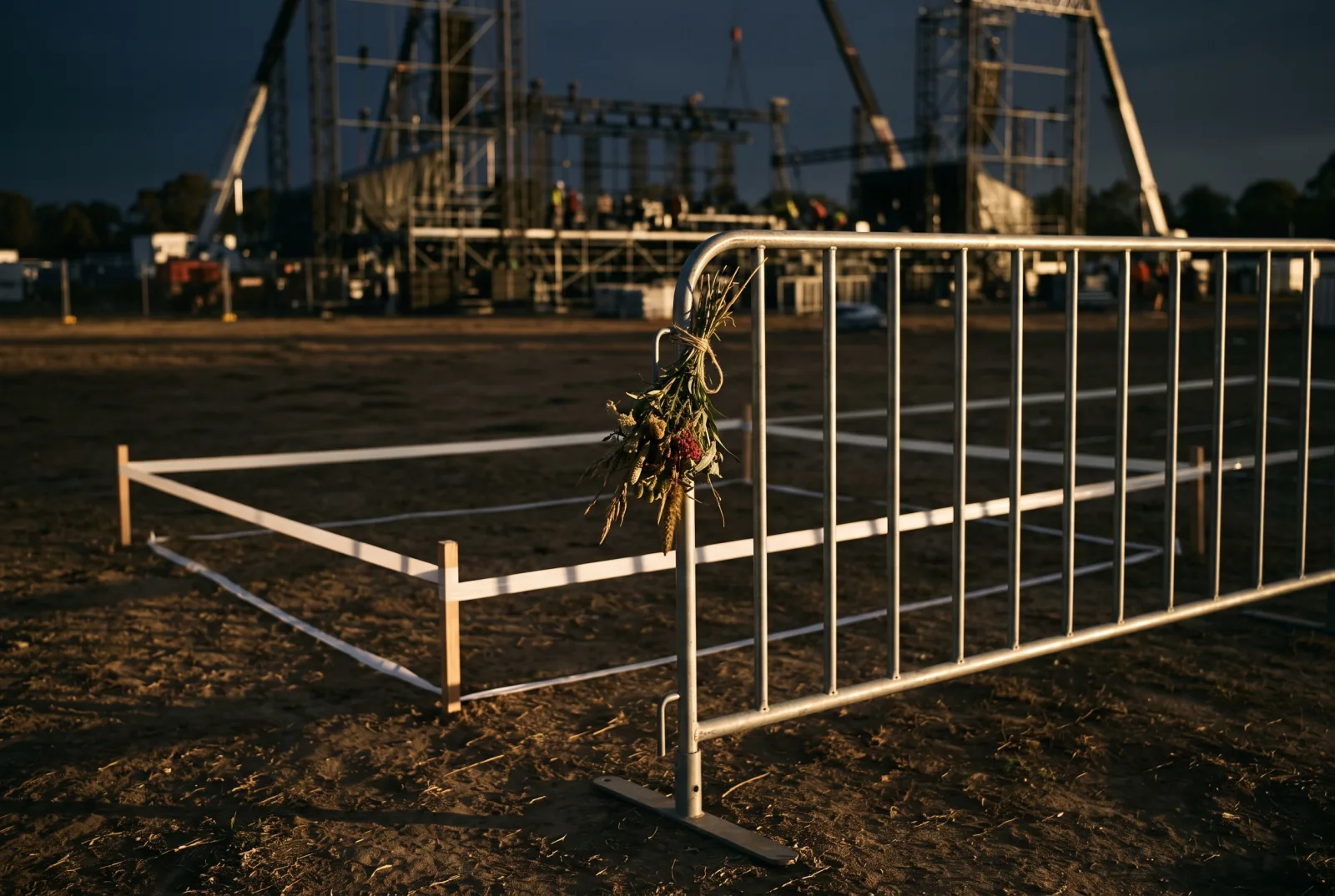
Ilustración: Rebobinados
There are sentences that have been stuck to Limp Bizkit like a label for twenty-five years: a sixteen-year-old girl was crushed to death at one of their shows. It is true, and it is terrible, and for that very reason it has to be told in full. Because there is a document that says almost the opposite of what popular memory kept. It was signed by an Australian coroner after twenty-one months of investigation, and it is among the harshest things ever written about a concert organisation. Not about the band.
Let's start with her, because she is the one thing that cannot be forgotten.
Jessica
Jessica Anna Michalik was born in Manly, Australia, on 7 January 1985. She had just turned sixteen on the day of the festival. She was at the front, against the barrier, where the ones who most want to be close go, when the band started a song and the crowd compressed towards the stage. She ended up on the ground with people on top of her. She was resuscitated, taken to hospital, and died five days later, on 31 January 2001, of asphyxia.
Everything that follows exists so that her death is not told wrongly. She is not a data point in a band's biography. She is the centre, and the rest is the investigation into why it happened.
The coroner who took the organisers apart
The proceedings lasted twenty-one months and included twenty-five days of evidence. The festival organisers took the stand to argue that the problem had been the band's style: aggressive music, an audience that jumps, things that happen.
The coroner dismantled them with a sentence worth quoting whole: that Limp Bizkit's style could and should have been known to the promoters before they were booked, and that to suggest there was any element of surprise in the way they played is nonsense. She went on: she said there was overwhelming evidence that the crowd density was unacceptable. Of the document the organisers presented as a risk assessment she wrote that it does not contain one iota of risk assessment in its pages. And on responsibility she left no room: it is theirs, nobody else's. She named the three promoters.
The barrier
Here is the fact almost nobody remembers, and it is the one that makes sense of everything.
The year before, at the same festival, a crowd collapse had already happened. A safety expert then recommended installing a secondary barrier, the kind that splits the crowd in two and takes pressure off the front row. It was not installed.
And there is more. The band itself had asked for that barrier. Their crew requested it in writing and were refused. Months later, their manager said so publicly: that they were disgusted, and that the organisers had justified the refusal by invoking an Australian regulatory body that does not even exist.
Which means the group everyone blames had asked for precisely the one thing that might have prevented Jessica's death. They were turned down with an invented excuse.
What she did hold against Durst
The document is not an acquittal, and telling it whole requires the other half. The same coroner wrote that Fred Durst's statements over the microphone, while the injured were being rescued, were alarming and inflammatory, and that you could see the crowd reacting to them. That they were insulting to the security staff trying to get people out. And of his conduct at an earlier incident, in Auckland, she said it was reprehensible.
But in the same paragraph she added what is almost never quoted: that there were moments when Durst sensibly asked the crowd to look after one another, to pick each other up. And she finished with something that puts things in their place: that it was unrealistic to think the singer should have been monitoring the mood of the crowd, because his brief is clear, and it is to entertain.
Both things are true. Durst behaved badly with the microphone and the coroner told him so to his face. And responsibility for a crush being possible at all was not his.
What each of them did afterwards
One gesture is worth many words. The band paid the airfares of Jessica's parents so they could travel to scatter her ashes. Of the promoters, the document mentions no equivalent gesture.
While we are here: Woodstock
Since we are correcting things, let's correct the other legend. Limp Bizkit did not set Woodstock '99 on fire. They played on the Saturday night; the fires, the looting and the collapse of the sound tower were the following night, the Sunday, during and after another band's closing set. What did happen at their show is that the crowd tore plywood sheets off the perimeter fencing to surf them over the crowd. That is theirs and nobody should take it from them. But the fire was twenty-four hours later, and it belonged to others.
What to remember
A sixteen-year-old girl was crushed to death at a festival. A coroner spent twenty-one months finding out why and concluded that the fault lay with the organisers: that the crowd density was unacceptable, that their risk assessment assessed nothing, and that they had ignored a safety recommendation from the year before. The band had asked for the barrier. The singer behaved badly with the microphone, and he was told so too.
Both things are true, and only one of them is remembered.
Remember it this way: the popular story blames the one who asked for the barrier and forgets the one who refused it. The name to hold on to is not the band's. It is Jessica Michalik's, and that of a barrier that was on the table and nobody would put up.
This piece deals with the death of a teenager in a crowd crush at a concert.
Sources
Limp Bizkit, an American band formed in Jacksonville, Florida, in 1994. On 26 January 2001, during their performance at the Big Day Out festival at the Sydney Showground in Homebush Bay, Australia, a crowd collapse occurred in which Jessica Anna Michalik, born 7 January 1985 in Manly, New South Wales, was critically injured. Taken to hospital, she died on 31 January 2001, aged sixteen; the determined cause was hypoxic encephalopathy from mechanical asphyxia. The coronial inquest, conducted by deputy coroner Jacqueline M. Milledge, lasted twenty-one months and included twenty-five days of testimony; her findings were delivered on 8 November 2002. In them the coroner expressly rejected the promoters' argument about the band's style, called the crowd density unacceptable, noted that the document presented as a risk assessment contained no evaluative content whatsoever, and attributed responsibility to the festival organisers, whom she named. The inquest also recorded that, following a crowd collapse at the previous edition of the festival, the installation of a secondary barrier had been recommended and not acted upon, and that the band's crew had requested an additional T-shaped barrier which was refused; in November 2001 the group's manager publicly expressed his outrage and stated that the organisers had justified the refusal by invoking a non-existent regulatory body. The coroner also criticised Fred Durst's statements over the PA during the rescue, calling them alarming, inflammatory and insulting to security staff, and his conduct at a previous incident in Auckland as reprehensible, while acknowledging that at certain moments he urged the crowd to help one another and considering it unrealistic to require the singer to monitor the state of the crowd. The band paid for the airfares of Jessica Michalik's parents for the scattering of her ashes. At Woodstock '99, Limp Bizkit performed on Saturday 24 July 1999; the fires, the looting and the collapse of a sound tower took place on the night of Sunday the 25th, during and after the closing performance by Red Hot Chili Peppers. A Rebobinados rewrite of previously verified research; interpretations are offered as the author's reading. No song lyrics are reproduced, for copyright reasons. Information drawn from the coronial report into the death of Jessica Michalik (New South Wales, November 2002), Wikipedia, NME, The Ringer, Ultimate Classic Rock and other coverage.
Keep rewinding

10s
metal
Bring Me the Horizon
Twenty years to get back to the scream
Bring Me the Horizon started in 2006 with a deathcore record and their turn did not happen in 2013: the leap to metalcore was in September 2008 and the synthesisers and clean vocals arrived in October 2010. Jordan Fish, eleven years in the band, was the one who put in the electronics. On 10 July 2026 they re-recorded that first record for its twentieth anniversary, with Oli Sykes back on the guttural scream.
00s
metal
Staind
The sleeve that nearly cost them everything
In October 1997, Fred Durst tried to pull Staind off the bill at the Webster Theatre in Hartford over the sleeve of their home-made record; then he listened to them and signed them. In 2001, Break the Cycle debuted at number one on the Billboard 200 and "It's Been Awhile" spent sixteen weeks at number one on the Modern Rock. Jon Wysocki, founding drummer, died on 18 May 2024.

90s
metal
Marilyn Manson
The lawsuit he withdrew while paying
The triad of Antichrist Superstar, Mechanical Animals and Holy Wood, and a file that is still open: two out-of-court settlements, one sworn retraction, the prosecutor's office that ruled out charges in January 2025 on statute-of-limitations grounds, the defamation suit he withdrew while paying 327,000 dollars and a jury trial set for November 2027.
Rewind with us
Comments · 0
No one has commented yet. Open the conversation.