
Mon Laferte
She never fit the boxes
By Rebobinados · Published on September 17, 2026
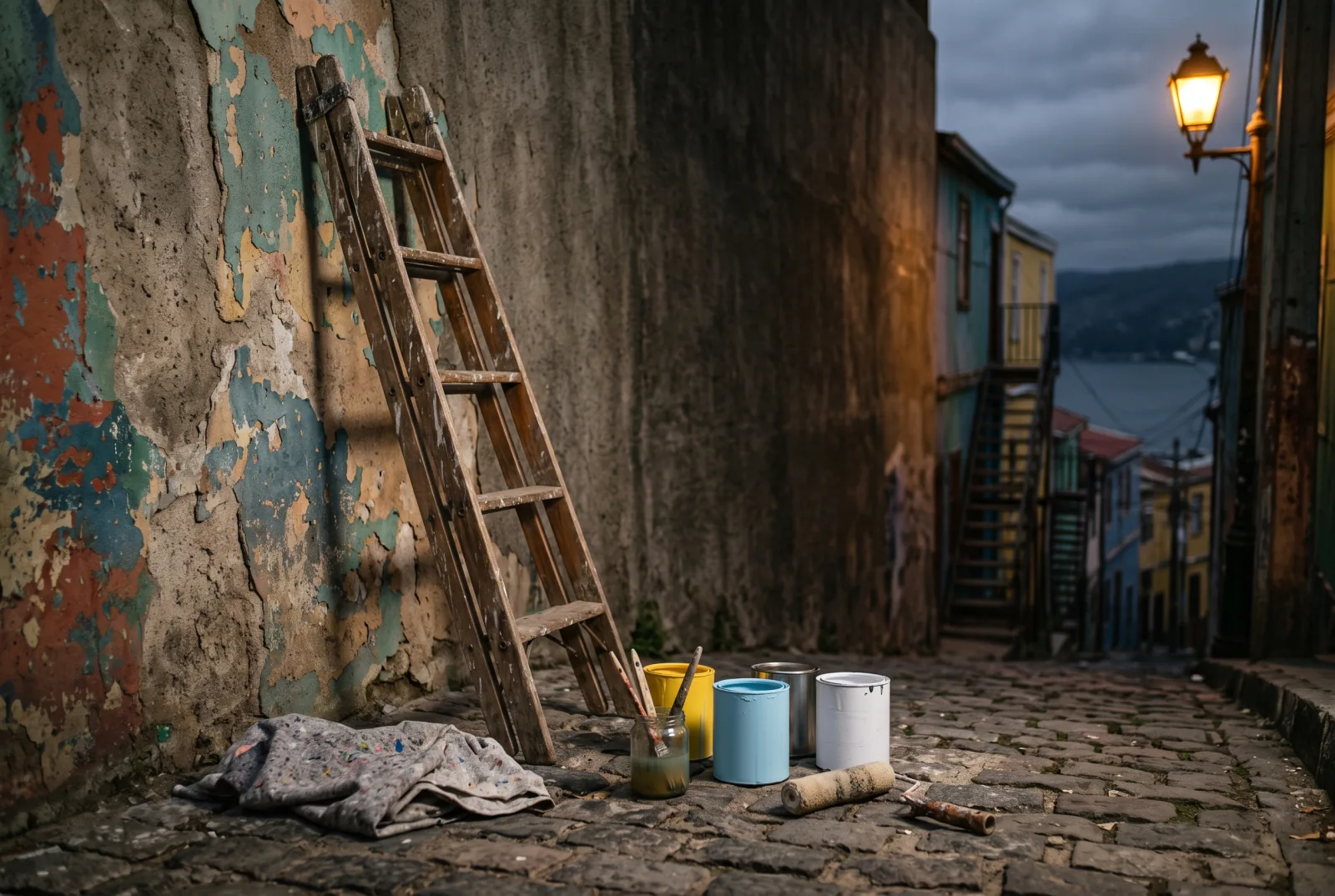
Ilustración: Rebobinados
There are voices radio needs in order to exist, and there are voices that exist in spite of radio. Mon Laferte is one of the second kind. Norma Monserrat Bustamante Laferte was born in Viña del Mar on 2 May 1983, left for Mexico in her mid-twenties with nothing in her pockets, and from there built something Chile still struggles to name in full: she is a singer-songwriter and she is a painter, and in both she does the same thing, which is never to repeat herself.
Let's start where everything with her starts, which is the voice.
The voice that did not need radio
"Tu falta de querer" appeared in 2015 and changed her life. It is the song half a continent met her through, the one now closing in on a billion streams on Spotify, far ahead of anything else of hers. A heartbreak anthem sung in kitchens, in cars, at the wakes of love affairs.
And here is what almost nobody knows: that song was never number one on Chilean radio. Its best placing was fifteen. It did not even need a programmer to push it. It grew from below, by word of mouth, which is the only way songs ever become truly permanent. Radio arrived late, the way it always does, to confirm what people had already decided on their own.
That is the first clue to who Mon Laferte is: someone who does not fit the circuit and overruns it anyway.
One voice for many musics
She has five Latin Grammys, which is a lot, and they are of a very particular kind: she won all five doing different things. Alternative song for "Amárrame", alternative album for "Norma", rock song for "Biutiful", singer-songwriter album for "Seis", alternative again for "Autopoiética". Bolero, cumbia, rock, ranchera, trap: she moves in and out of genres like someone switching languages without an accent.
That is her signature. Most artists find a formula that works and milk it for twenty years. She does the opposite: every record dismantles the one before. She is allergic to doing the same thing twice, and that restlessness is exactly what makes her impossible to file.
The night her body was the message
On 14 November 2019, in the middle of the Latin Grammy red carpet in Las Vegas, she opened her coat and showed her torso painted with a sentence about what was happening in Chile during the uprising. It is by some distance the most reproduced image of her career. A Chilean artist standing in the most commercial shop window of Latin music, using it to say what was burning inside her at that moment.
That same night she received an award, and on stage she read a décima that hurt. It is worth telling properly, because it is almost always told wrong: she did not write that décima. It was written by the Chilean singer La Chinganera, who passed it to her to read. Two gestures by two women, and each deserves her own. What Mon wore painted on her body was hers; the words she read belonged to another Chilean who also wanted them heard. That she carried them onto that stage without signing them as her own says a good deal about both of them.
Then she picked up a brush
And here comes the other half, the one less known in Chile than people assume. Mon Laferte paints. And she does not paint as a famous singer's hobby: she paints seriously, she is self-taught — she has said so, she never studied painting, or studied anything — and she climbs twelve-metre scaffolding to make murals the size of a building.
Her first mural was in Valparaíso, on Subida Cumming, in October 2019, alongside a duo from the city. Others followed: an enormous one on Cerro Alegre about the menstrual cycle, the stomach pain, the moods of those days — a subject almost nobody puts on a twelve-metre party wall in plain view of an entire city. She painted in Mexico City, in Los Angeles, and at the Estadio Nacional in Santiago alongside "Mono" González, one of the country's great muralists. From voice to wall without asking permission to change trades.
What it means: greatness does not fit in boxes
Look at the whole career and a pattern appears that explains her better than any award. The institutions always put Mon Laferte in the box next door. Her Latin Grammys are all genre categories, never the four big ones. In the United States, the first time they nominated her, they filed a Chilean singer-songwriter under regional Mexican music — the one for mariachi and norteño. And when she moved to painting and was given the big museum rooms, there were people who argued about whether she belonged there.
History had already answered all of that with another Chilean. Violeta Parra too was waved away as "primitive", as "quaint", when she sang and embroidered and painted, all at once, without asking anyone's permission. The same border between high culture and popular culture used against Violeta was used against Mon half a century later. And the verdict will be the same: boxes were made for smaller artists. The great ones do not fit, and that is why they end up moving the walls.
After years in which music always gave her its prizes in the small room, on 26 February 2026 the real big stage arrived: the Gaviota de Platino at the Viña festival, with the Quinta Vergara full, in the city where she was born. The sixth person to receive it in the award's history, and the youngest of them all. The audience had shouted for it nine years earlier. It took time, but it came, and it came home.
What to remember
Mon Laferte made her generation's most listened-to heartbreak song without radio helping her. She won five Latin Grammys without ever repeating the same trick. She turned her own body into a placard while her country burned. She climbed twelve metres of scaffolding to paint what women feel and nobody draws. And every time an institution tried to put her in the box next door, she painted a bigger one over it.
She is not the winner of "Rojo" — she came third, a minor detail. She is the woman from Viña who went to Mexico and came back as one of those artists who fit no definition because they contain them all. Violeta was right ahead of her time. Mon is proving her right all over again.
Sources
Mon Laferte is the stage name of Norma Monserrat Bustamante Laferte, a Chilean singer-songwriter and visual artist born in Viña del Mar on 2 May 1983, resident in Mexico since 2007 and a naturalised Mexican citizen since 30 November 2022. She took part in the second series of "Rojo fama contrafama" (TVN, 2003), where she finished third behind Mario Guerrero and Miguel Garcés. She has five Latin Grammys, all in genre categories: Best Alternative Song for "Amárrame" (2017), Best Alternative Music Album for "Norma" (2019), Best Rock Song for "Biutiful" (2020), Best Singer-Songwriter Album for "Seis" (2021) and Best Alternative Music Album for "Autopoiética" (2024). "Tu falta de querer" (2015) is her most streamed recording on Spotify (more than 960 million plays as of September 2026); its best placing on Chilean radio was number 15. On 14 November 2019, on the red carpet of the twentieth Latin Grammy ceremony in Las Vegas, she bared her torso painted with a legend referring to the repression during the social uprising; the décima she read on receiving that night's award for Best Alternative Music Album was written by the Chilean singer La Chinganera. Her first American Grammy nomination (2022) was in the Best Regional Mexican Music Album category, for "Seis". As a visual artist she is self-taught; her first mural was completed on Subida Cumming in Valparaíso on 29 October 2019, and she has also painted on Cerro Alegre, in Mexico City, in Los Angeles and at the Estadio Nacional in Santiago (alongside Alejandro "Mono" González, January 2023). She received the Gaviota de Platino at the Viña del Mar festival on 26 February 2026, the sixth person to obtain it and the youngest. A Rebobinados rewrite of previously verified research; interpretations of the meaning of her work — including the reading of her lineage with Violeta Parra — are offered as the author's reading. No song lyrics are reproduced, for copyright reasons.
Keep rewinding

10s
pop
Bruno Mars
Eleven names in the credits
"Uptown Funk" came out on 10 November 2014 with six writers and today it has eleven. In February 2015 The Gap Band's publisher filed a claim over "Oops Up Side Your Head" in YouTube's copyright system —there was never a lawsuit— and on 28 April five names were added, with 17 % of the publishing. It happened weeks after the "Blurred Lines" verdict, and the song had been fourteen weeks at number one.

00s
pop
André Rieu
It was not from the jazz suite
The waltz with which André Rieu reached half the world is not from Shostakovich's Suite for Jazz Orchestra No. 2: it is from the Suite for Variety Orchestra, which the composer did not assemble, and it was born in 1956 as music for a Soviet film about settlers in Kazakhstan. The error comes from a misprint in volume 10 of the complete works (Muzyka, Moscow, 1984), corrected only in 2001. And the title "The Second Waltz" was invented by his wife, because the real one did not sell.

90s
pop
Daniela Mercury
She took the neighbourhood out of the song
"O Canto da Cidade" was written by Tote Gira, a composer from Nordeste de Amaralina who recorded the demo on a borrowed cassette, marking the beat on the door of a refrigerator; Mercury's team almost threw the tape away. She shares the credit because she deleted the references to the Pelourinho so that the song would serve all of Brazil. The album, from 20 September 1992, sold more than 2 million copies and nationalised axé. But she did not invent it: the name was a journalist's insult in 1987.
Rewind with us
Comments · 0
No one has commented yet. Open the conversation.