
Nat King Cole
The empty easel
By Rebobinados · Published on September 4, 2026
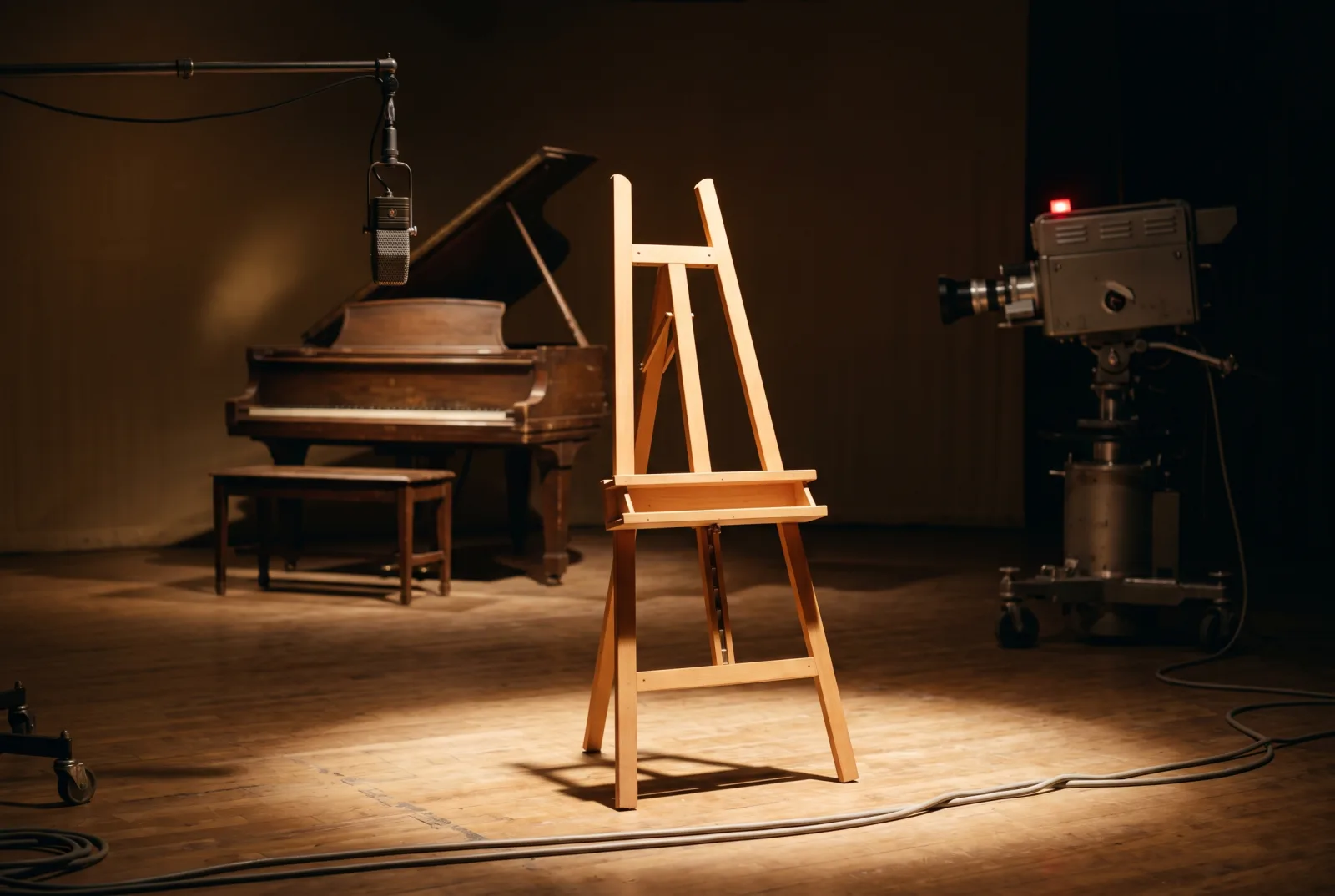
Ilustración: Rebobinados
In November 1956, Nat King Cole launched his own show on NBC.
Fifteen minutes, on Mondays, at half past seven in the evening, right before the news. A Black man with his name on a show on one of the three great American networks.
Thirteen months later it was over. And the reason is the part worth telling properly, because it is almost always told wrong.
He was not the first, and he was not cancelled
Two corrections, and neither of them takes anything away from him.
The first: he was not the first African American with a show of his own on American television. Bob Howard had his on CBS from 1948. Hazel Scott premiered on DuMont on 3 July 1950. Billy Daniels, on ABC, in 1952.
What Cole had was something else, and it genuinely was unprecedented: the first major Black star with a weekly slot of his own, on one of the three national networks, in prime time and sustained over time.
The second correction matters more: NBC did not cancel it. The network kept it on the air at a loss for more than a year, expanded it from fifteen to thirty minutes in July 1957, and offered him a new slot on Saturdays.
It was Cole who decided to end it. The last episode went out on 17 December 1957.
"Madison Avenue is afraid of the dark"
What never turned up was a national sponsor.
No big American brand wanted to put its name next to a Black man's in prime time, for fear of offending racist audiences in the South and losing sales. There was a regional sponsor, a brewery, and not much else. Cole ended up putting in part of his own salary to keep the show going.
And when he left, he did not leave quietly. He wrote an article explaining why, and published it in Ebony magazine, in February 1958. It was titled "Why I Quit My TV Show".
That is where the line that sums it all up comes from: "Madison Avenue is afraid of the dark". Madison Avenue, the street where the big advertising agencies were.
That changes the portrait completely. This is not the story of a man who had something taken away from him. It is the story of a man who got up from the table and said publicly why.
The voice
All of this was happening around what really mattered, which was how he sang.
He had started out as a jazz pianist, and a very good one, with a trio of piano, guitar and double bass. He sang now and then, almost as a favour.
Audiences started asking him to sing more. And what happened is what rarely happens: the excellent instrumentalist turned out to be, on top of that, one of the century's finest singers.
His voice is probably the most velvet ever recorded. He never forced, never pushed, never raised the volume to move you. He said the words with a clarity and a calm that did the rest.
What it cost him
Television was only one episode.
In 1948 he bought a house in Hancock Park, a white neighbourhood in Los Angeles. The residents' association let him know they did not want "undesirables". They burned a cross on his lawn. They poisoned his dog.
On 10 April 1956, in Birmingham, Alabama, three white men attacked him on stage while he was singing.
After that, the NAACP criticised him publicly for continuing to perform before segregated audiences. It was a harsh charge and he took it in: from then on he got more involved, and he took part in organising the 1963 March on Washington.
He died of lung cancer on 15 February 1965. He was forty-five.
In 1991, his daughter Natalie recorded a virtual duet with his voice on "Unforgettable". It won seven Grammys.
What to remember
Nat King Cole is the proof that sometimes dignity is exercised by walking away.
Put on "Unforgettable", "Nature Boy" or "Mona Lisa" and you will hear a voice that asks for nothing, that does not insist, that trusts you are listening.
And remember that the man who owned that voice hosted a show American television did not know how to keep, and that when he left it he took the trouble to write down why, with a line that still works sixty years later.
Remember him like this: not as the pioneer who had everything taken from him, but as the man who opened the door, saw that they would not quite let him through, and turned around saying so out loud.
Sources
Nathaniel Adams Coles, born in Montgomery, Alabama, on 17 March 1919 and died in Santa Monica, California, on 15 February 1965, at forty-five, of lung cancer. He began as a jazz pianist leading a trio of piano, guitar (Oscar Moore) and double bass (Wesley Prince, later Johnny Miller), and moved into singing at the audience's request. "The Nat King Cole Show" was broadcast on NBC between 5 November 1956 and 17 December 1957: fifteen minutes on Mondays at 7.30 p.m., expanded to half an hour in July 1957. Two points that are often told wrong are worth correcting. First, he was not the first African American with a show of his own on American television: he was preceded by Bob Howard (CBS, from 1948), Hazel Scott (DuMont, from 3 July 1950) and Billy Daniels (ABC, 1952); what was singular about Cole was being the first major Black star with a weekly slot of his own on one of the three great national networks, in prime time and on a sustained basis. Second, NBC did not cancel the show: it kept it on the air at a loss, expanded it and offered him a new Saturday slot; it was Cole who decided not to continue. He never secured a national sponsor — only regional support — and ended up contributing part of his own fee. He explained his decision in the article "Why I Quit My TV Show", published in Ebony magazine in February 1958, where he coined the phrase "Madison Avenue is afraid of the dark". In 1948, after buying a house in the Hancock Park neighbourhood of Los Angeles, he faced hostility from the residents' association, a cross burned on his lawn and the poisoning of his dog. On 10 April 1956 he was assaulted on stage by three white men during a performance in Birmingham, Alabama; he was subsequently criticised by the NAACP for performing before segregated audiences and became more actively involved, taking part in organising the 1963 March on Washington. In 1991 his daughter Natalie Cole recorded a virtual duet over his voice on "Unforgettable", which won seven Grammy awards in 1992. Ray Charles, Aretha Franklin, Frank Sinatra and Tony Bennett have profiles of their own in this series. Externally authored text, edited and verified for Rebobinados. Interpretations of the meaning of his work are offered as the author's reading. No song lyrics are reproduced, for copyright reasons. Information drawn from Ebony magazine, the Jim Crow Museum at Ferris State University, Wikipedia and other coverage.
Keep rewinding

10s
pop
Bruno Mars
Eleven names in the credits
"Uptown Funk" came out on 10 November 2014 with six writers and today it has eleven. In February 2015 The Gap Band's publisher filed a claim over "Oops Up Side Your Head" in YouTube's copyright system —there was never a lawsuit— and on 28 April five names were added, with 17 % of the publishing. It happened weeks after the "Blurred Lines" verdict, and the song had been fourteen weeks at number one.

00s
pop
André Rieu
It was not from the jazz suite
The waltz with which André Rieu reached half the world is not from Shostakovich's Suite for Jazz Orchestra No. 2: it is from the Suite for Variety Orchestra, which the composer did not assemble, and it was born in 1956 as music for a Soviet film about settlers in Kazakhstan. The error comes from a misprint in volume 10 of the complete works (Muzyka, Moscow, 1984), corrected only in 2001. And the title "The Second Waltz" was invented by his wife, because the real one did not sell.

90s
pop
Daniela Mercury
She took the neighbourhood out of the song
"O Canto da Cidade" was written by Tote Gira, a composer from Nordeste de Amaralina who recorded the demo on a borrowed cassette, marking the beat on the door of a refrigerator; Mercury's team almost threw the tape away. She shares the credit because she deleted the references to the Pelourinho so that the song would serve all of Brazil. The album, from 20 September 1992, sold more than 2 million copies and nationalised axé. But she did not invent it: the name was a journalist's insult in 1987.
Rewind with us
Comments · 0
No one has commented yet. Open the conversation.