
Oasis
The guns fell silent
By Rebobinados · Published on September 16, 2026
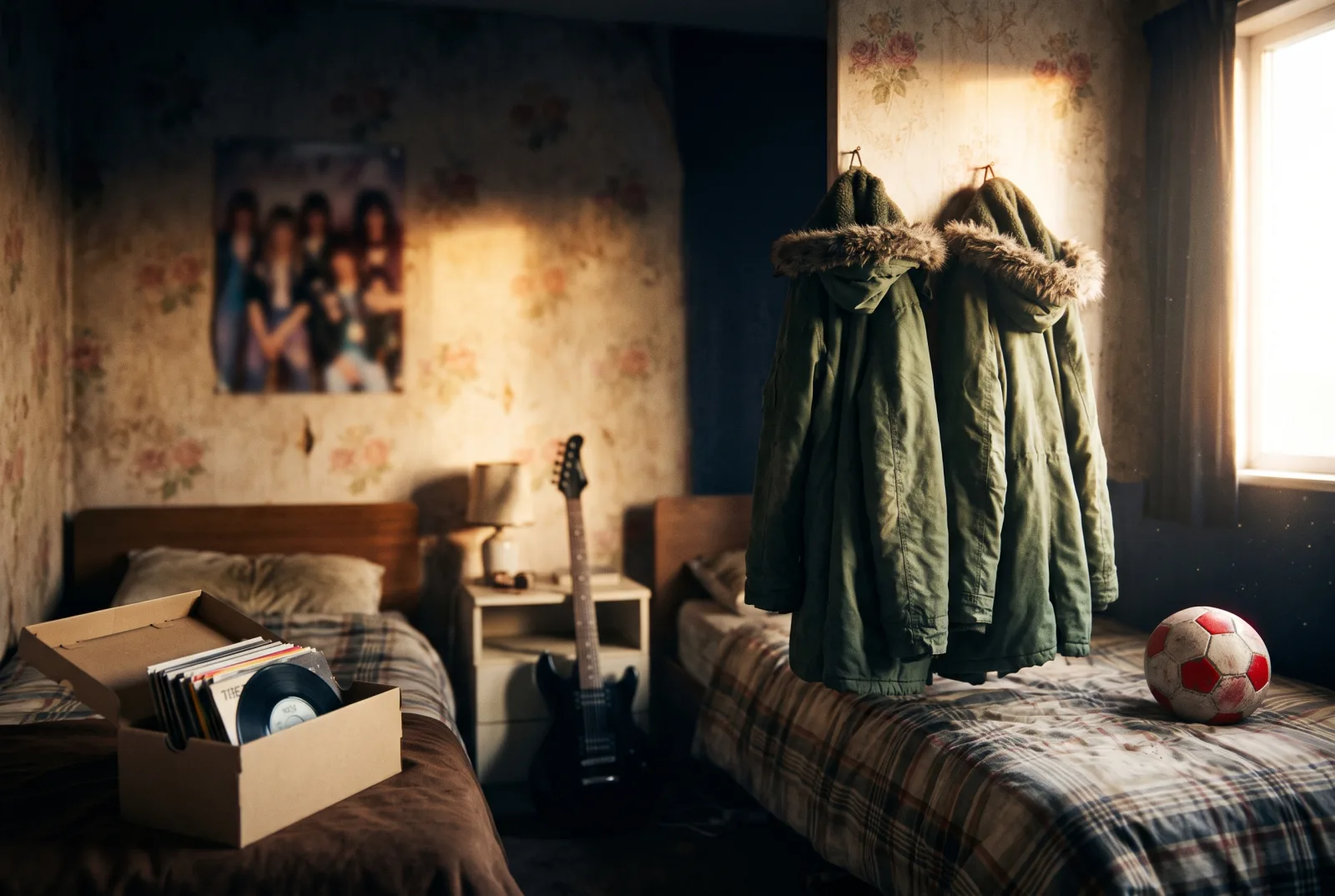
Ilustración: Rebobinados
In August 2024, two brothers who had not spoken to each other for fifteen years posted, at the same moment, the same message: "The guns have fallen silent. The stars have aligned. The great wait is over."
They were announcing the return of Oasis.
The story of that band is, at bottom, the oldest story humanity has: two brothers who love each other and tear each other apart. Noel and Liam Gallagher fought for decades with a ferocity that became legend — insults through the press, blows backstage, concerts cancelled at the last minute — and, at the same time, together, wrote some of the greatest anthems in rock.
It is Cain and Abel in parkas, with guitars. With one enormous difference: this time the story ended in reconciliation and not in tragedy.
Burnage
The Gallaghers grew up in Burnage, a working-class district in the south of Manchester, sons of parents who had each emigrated separately from Ireland.
The band was born almost by accident, in 1991. Liam, the younger one, joined a local group as singer and renamed it after a leisure centre he had seen on a poster stuck to the wall of the bedroom he shared with his brother.
Noel, the elder, who worked as a roadie for another band, joined as guitarist and, above all, as the songwriter: the musical brain of the whole thing. Between Liam's swagger and Noel's songs they put together something unstoppable.
The biggest band in the world
And unstoppable it truly was.
"Definitely Maybe", in 1994, was the fastest-selling debut in the history of the British charts: "Live Forever", "Supersonic", "Rock 'N' Roll Star". The following year came "(What's the Story) Morning Glory?", which passed twenty-two million copies and carried "Wonderwall" and "Don't Look Back in Anger".
Oasis became the band of Britpop, the voice of the British working class, with that exact mix of arrogance and melody. In 1996 they played Knebworth to two hundred and fifty thousand people across two nights; two and a half million had applied for tickets.
For a few years they were, quite simply, the biggest band in the world. So big that they defined the landscape of an entire era: against that pose of lad, lager and football came Brian Molko with his lips painted, making room for the ones who did not fit in there.
The dressing room in Paris
But the same blood that bound them set them against each other.
They insulted each other through the press, they came to blows, one would walk off stage and the other would tear him to pieces in the papers the next morning. For years the band operated on the brink of explosion.
And it exploded for good on 28 August 2009, at a festival in Paris, minutes before they were due on stage. Noel left the band with a curt sentence: he could not go on working with Liam a single day longer.
That is where Oasis died. In a dressing room, over a fight between brothers.
Fifteen years of cold war
What followed were fifteen years of darts thrown from a distance.
Each built his own career — Liam on his own, Noel with his new band — and both did well. But they went on wounding each other through the press and on social media, the way only brothers can, knowing exactly where the scars are.
Everybody took any possibility of a reunion to be dead and buried. They were too stubborn, too proud, they had said too much to each other.
The great wait
And then came the message of August 2024, and with it "Oasis Live '25": a reunion tour thirty years after "Morning Glory", with concerts in Manchester and in London.
It sold out around the world and it happened. Two brothers who had not shared a stage for sixteen years stood side by side again, with the same songs, in front of crowds singing every word.
In February 2026, Lionel Richie read out their name on television while announcing this year's intake into the Rock and Roll Hall of Fame. The ceremony is in November.
The songs are no longer theirs
Noel and Liam Gallagher are alive, and they came back.
There is something deeply moving in that, beyond the music, because conflict between brothers is as old as humanity and almost always ends badly. Not this time.
The songs, in any case, stopped being only theirs a long time ago. "Wonderwall", "Live Forever" and above all "Don't Look Back in Anger" belong to the crowds who sing them in unison on the terraces, in the pubs, in mourning: the whole of Manchester sang it in the street after the 2017 attack, to console itself.
If you put them on, you will hear two brothers from a working-class neighbourhood who fought like nobody else and wrote anthems like nobody else, and who, when the guns finally fell silent, walked back onto the same stage together.
Sources
Oasis, a British band formed in Manchester in 1991, led by brothers Liam Gallagher (vocals) and Noel Gallagher (guitar and principal songwriter), raised in the working-class district of Burnage; a central figure of Britpop. "Definitely Maybe" (1994) was the fastest-selling debut album in the history of the United Kingdom, with "Live Forever" and "Supersonic"; "(What's the Story) Morning Glory?" (1995) passed 22 million copies and included "Wonderwall" and "Don't Look Back in Anger". In 1996 they played to some 250,000 people across two nights at Knebworth. They have sold around 75 million records. The relationship between the brothers was notoriously fraught; the band broke up on 28 August 2009 at the Rock en Seine festival in Paris, when Noel declared that he could not go on working with Liam. After the split, Liam formed Beady Eye and then continued as a solo artist, and Noel formed Noel Gallagher's High Flying Birds. In August 2024 they announced the reunion tour "Oasis Live '25", which took place in 2025 to sold-out audiences. Oasis are part of the 2026 class of the Rock and Roll Hall of Fame, announced on American Idol by Lionel Richie and Ryan Seacrest; the ceremony is set for 14 November 2026 in Los Angeles. After the Manchester Arena attack (2017), crowds sang "Don't Look Back in Anger" as an anthem of consolation. Externally authored text, edited and verified for Rebobinados. Interpretations of the meaning of their work are offered as the author's reading. No song lyrics are reproduced, for copyright reasons. Information drawn from Rolling Stone, Variety, Britannica, NME and other press coverage.
Keep rewinding

00s
britpop
Stereophonics
Sacked just before the only number one
Stuart Cable, drummer and co-founder, was sacked in September 2003 for a lack of commitment: "Dakota", the band's only singles No. 1 in the United Kingdom, was recorded in 2005 without him, with Javier Weyler on drums. He died on 7 June 2010, aged 40, choked on his own vomit from acute alcohol poisoning.
90s
britpop
Pulp
Sixteen years of overnight success
It took them sixteen years to become an overnight success, and they wrote the sharpest anthem ever written about social class. When the spotlight found them, they had plenty to say.

90s
britpop
Damon Albarn
He never stood still
He had one of Britain's biggest bands in his hands and, instead of milking it, he went off to invent a cartoon band, then an opera in Mandarin, then records made in the heart of Africa. He is not driven by a style: he is driven by curiosity.
Rewind with us
Comments · 0
No one has commented yet. Open the conversation.