
Decade 80s · Rhythm progresivo
Vangelis
The music everyone knows and nobody can name
By Rebobinados · Published on September 27, 2026
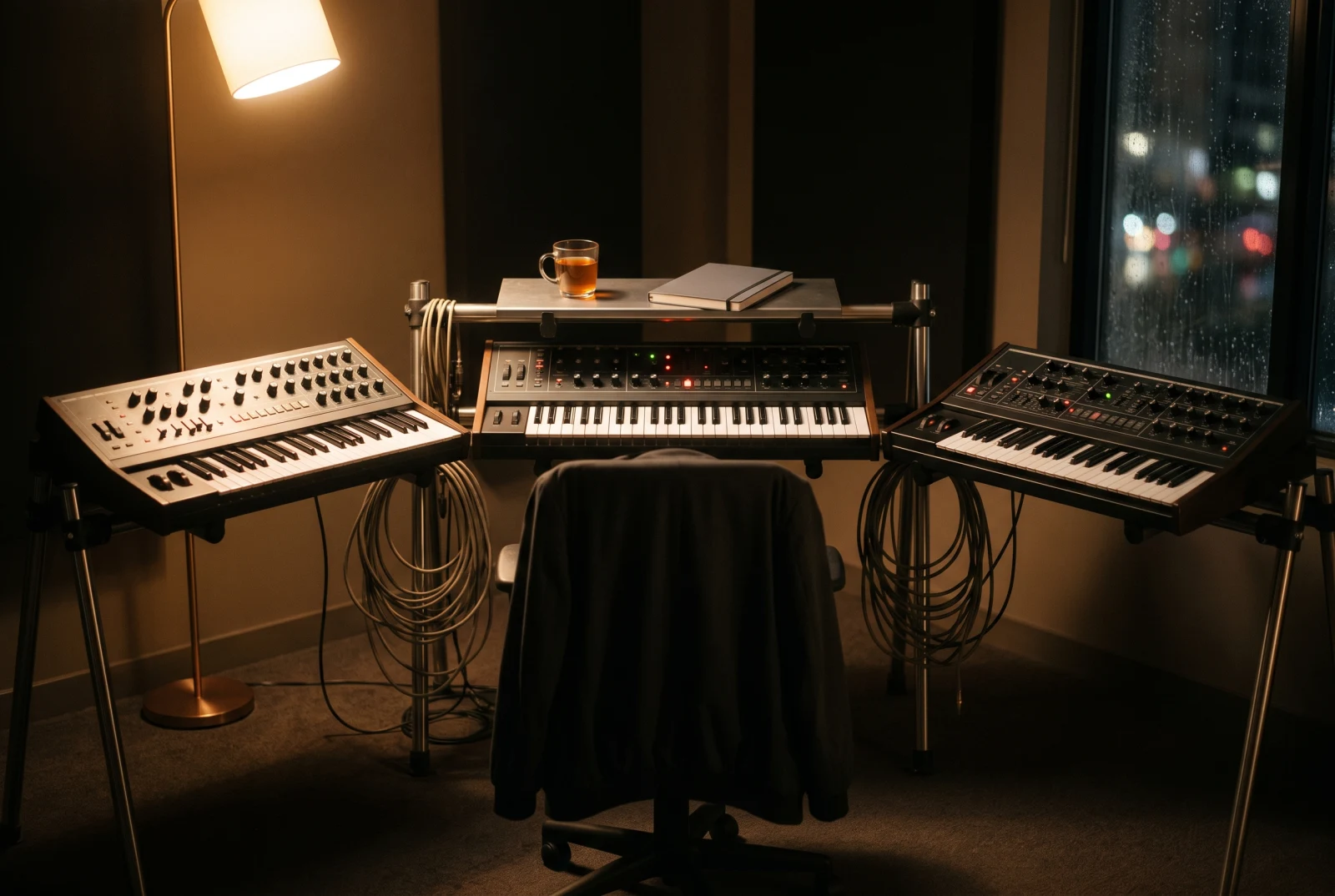
Ilustración: Rebobinados
There are two pieces of music anyone recognises in two seconds and almost nobody can attribute: the slow-motion piano behind some runners on a beach and the synthetic rain of a future city with a detective inside it. Both are by the same man, a self-taught Greek called Evángelos Odysséas Papathanassíou. When the Academy gave him the Oscar for the first, on 29 March 1982, he did not go to collect it: among other reasons, he was afraid of planes. For a composer whose biography is always told as that of a loner who never showed his face, that empty chair is the best available proof.
The one who pretended to read
He was born on 29 March 1943 in Agria, Greece, and he composed as a child without ever having learned to read or write music. He said it himself in a phrase worth more than any explanation: he pretended he was reading and played from memory. It was not a shortcoming he was ashamed of, nor a merit he showed off; it was his method. The hands went ahead of the theory and he let them go.
Before the cinema he had a whole life in a band. Aphrodite's Child formed in 1967 alongside the singer Demis Roussos, settled in Paris — not in London, as keeps being repeated — and broke up in 1971; 666, its most ambitious record, came out in 1972, when the group no longer existed. He moved to London in 1974 and set up his own studio there, Nemo, which is where his work really begins: a man alone, surrounded by keyboards, with nobody to tell him when to stop.
The audition for Yes that never came off
In 1974, when Rick Wakeman left Yes, Jon Anderson invited Vangelis to audition for the job. He sent his keyboards to England. It did not come off for three accumulated reasons, and none of them has anything to do with the music: the work visa, the refusal of the British musicians' union and his fear of flying. Yes signed Patrick Moraz.
Out of that failed encounter came, all the same, a long partnership: Jon & Vangelis, the project they recorded together over years. It is a constant in his story. Every time Vangelis does not come in through the door someone opens for him, he turns up later round the side, with something nobody had asked for.
Chariots of Fire, number one
Chariots of Fire (1981) told a story of British athletes in the twenties, and the logical thing would have been a period score. Vangelis refused and made it electronic. The choice was emphatically right and it had a consequence that almost never gets mentioned: the main theme was number one on the Billboard Hot 100 on 8 May 1982 and the album topped the American chart for four weeks. An electronic instrumental composed by a Greek reached first place in the United States.
The Oscar, it is worth being precise, was not for that single piece: the category was best original score and it rewarded the complete soundtrack. It was handed out at the fifty-fourth ceremony and he was not there. Ever since, that melody has accompanied every human effort on the planet, from an Olympic final to the parody of someone running down an office corridor.
Twelve years of rain
A year later came Blade Runner, by Ridley Scott, where he did something harder than moving people: he built an entire atmosphere. Those dense, humid synthesizers are as responsible for the film's soul as the art direction. And yet, for twelve years, the record did not exist. Because of a dispute, Vangelis withheld permission to release his own recordings; the studio put out some orchestral adaptations in 1982 and the official version, with his music, did not appear until 1994.
He went on working like that, in his own way, to the end: concept records about the cosmos and mythology, 1492: Conquest of Paradise, commissions he accepted or turned down without giving explanations. The NASA business has to be stated precisely, because it tends to get inflated: Mythodea, from 2001, was adopted as the theme music of the Mars Odyssey mission. It was not a commission from the agency. He died on 17 May 2022, aged 79, in a Paris hospital, of heart failure while receiving treatment for covid-19.
What to remember
Vangelis touched half the world without singing a word and without learning to read a score. His work sits in a strange place: it is among the most listened to of the century and among the least attributed, because people recognise the music and not the name. He seems to have preferred exactly that.
And the empty chair of 1982 is not a picturesque anecdote. A man afraid of flying set music to physical effort, to the finish line, to the run along the beach, and he did it without moving from a studio in London. He also stayed out of Yes for not getting on a plane and, on the rebound, founded a duo that lasted decades. His entire biography is made of doors he did not go through and music that reached the other side anyway.
Sources
Vangelis, the stage name of Evángelos Odysséas Papathanassíou, was born on 29 March 1943 in Agria, Greece, and died on 17 May 2022, aged 79, in a Paris hospital, of heart failure while receiving treatment for covid-19. A self-taught composer, he never learned to read or write conventional music and stated that he pretended to read while playing from memory. He was a member of Aphrodite's Child, formed in 1967 alongside Demis Roussos and based in Paris; the group broke up in 1971 and its album "666" was released in 1972. He moved to London in 1974, where he established his Nemo Studios. That same year, after Rick Wakeman's departure, Jon Anderson invited him to audition as keyboard player for Yes; he did not join because of difficulties with the work visa, the refusal of the British musicians' union and his fear of flying, and the job went to Patrick Moraz. Out of that relationship came the Jon & Vangelis project. He composed the soundtrack for "Chariots of Fire" (1981), for which he received the Oscar for best original score at the fifty-fourth ceremony, held on 29 March 1982, which he did not attend; the award went to the complete soundtrack and not to an individual piece. The main theme reached number one on the Billboard Hot 100 on 8 May 1982 and the album topped the American albums chart for four weeks. His soundtrack for "Blade Runner" (1982), by Ridley Scott, was not officially released until 1994 because of a dispute that led him to withhold permission over his recordings; in 1982 the studio put out orchestral adaptations. He also composed "1492: Conquest of Paradise" and numerous concept works; his work "Mythodea" was adopted in 2001 as the theme music of NASA's Mars Odyssey mission, without having been a commission from that agency. Profile compiled for Rebobinados with fact-checking; interpretations of the meaning of the work are offered as the author's reading. No song lyrics are reproduced, for copyright reasons. Information drawn from Billboard, the Academy of Motion Picture Arts and Sciences, The Guardian, Variety, Wikipedia and other coverage.
Keep rewinding

70s
progresivo
Jean-Michel Jarre
Twenty-five times in his whole life
His father was Maurice Jarre, three Oscars for "Lawrence of Arabia", "Doctor Zhivago" and "A Passage to India", and he left home when the son was 5: "we saw each other twenty or twenty-five times in our whole lives". *Oxygène* came out in December 1976, recorded in the former kitchen of his flat with a broken Mellotron, and sold some 18 million. Of his father's inheritance he received nothing: the European Court of Human Rights dismissed the case on 15 February 2024.

70s
progresivo
Roger Hodgson
The two wrists and the broken pact
"Dreamer" and "Breakfast in America" are his, written at nineteen, even though they are attributed to Rick Davies. In 1983 he left Supertramp with a verbal pact that Davies broke five years later, and in 1987 he fell from a loft and broke both wrists: he was told he would never play again. Davies died on 6 September 2025, at the age of 81.

70s
progresivo
Yes
The cathedrals and the borrowed name
The only American number one credited to Yes, "Owner of a Lonely Heart", was strictly speaking recorded by a different band: Chris Squire, Alan White, Tony Kaye and guitarist Trevor Rabin had put together a group called Cinema, and in June 1983 Atlantic executives suggested they call it Yes. Jon Anderson joined once the album was well under way.
Rewind with us
Comments · 0
No one has commented yet. Open the conversation.