
ABBA
The divorce the song does not tell
By Rebobinados · Published on September 11, 2026
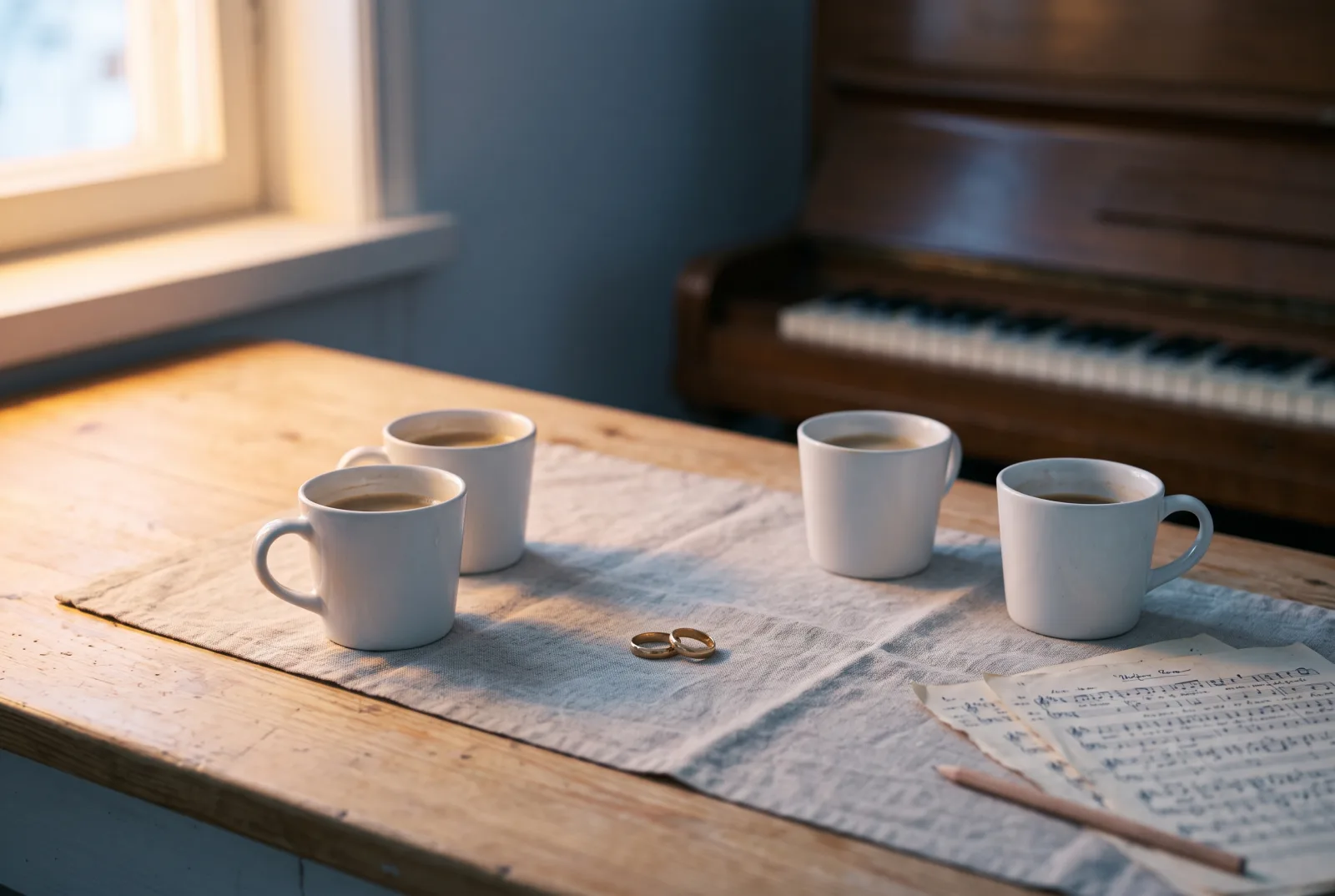
Ilustración: Rebobinados
"The Winner Takes It All" is always told the same way: Björn wrote his divorce and made Agnetha sing it.
Björn has expressly denied it. He said the basis is the experience of a divorce, but that the song is fiction.
It is worth taking seriously, because he is the author and because the romantic version —the wife weeping over the lyrics her husband wrote her— is too good to check.
What is true, and needs no embellishing, is the calendar.
January 1979
Björn and Agnetha announced their separation in January 1979. Not in the early eighties, as is usually said: in 1979, when ABBA were still the biggest group in the world.
Benny and Frida divorced in 1981.
And between one thing and the other they went on working together every day. Recording, composing, appearing on television with all four of them smiling.
That is the remarkable part, and it needs no autobiographical song to be so: two broken marriages that went on holding up the same enterprise for three more years.
What Björn has said, and it explains the group's entire sound, is that their music could sound cheerful without being it. That even when they were very sad they sounded jubilant.
The four of them and the division of labour
ABBA were two couples, and the name is their four initials.
Björn and Benny composed and produced, the two of them together —the production credit is sometimes given to Benny alone, and that is wrong—. Agnetha and Frida supplied the two voices that, interwoven, are what makes an ABBA song recognisable in two seconds.
They won Eurovision on 6 April 1974 in Brighton with "Waterloo", the first time Sweden had won. In that same contest Olivia Newton-John was competing for the United Kingdom, and came fourth.
Then came "Dancing Queen", their only number one in the United States, "Mamma Mia", "Fernando", "Take a Chance on Me" and "SOS".
The figures, without inflation
It goes around that ABBA sold between two hundred and four hundred million records. It is one of those figures that grow by themselves every time somebody copies them.
The audited estimates are between one hundred and fifty and one hundred and seventy million.
They are still the best-selling continental European group in history. There is no need to round upwards: with the real number there is already no competition.
Björn is also quoted as saying that before them nobody in the English-speaking world wanted to listen to a Swedish group. I have not been able to locate that line in any source, so it goes without quotation marks: the idea is correct, the specific quote is not documented.
What ABBA did open was the way for all the Swedish pop that followed, Roxette included.
What it cost them to be taken seriously
For years they were the example of everything rock criticism despised: too bright, too commercial, too cheerful.
It took decades for the obvious to be acknowledged: that making something that sounds easy is the hardest thing there is, and that the arrangements underneath "Dancing Queen" are not improvised by anybody.
"ABBA Gold" ended up as one of the best-selling records in history and the one that has spent the longest on the British charts.
In 2000 they turned down an offer of a billion dollars for a reunion tour. They said they did not want to go on stage as old people.
Twenty-one years later they found the way out: "Voyage", the record, in November 2021, and from May 2022 a show in London where their digital avatars play, looking the way they looked in 1979.
They did not go out as old people. They sent the young ones in their place.
What to remember
ABBA are proof that pop done well ages better than almost everything that was considered serious at the time.
Put on "Dancing Queen", "SOS" or "The Winner Takes It All" and you will hear unfailing melodies with a construction underneath that almost nobody has matched.
And with the story of the divorces, be careful with the pretty version. The marriages really did break up, and they really did go on working together for years afterwards. But the song, according to its author, is not the chronicle of that.
Remember it like this: four Swedes who sounded jubilant while everything was falling apart around them, and who had the honesty to make clear afterwards that not everything they sang had happened to them.
Sources
ABBA, Swedish group formed in Stockholm in 1972 by Agnetha Fältskog, Björn Ulvaeus, Benny Andersson and Anni-Frid "Frida" Lyngstad; the name is an acronym of their initials. It was made up of two couples: Agnetha and Björn, and Benny and Frida. Björn and Benny wrote and produced jointly. They won the Eurovision Song Contest on 6 April 1974 in Brighton with "Waterloo", Sweden's first victory in the contest, in which Olivia Newton-John was also competing for the United Kingdom and came fourth. Their later hits include "Dancing Queen" —their only number one in the United States—, "Mamma Mia", "Fernando", "Take a Chance on Me", "SOS" and "The Winner Takes It All". Björn Ulvaeus has expressly denied that "The Winner Takes It All" is an autobiographical account of his divorce, pointing out that it starts from the experience of a separation but that the song is a fiction. The separation of Björn and Agnetha was announced in January 1979; Benny and Frida divorced in 1981, and the group went on working until 1982. Audited sales estimates place the group between 150 and 170 million records, and not at the figures of 200 to 400 million that circulate frequently; they remain the best-selling continental European group in history. The line attributed to Björn according to which the English-speaking world did not want to listen to a Swedish group could not be located in any documented source. "ABBA Gold" is one of the best-selling albums of all time and the one with the longest run on the British charts. In 2000 the group turned down an offer of close to a billion dollars for a reunion tour. The album "Voyage" was released in November 2021 and the digital avatar show "ABBA Voyage" opened in London in May 2022. Olivia Newton-John and Roxette have their own profiles in this series. Externally authored text, edited and verified for Rebobinados. Interpretations of the meaning of their work are offered as the author's reading. No song lyrics are reproduced, for copyright reasons. Information drawn from Official Charts, AllMusic, Wikipedia, The Guardian and other coverage.
Keep rewinding

10s
pop
Bruno Mars
Eleven names in the credits
"Uptown Funk" came out on 10 November 2014 with six writers and today it has eleven. In February 2015 The Gap Band's publisher filed a claim over "Oops Up Side Your Head" in YouTube's copyright system —there was never a lawsuit— and on 28 April five names were added, with 17 % of the publishing. It happened weeks after the "Blurred Lines" verdict, and the song had been fourteen weeks at number one.

00s
pop
André Rieu
It was not from the jazz suite
The waltz with which André Rieu reached half the world is not from Shostakovich's Suite for Jazz Orchestra No. 2: it is from the Suite for Variety Orchestra, which the composer did not assemble, and it was born in 1956 as music for a Soviet film about settlers in Kazakhstan. The error comes from a misprint in volume 10 of the complete works (Muzyka, Moscow, 1984), corrected only in 2001. And the title "The Second Waltz" was invented by his wife, because the real one did not sell.

90s
pop
Daniela Mercury
She took the neighbourhood out of the song
"O Canto da Cidade" was written by Tote Gira, a composer from Nordeste de Amaralina who recorded the demo on a borrowed cassette, marking the beat on the door of a refrigerator; Mercury's team almost threw the tape away. She shares the credit because she deleted the references to the Pelourinho so that the song would serve all of Brazil. The album, from 20 September 1992, sold more than 2 million copies and nationalised axé. But she did not invent it: the name was a journalist's insult in 1987.
Rewind with us
Comments · 0
No one has commented yet. Open the conversation.