
Alicia Keys
The classically trained pianist who swept the Grammys at twenty-one
By Rebobinados · Published on September 19, 2026
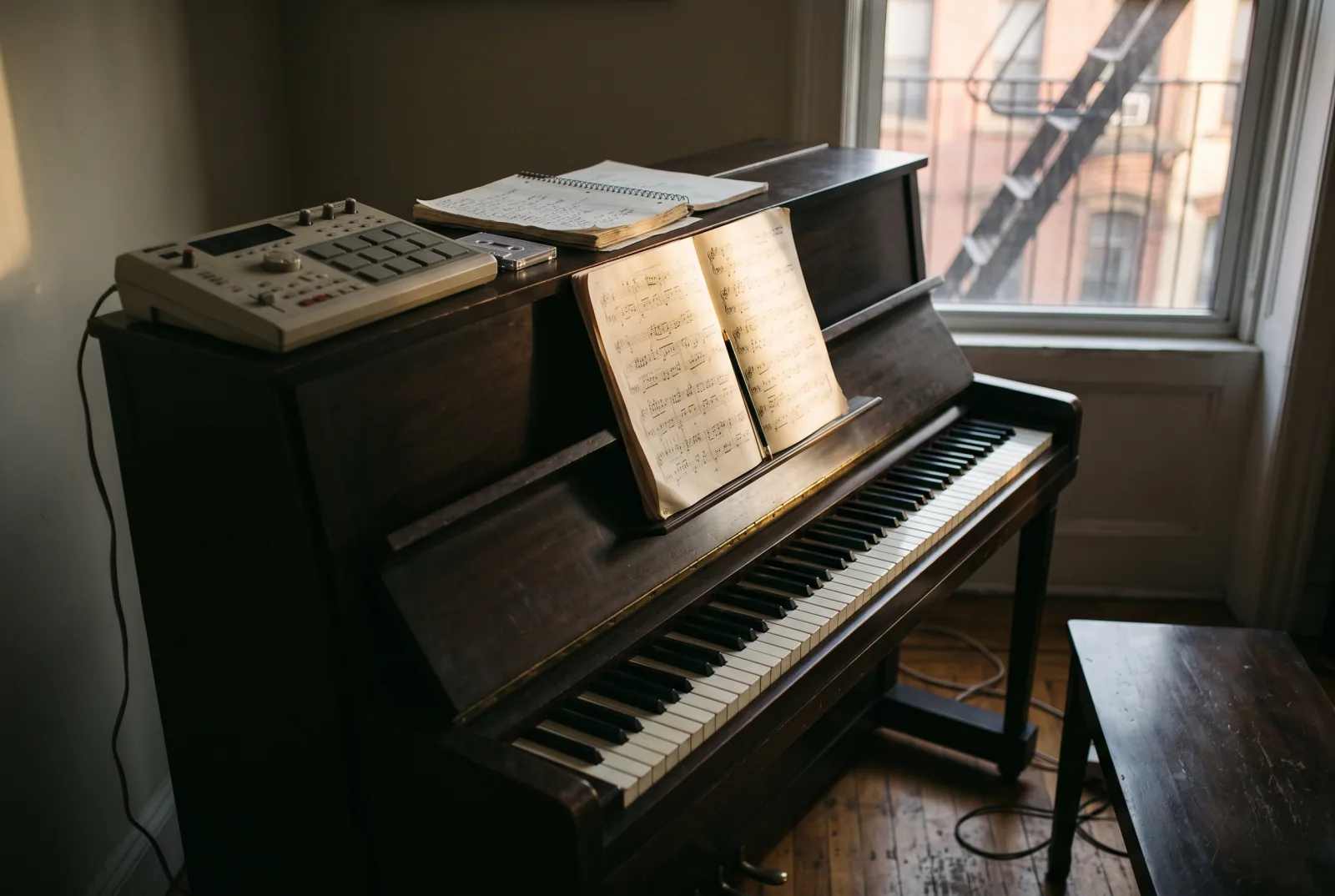
Ilustración: Rebobinados
In 2001, when pop was dominated by manufactured products, choreography and lip-syncing, a young woman from New York appeared who sat down at the piano —a real piano, played by her— and sang songs she had written herself, rooted in soul, in classical music and in hip hop all at once. Her name was Alicia Keys, and her first song, "Fallin'", with that melody rising and falling like an old blues lament, placed her at once in a different category. The following year, in her first appearance at the Grammys, she took home five awards in a single night. She was twenty-one. She wasn't a product: she was a complete musician, and you could tell from the very first note.
Real training
What set Alicia Keys apart was the training. She wasn't a singer handed songs and choreography: she was a classically trained pianist who had studied the great composers, and who fused that background with the soul of Aretha and Nina Simone and with the hip hop of her native New York. When she played, you heard someone who knew music in depth, not on the surface.
Her debut album, "Songs in A Minor", was already playing with the language of classical music in its very title. And the songs confirmed it: "Fallin'", then "If I Ain't Got You" —one of the finest soul ballads of her generation—, "No One", and years later "Empire State of Mind", the anthem to New York alongside Jay-Z. A career built on solid songwriting and a voice full of soul, with more than a dozen Grammys along the way. In an era of the disposable, she made things meant to last.
The bare face
And there is a gesture, already in her maturity, that defines her as much as her music does. At one point in her career, Alicia Keys decided to stop wearing make-up: to appear in public, in photographs, in videos, with a bare face, just as she is. She explained it as an act of freedom, of refusing the brutal pressure the industry puts on women to look perfect, retouched and covered at all times.
It was a powerful statement, especially coming from someone so visible. In a world where women, and artists in particular, are held to an impossible physical perfection, one of the most famous of them said: this is how I am, and this is enough. It wasn't a one-day pose; she kept it up. And with that she gave a great many people permission to show themselves as they are. The same confidence she had at the piano she carried to her own face.
What to remember
Alicia Keys burst onto the scene in 2001 as the opposite of the manufactured pop of her era: a classically trained pianist who wrote her own songs and fused soul, classical music and hip hop. Her debut earned her five Grammys in one night, at twenty-one, and she built a career of solid songwriting with classics like "If I Ain't Got You" and "No One". And she had the courage to show her face without make-up, standing up to the industry's pressure over appearance.
Remember it this way: at a moment of artificial shine, she brought a real piano, songs of her own and an enormous confidence, in her music and in herself. The same confidence that led her to sweep the Grammys at twenty-one led her, years later, to show herself exactly as she is. Talent and authenticity, from the first note to the last.
Sources
Alicia Keys (Alicia Augello Cook), American singer, songwriter and pianist born on 25 January 1981 in New York; living. A classically trained pianist, she fused soul, R&B, classical music and hip hop. Her debut album, "Songs in A Minor" (2001), included "Fallin'"; at the 2002 Grammy ceremony she won five awards, among them song of the year and best new artist. Her later hits include "If I Ain't Got You", "No One" and "Empire State of Mind" (with Jay-Z). She has won numerous Grammy Awards over the course of her career. In 2016 she publicly championed her decision to go without make-up as a statement against the industry's pressures over appearance. Aretha Franklin has her own profile in this series. Profile compiled for Rebobinados with fact-checking; interpretations of the meaning of the work are offered as the author's reading. No song lyrics are reproduced, for copyright reasons. Information drawn from Wikipedia, MasterClass, Stereogum and other coverage.
Keep rewinding
00s
soul
Duffy
She told it first
Rockferry (2008) was the best-selling album of the year in the United Kingdom, with 1,685,000 copies, three BRITs in 2009 and the Grammy for Best Pop Vocal Album. In 2020 Duffy told it herself, before anybody else, that she was drugged, held captive and raped. And it is not an epilogue: a new song in 2024, a Disney+ documentary announced in 2025 and a signing with TaP Management in 2026.
80s
soul
Hall & Oates
The craft they called a guilty pleasure
Daryl Hall and John Oates put six songs at number one in the United States, and Billboard named them the most successful duo in Hot 100 history — a measure of chart performance, not of records sold. They met in Philadelphia in 1967 and ended up in a Nashville court in 2023, over the sale of the company that held their name and royalties.
90s
soul
Seal
The song that embarrassed him, and the scars he never hid
The song that won the Grammy for record of the year sat in a drawer for years because its author thought it was bad and was embarrassed to show it: it took a producer who believed in it more than he did. With the scars on his face he did the opposite: he never covered them.
Rewind with us
Comments · 0
No one has commented yet. Open the conversation.