
Andrés Calamaro
Writing the way you breathe
By Rebobinados · Published on September 8, 2026
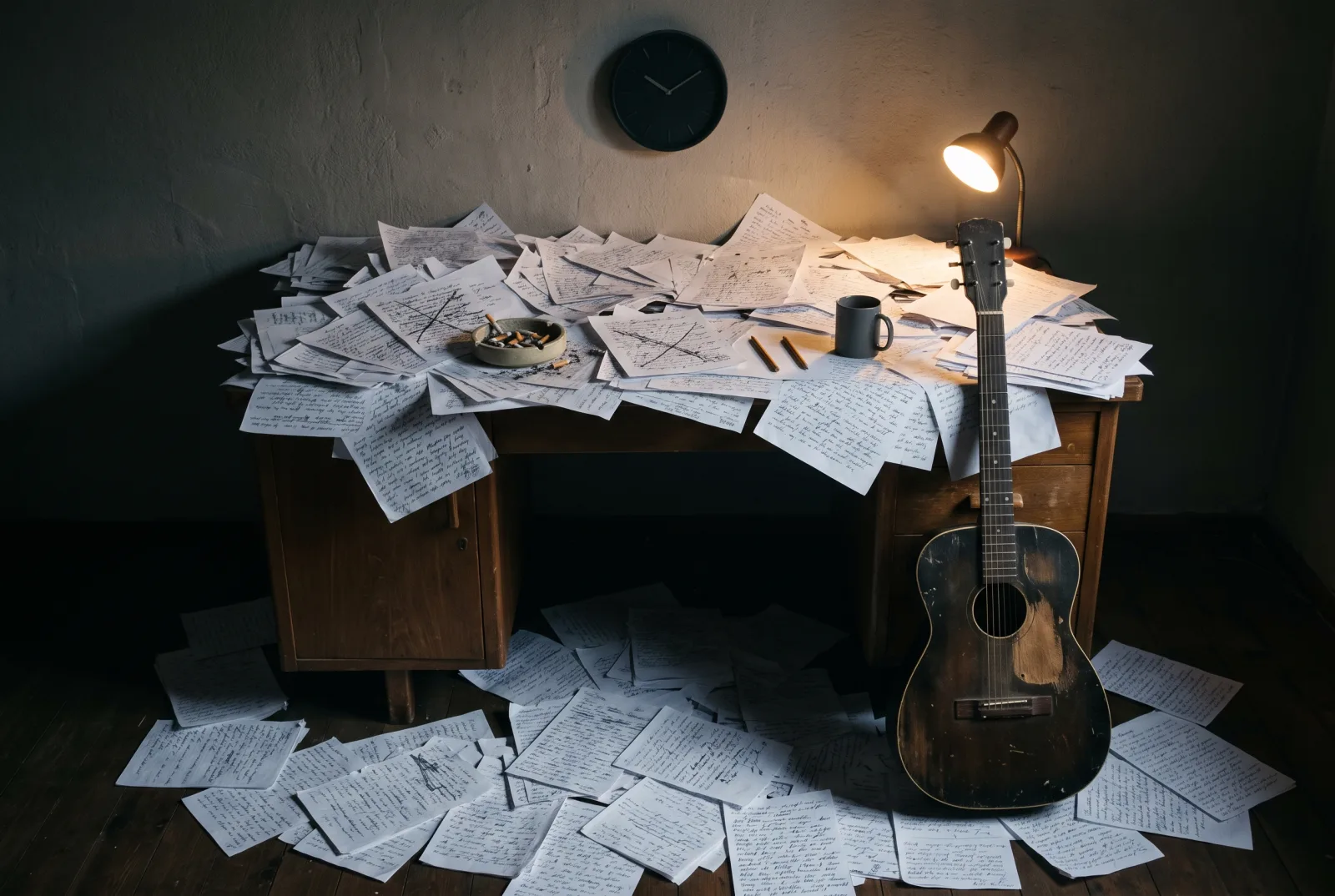
Ilustración: Rebobinados
In the year 2000, Andrés Calamaro put out a record with a hundred and three songs on it.
A hundred and three. Five compact discs. It was called "El Salmón" and it was not a compilation: it was all new material.
No artist does that. Not because it cannot be done, but because it occurs to nobody that it might be a good idea.
The man who writes the way other people breathe
Calamaro gets called a graphomaniac, and the nickname is fairly literal.
He does not write songs when he has something to say. He writes all the time, and what is left is what is left.
One recurring misunderstanding is worth clearing up: "El Salmón" was not recorded in one sitting. It came out of long, sustained sessions, out of a stretch of runaway production. The extraordinary thing is not the speed, it is that he never stopped.
And the method has an obvious price: among a hundred and three songs there is everything. But it also has a virtue almost nobody achieves, which is not filtering too soon. Whoever writes little chooses far too early.
Twenty-five years on he is exactly the same. In 2026 he is preparing a box set with a hundred and nine songs.
Madrid, and a band from two shores
He was born in Buenos Aires in 1961 and by twenty he was already the keyboard player in Los Abuelos de la Nada, between 1981 and 1985.
In the early nineties he settled in Madrid, and that is where the interesting part happened.
Ariel Rot and Julián Infante, who came from Tequila, had a covers project going. Rot called him to come in on it. Out of that came Los Rodríguez, in 1990, with Germán Vilella on drums.
This needs saying precisely, because it usually gets told the other way round: it was not Calamaro who founded the band and called the others. They called him. He was a founder, yes, but not the driving force.
And what they did between 1990 and 1996 was odd and valuable: they welded Argentine rock to Spanish flavour in a single sound, and they worked enormously on both sides of the Atlantic. "Sin documentos", from 1993, is one of the anthems of rock in Spanish of that decade.
Few artists truly belong to both worlds. He does.
Alta suciedad
After Los Rodríguez came his best run on his own.
"Alta suciedad", from 1997, with "Flaca" and "Loco". "Honestidad brutal", from 1999, a double, already announcing what was coming. And "El Salmón" the following year.
In four years he released an amount of music that would have lasted others twenty, and the best of it still plays today in any bar in Buenos Aires or Madrid.
He also wrote for other people. "Mi enfermedad" is his, though the massive hit was Fabiana Cantilo's version in 1991, not the one by Los Rodríguez.
What to remember
Calamaro is the proof that sometimes quantity is a form of quality.
Put on "Flaca", "Sin documentos" or "Loco" and you will hear someone with an unerring ear for melody and a way of writing that sounds like conversation, not like lyrics.
What sets him apart is not having written three perfect songs. It is having written a thousand, and that among those thousand there are three perfect ones, and a hundred more good ones, and that he never once stopped to decide which were which.
Remember him like this: not as the author of "Flaca", but as the man who never learned how to stop, and who for that reason left behind more good music than almost anyone of his generation.
Sources
Andrés Calamaro Masel, born in Buenos Aires on 22 August 1961; still alive and active, with the "Como Cantor" tour in 2026 and a box set of 109 songs in preparation. He was the keyboard player in Los Abuelos de la Nada between 1981 and 1985, without being a founding member. Los Rodríguez formed in Madrid in 1990 out of a covers project by Ariel Rot and Julián Infante, both formerly of Tequila, who brought Calamaro in; the line-up was completed by Germán Vilella. This point is worth being precise about, because the founding of the band is often attributed to Calamaro. Los Rodríguez split up in 1996; "Sin documentos" gives its title to their third album, from 1993. His solo discography includes "Alta suciedad" (1997), with "Flaca" and "Loco"; "Honestidad brutal" (1999), a double album; and "El Salmón" (2000), with 103 songs across five discs, the fruit of a prolonged recording period and not of a single session. "Mi enfermedad" is his own composition, recorded by Los Rodríguez on "Buena suerte" (1991), although its mass exposure came from Fabiana Cantilo's version of the same year. "Estadio Azteca" belongs to "El cantante" (2004), a record made up mostly of covers, and its lyrics are by Marcelo "Cuino" Scornik. Externally authored text, edited and verified for Rebobinados. Interpretations of the meaning of his work are offered as the author's reading. No song lyrics are reproduced, for copyright reasons. Information drawn from Wikipedia, AllMusic and other coverage.
Keep rewinding

10s
pop
Bruno Mars
Eleven names in the credits
"Uptown Funk" came out on 10 November 2014 with six writers and today it has eleven. In February 2015 The Gap Band's publisher filed a claim over "Oops Up Side Your Head" in YouTube's copyright system —there was never a lawsuit— and on 28 April five names were added, with 17 % of the publishing. It happened weeks after the "Blurred Lines" verdict, and the song had been fourteen weeks at number one.

00s
pop
André Rieu
It was not from the jazz suite
The waltz with which André Rieu reached half the world is not from Shostakovich's Suite for Jazz Orchestra No. 2: it is from the Suite for Variety Orchestra, which the composer did not assemble, and it was born in 1956 as music for a Soviet film about settlers in Kazakhstan. The error comes from a misprint in volume 10 of the complete works (Muzyka, Moscow, 1984), corrected only in 2001. And the title "The Second Waltz" was invented by his wife, because the real one did not sell.

90s
pop
Daniela Mercury
She took the neighbourhood out of the song
"O Canto da Cidade" was written by Tote Gira, a composer from Nordeste de Amaralina who recorded the demo on a borrowed cassette, marking the beat on the door of a refrigerator; Mercury's team almost threw the tape away. She shares the credit because she deleted the references to the Pelourinho so that the song would serve all of Brazil. The album, from 20 September 1992, sold more than 2 million copies and nationalised axé. But she did not invent it: the name was a journalist's insult in 1987.
Rewind with us
Comments · 0
No one has commented yet. Open the conversation.