
Beto Cuevas
The one who grew up far away
By Rebobinados · Published on October 1, 2026
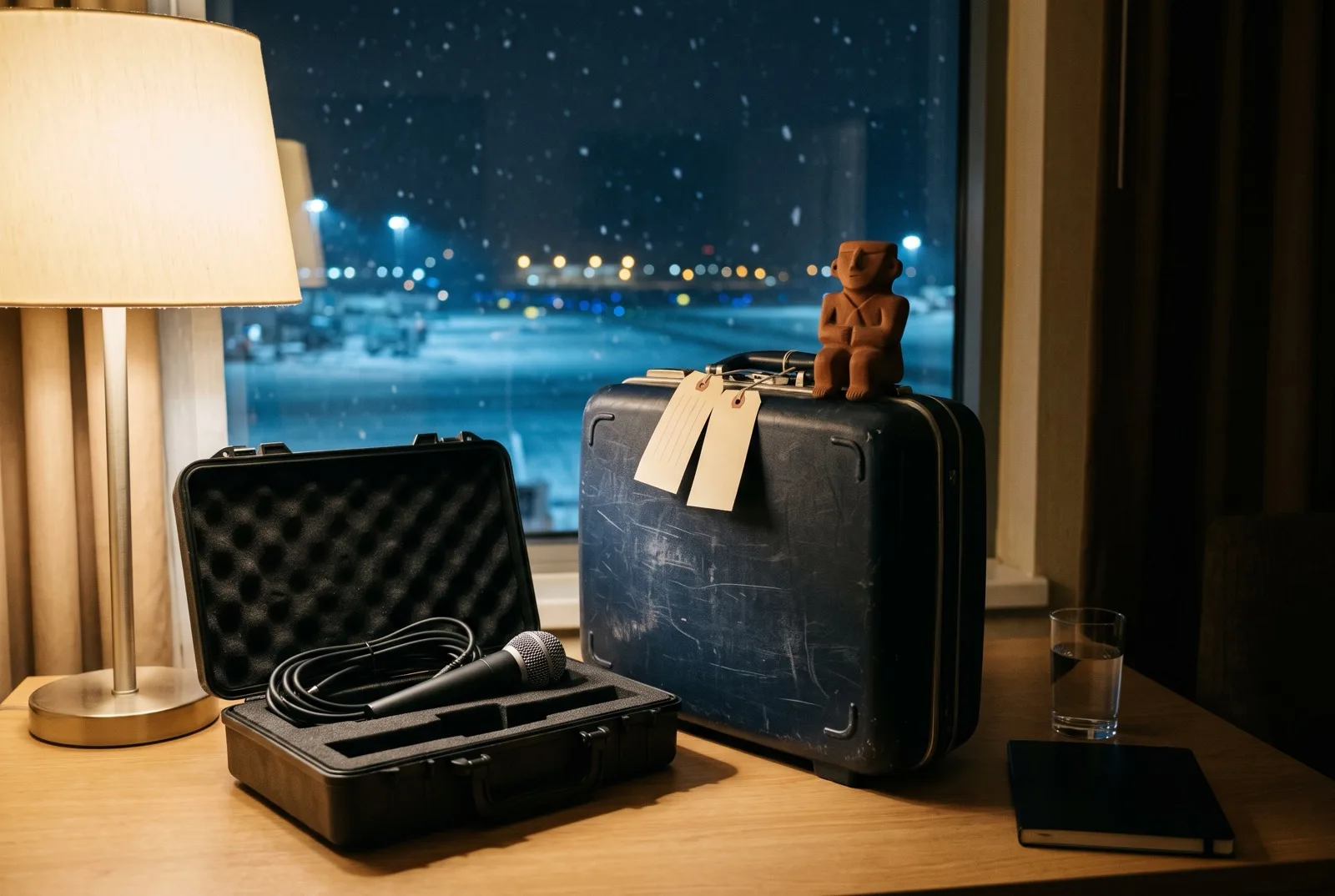
Ilustración: Rebobinados
Beto Cuevas did not fit into a single country or a single language. Born in Santiago, raised between Caracas and Montreal, speaking Spanish, English and French, he was a man of several worlds from childhood. That condition of the eternal traveller, of someone who never quite belonged to one place, ended up being his great strength: it gave him a wide view that he poured into music and that made him one of the most important voices in Spanish-language rock.
A child raised far away
His story begins with a move, and it is worth telling properly because it is usually told badly. The family of Luis Alberto Cuevas Olmedo left Chile around 1969, when he was about two years old, because his father was transferred for work to Caracas. That was four years before the coup of 1973. In 1978 they moved again, also for his father's work, this time to Montreal.
It is common to read that Cuevas is a son of political exile, and he himself has denied it: "We did not come to Canada because of political problems, as many people think". The dictatorship is in his biography all the same, but through another door: once settled in Canada, his father hosted a radio programme about Chile and human rights. He grew up hearing about a country he barely knew.
That is how he became trilingual, studied graphic design and absorbed different cultures. When he came back to Chile, already a young man, he brought with him that uncommon mix: Chilean roots and an international cultural education.
The voice of La Ley
In 1988 he joined La Ley, the band that was redefining Chilean rock. At first he wrote lyrics and melodies while Andrés Bobe took care of the musical creation. When Bobe died in a motorcycle accident in 1994, Cuevas had to step forward and become the group's leader and its public face.
Under his lead, La Ley conquered Latin America. They won the American Grammy for Uno in 2001 — the first for a Chilean group — and two Latin Grammy awards, for the MTV Unplugged in 2002 and for Libertad in 2004. A band from Santiago filling venues in Mexico and in the United States was not an everyday occurrence.
The solo reinvention
When La Ley broke up in 2005, many thought Cuevas would be tied to that story for ever. But he had other plans. In 2008 he released Miedo Escénico, with "Vuelvo" and "Háblame", which played all over the continent. In 2012 came Transformación, recorded in the United States — part of it in the studio that had belonged to Frank Zappa — and that record earned him the 2013 Latin Grammy for best pop/rock album. It is his greatest personal award and the best proof that he could sustain a career on his own.
Meanwhile, the story of La Ley was not closed: the band came back in 2013, played at Viña del Mar in 2014, released Adaptación in 2016 and it was Cuevas himself who announced the definitive split that year.
More than a musician
Cuevas never settled for being only a singer, and his least-known side is precisely the one he is formally trained in: he is a graphic designer with a degree from Montreal, and a painter. For a time he drew a portrait a day on his phone, and that series ended up on show at Art Basel Miami in 2013.
He also acted in film — La mujer de mi hermano, Borderland — was a coach on musical talent shows in Mexico in 2012 and in Chile in 2022 and 2023, and in 2019 he took to the stage to play Jesus in a Mexican production of Jesucristo Superstar. That need to try new things probably comes from his own history: the boy who grew up changing countries and languages learned not to be afraid of the unknown.
What to remember
Beto Cuevas is proof that roots and flight are not at odds. Raised between languages and continents, he took that traveller's life and turned it into a career of Latin American reach: first as the voice that took La Ley to the top, then as a solo artist capable of winning a Latin Grammy on his own.
And there is something in his story worth not over-romanticising. He did not leave Chile to escape; he left as a child, because his father was transferred, and he grew up hearing about a faraway country on a radio programme his father hosted. He came back of his own free will, and ended up representing that country before an entire continent. That is not the tale of the exile who returns. It is the tale of someone who chose where he was from.
Sources
Beto Cuevas (Luis Alberto Cuevas Olmedo) was born on 12 September 1967 in Santiago, Chile. His family moved to Caracas around 1969, when he was about two years old, for his father's work, and in 1978 they moved to Montreal, Canada, also for work. Cuevas has publicly denied that the family's departure from the country was for political reasons; once in Canada, his father hosted a radio programme about Chile and human rights. Various encyclopaedic sources maintain the political exile version, which the artist himself contradicts in interviews. He holds Chilean and Canadian citizenship, is trilingual (Spanish, English and French) and is a graphic designer with a degree from Montreal. He joined La Ley in 1988; at first he contributed lyrics and melodies while Andrés Bobe handled the musical composition. After Bobe's death in 1994 he took over the leadership of the group. With La Ley he won the Grammy for best Latin rock or alternative album for "Uno" (2001), the first for a Chilean group, and two Latin Grammy awards: for "MTV Unplugged" (2002) and for "Libertad" (2004). After La Ley broke up in 2005 he began his solo career with "Miedo Escénico" (2008), which included "Vuelvo" and "Háblame"; "Transformación" (2012), recorded in the United States, won the Latin Grammy for best pop/rock album in 2013. La Ley reunited in 2013, performed at the Festival de Viña del Mar in 2014, released "Adaptación" in 2016 and Cuevas announced its definitive split on 29 July 2016. He acted in the films "La mujer de mi hermano" (2005) and "Borderland" (2007); he was a coach on La Voz México (2012) and on The Voice Chile (2022 and 2023); and he played Jesus in the Mexican production of "Jesucristo Súper Estrella" that opened on 12 July 2019 in Mexico City. He is also a painter and produced a series of daily portraits drawn on a mobile phone, exhibited at Art Basel Miami in December 2013. Profile compiled for Rebobinados with fact-checking; interpretations of the meaning of the work are offered as the author's reading. No song lyrics are reproduced, for copyright reasons. Information drawn from La Tercera, Chilevisión, BioBioChile, CNN Chile and other coverage.
Keep rewinding

10s
pop
Bruno Mars
Eleven names in the credits
"Uptown Funk" came out on 10 November 2014 with six writers and today it has eleven. In February 2015 The Gap Band's publisher filed a claim over "Oops Up Side Your Head" in YouTube's copyright system —there was never a lawsuit— and on 28 April five names were added, with 17 % of the publishing. It happened weeks after the "Blurred Lines" verdict, and the song had been fourteen weeks at number one.

00s
pop
André Rieu
It was not from the jazz suite
The waltz with which André Rieu reached half the world is not from Shostakovich's Suite for Jazz Orchestra No. 2: it is from the Suite for Variety Orchestra, which the composer did not assemble, and it was born in 1956 as music for a Soviet film about settlers in Kazakhstan. The error comes from a misprint in volume 10 of the complete works (Muzyka, Moscow, 1984), corrected only in 2001. And the title "The Second Waltz" was invented by his wife, because the real one did not sell.

90s
pop
Daniela Mercury
She took the neighbourhood out of the song
"O Canto da Cidade" was written by Tote Gira, a composer from Nordeste de Amaralina who recorded the demo on a borrowed cassette, marking the beat on the door of a refrigerator; Mercury's team almost threw the tape away. She shares the credit because she deleted the references to the Pelourinho so that the song would serve all of Brazil. The album, from 20 September 1992, sold more than 2 million copies and nationalised axé. But she did not invent it: the name was a journalist's insult in 1987.
Rewind with us
Comments · 0
No one has commented yet. Open the conversation.