
Celine Dion
The most powerful voice in the world, and the courage to come back from the Eiffel Tower
By Rebobinados · Published on September 21, 2026
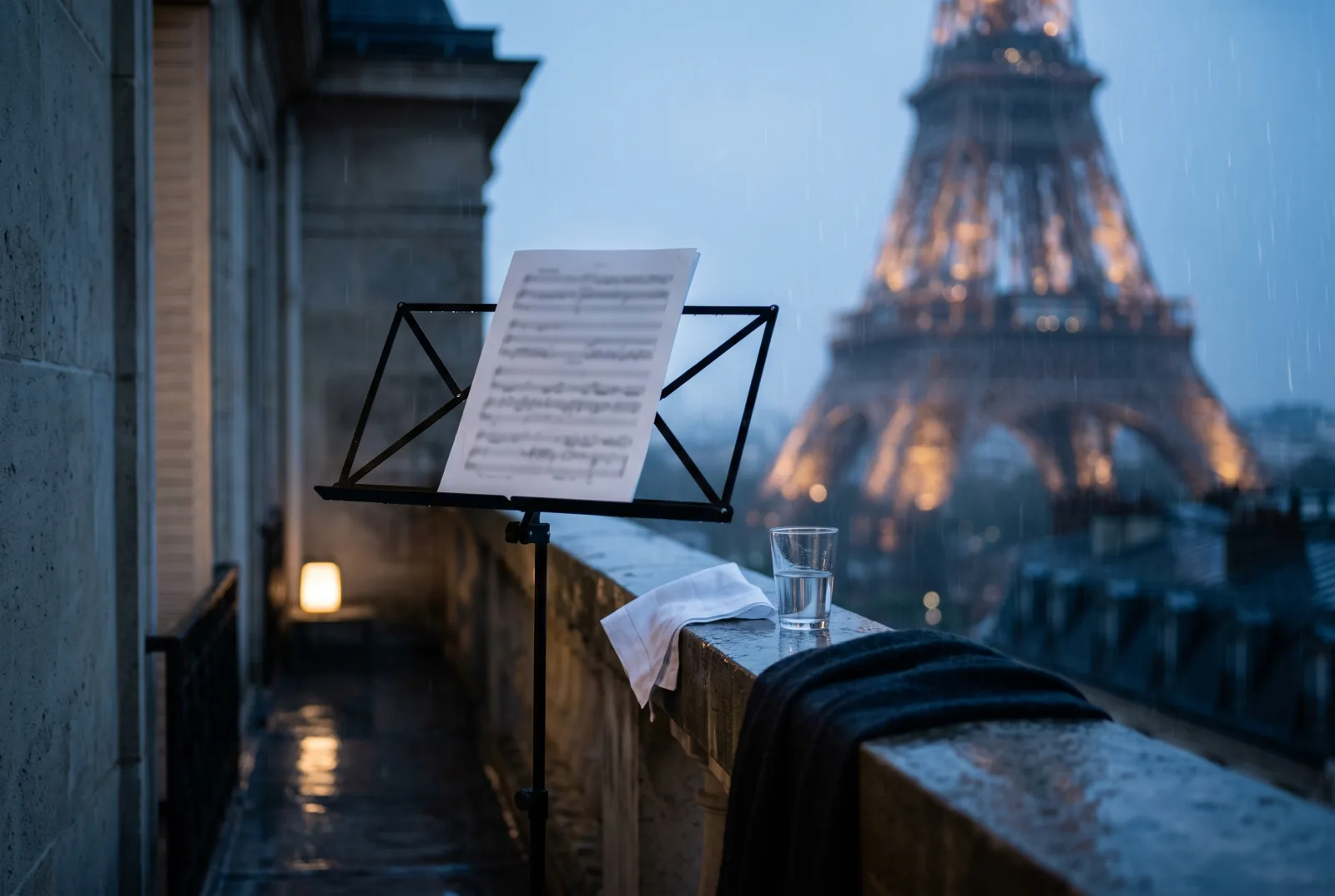
Ilustración: Rebobinados
In July 2024, at the opening ceremony of the Paris Olympic Games, the entire world held its breath. In the rain, lit up high on the Eiffel Tower, a woman appeared whom many believed they would never hear sing again. Celine Dion, struck by a rare and cruel illness that had robbed her of control of her body, stood in front of billions of people and sang an old Édith Piaf song with all her power intact. It was one of the most moving comebacks music has ever seen. And to grasp its size you have to understand where she came from and what she had been through.
The fourteenth child
Celine Dion was born in Quebec, into an enormous and humble family: she was the youngest of fourteen children. From there, from a house where nothing was in abundance except music, came one of the most prodigious voices the planet has produced. She was discovered and shaped by René Angélil, who would be her manager all her life and, later, her husband and the love of her life until his death in 2016.
Her voice is in a category of its own: a power, a range and a technical control that place her among the greatest in history. "The Power of Love", "Because You Loved Me", "It's All Coming Back to Me Now", and of course "My Heart Will Go On", the theme of "Titanic", one of the best-selling and best-known songs of all time. Celine could fill a stadium with her voice alone, hold a note to infinity, go from a murmur to an explosion without a hair out of place. She became one of the most successful artists in history out of sheer vocal might.
The cruelest illness for a singer
And then came the most unfair blow possible. In 2022, Celine Dion revealed that she had stiff person syndrome, a rare neurological illness that causes muscle spasms and rigidity, and that attacks precisely what a singer needs most: control of her own body, of her breathing, of her voice. The illness forced her to cancel tours and to step away from the stage. For somebody whose entire life was singing, it was the worst news there was.
Many feared she would never come back. The uncertainty was total; not even she knew whether her body would allow it. That in those circumstances she decided to go up the Eiffel Tower, in front of the whole world, to sing live was not merely an artistic comeback: it was an enormous act of courage. She did not sing to prove that she was cured —she was not—, but to prove that the illness had not defeated her. The voice came out, whole, powerful, and millions of people wept as they listened to her.
What to remember
Celine Dion, the youngest of fourteen children of a humble Quebec family, became one of the most powerful and successful voices in history, with anthems like "My Heart Will Go On". A rare and cruel neurological illness took away control of her body and kept her away from the stage. And in 2024, against all the odds, she sang again from the Eiffel Tower, at the opening of the Paris Games, in one of the most moving comebacks anyone can remember.
Remember her like this: there are voices that are great for their power, and voices that are great for what they are able to carry. Celine Dion's is both. She came back when many had given up on her, and she proved that there is a force no illness manages to put out entirely: the will to sing again.
Sources
Celine Dion, Canadian singer born on 30 March 1968 in Charlemagne, Quebec, the youngest of fourteen children; she is still alive. She was discovered and managed by René Angélil, later her husband, who died in 2016. She is one of the best-selling artists in history, with hits such as "The Power of Love", "Because You Loved Me", "It's All Coming Back to Me Now" and "My Heart Will Go On", theme of the film "Titanic" (1997). In December 2022 she revealed that she had stiff person syndrome, a rare neurological disorder that forced her to cancel her tours. On 26 July 2024 she gave her first performance since the diagnosis at the opening ceremony of the Paris Olympic Games, singing Édith Piaf's "L'Hymne à l'amour" from the Eiffel Tower. Profile compiled for Rebobinados with fact-checking; interpretations of the meaning of the work are offered as the author's reading. No song lyrics are reproduced, for copyright reasons. Information drawn from CBS News, CBC, Rolling Stone, Good Morning America and other coverage.
Keep rewinding

10s
pop
Bruno Mars
Eleven names in the credits
"Uptown Funk" came out on 10 November 2014 with six writers and today it has eleven. In February 2015 The Gap Band's publisher filed a claim over "Oops Up Side Your Head" in YouTube's copyright system —there was never a lawsuit— and on 28 April five names were added, with 17 % of the publishing. It happened weeks after the "Blurred Lines" verdict, and the song had been fourteen weeks at number one.

00s
pop
André Rieu
It was not from the jazz suite
The waltz with which André Rieu reached half the world is not from Shostakovich's Suite for Jazz Orchestra No. 2: it is from the Suite for Variety Orchestra, which the composer did not assemble, and it was born in 1956 as music for a Soviet film about settlers in Kazakhstan. The error comes from a misprint in volume 10 of the complete works (Muzyka, Moscow, 1984), corrected only in 2001. And the title "The Second Waltz" was invented by his wife, because the real one did not sell.

90s
pop
Daniela Mercury
She took the neighbourhood out of the song
"O Canto da Cidade" was written by Tote Gira, a composer from Nordeste de Amaralina who recorded the demo on a borrowed cassette, marking the beat on the door of a refrigerator; Mercury's team almost threw the tape away. She shares the credit because she deleted the references to the Pelourinho so that the song would serve all of Brazil. The album, from 20 September 1992, sold more than 2 million copies and nationalised axé. But she did not invent it: the name was a journalist's insult in 1987.
Rewind with us
Comments · 0
No one has commented yet. Open the conversation.