
Charly García
The dinosaurs and the survivor
By Rebobinados · Published on October 1, 2026
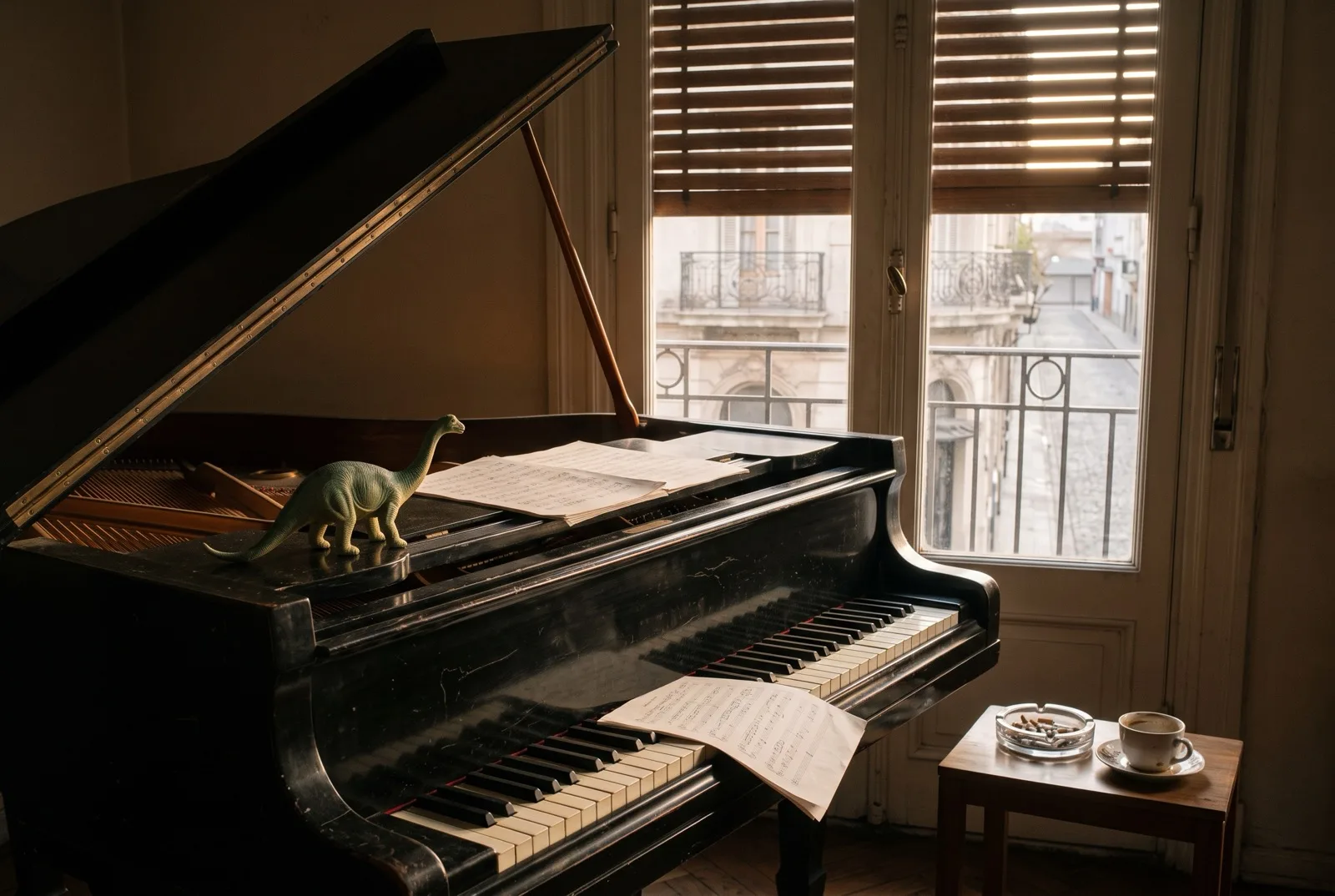
Ilustración: Rebobinados
If Argentine rock had a single name to sum it all up, many would say Charly García. He is not just a musician: he is an institution, a chronicler, a collective conscience. For more than half a century he set the dreams, the fears and the pains of several generations of Argentines to melody, even in the darkest moments, when singing certain things could cost you dearly. An outright genius and a survivor of his own excesses, he is one of those rare artists who go beyond music to become part of a people's identity.
The prodigy and his legendary bands
Charly was born in Buenos Aires on 23 October 1951. He was a child prodigy on the piano, with perfect pitch, trained at the Conservatorio Nacional before turning to rock. And his list of bands is, on its own, half the history of Argentine rock.
First Sui Generis, the folk-rock duo with Nito Mestre that marked a whole generation of young people in the seventies with intimate, poetic songs. Then, after a spell in La Máquina de Hacer Pájaros, came Serú Girán, alongside David Lebón, Pedro Aznar and Oscar Moro: a band of extremely high musical calibre, nicknamed "the Argentine Beatles".
At every one of those stages, Charly did not follow trends: he created them. His musical ambition, his sophistication as a songwriter and his capacity to reinvent himself always kept him a step ahead.
Saying what could not be said
What makes Charly unique is that he was far more than a great songwriter: he was a witness to his time, and he found a way to say what could not be said.
"Canción de Alicia en el país" is from 1980, with Serú Girán, in the very heart of the dictatorship: a ferocious critique hidden behind the Lewis Carroll metaphor to dodge the censors. "Los dinosaurios", by contrast, came out in November 1983, on Clics modernos, which he recorded in New York because Buenos Aires was suffocating him. It is a chilling portrait of the terror of those years, released five weeks before the handover of power. That a song so direct could only come out then says quite a lot about what could and could not be sung.
His solo work from those years is a succession of foundation stones, and it is worth placing them correctly because they are almost always shifted around. Yendo de la cama al living is from October 1982, recorded in the last year of the dictatorship, after the Falklands war. Clics modernos, from November 1983. Only Piano Bar, from September 1984, is a record made in democracy. And "No voy en tren" and "Rezo por vos" are on none of the three: they are from Parte de la religión, from 1987, the album that closes that run and that is almost never mentioned.
Between "Demoliendo hoteles", "No soy un extraño", "No voy en tren" and "Rezo por vos" there are five years, four albums and a country that changed regime. Charly set that whole stretch to music.
The survivor
Charly's life was also a rollercoaster of excess that came close to costing him everything, and the kindly tale of the "scandals" does him few favours.
The episode that marked rock bottom has a date: on 9 June 2008, in Mendoza, he had a crisis in a hotel, wrecked two rooms, assaulted his assistant and ended up in intensive care. Thirty grams of cocaine were found in the room, which led to a case in the federal courts. It was not a rock star's prank: it was the point at which addiction ran over everything else.
And from there he came back. Against all predictions he recovered, went back to composing, went back to playing, and over the years he became a living national treasure, cared for and revered. In September 2024 he surprised everyone with La lógica del escorpión, his fourteenth studio album, recorded with Lebón, Aznar, Fito Páez and with a posthumous contribution from Spinetta.
His health remains fragile. In April 2026 he was operated on for a tumour in one kidney and spent a week in hospital before being discharged. That he is still here, still creating, is not a figure of speech: it is a fact that has been in doubt more than once.
What to remember
Charly García is the heart of Argentine rock, a genius who for more than fifty years set the soundtrack to a country's life, in its joys and in its horrors. He had the courage to sing what was forbidden when others kept quiet, the ambition to make music that was sophisticated and popular at once, and the strength to survive his own demons when everything pointed the other way.
From Sui Generis to Serú Girán and to his solo work, he left a songbook that is, to a large extent, the emotional memory of Argentina. Few artists in the world can say that their music blends into the history of their people. Charly can. That is why, more than an idol, he is a treasure, and it is worth saying so while he is here.
This piece mentions problematic drug use. If you or someone you know is struggling with alcohol or drug use, help is available, and asking for it is an act of strength. In Chile, SENDA's Drugs and Alcohol helpline answers free of charge 24 hours a day on 1412.
Sources
Charly García (Carlos Alberto García) was born on 23 October 1951 in Buenos Aires. A child prodigy on the piano with perfect pitch and training at the Conservatorio Nacional, he is one of the central figures of Argentine rock. He was part of Sui Generis (a duo with Nito Mestre), La Máquina de Hacer Pájaros and Serú Girán (with David Lebón, Pedro Aznar and Oscar Moro, 1978-1982), a group nicknamed "the Argentine Beatles". "Canción de Alicia en el país" belongs to Serú Girán's album "Bicicleta" (1980) and uses the Lewis Carroll metaphor to evade the dictatorship's censorship. "Los dinosaurios" belongs to "Clics modernos", released on 5 November 1983 and recorded in New York, five weeks before the handover of power on 10 December 1983. "Yendo de la cama al living" was released on 28 October 1982, during the last year of the dictatorship; "Piano Bar", on 22 September 1984, contains "Demoliendo hoteles"; "No soy un extraño" belongs to "Clics modernos"; "No voy en tren" and "Rezo por vos" belong to "Parte de la religión" (10 August 1987). On 9 June 2008, in Mendoza, García was involved in an episode at a hotel in which he wrecked two rooms and assaulted his assistant; he was admitted to intensive care and cocaine was found in the room, which led to a case in the federal courts. In September 2024 he released "La lógica del escorpión", his fourteenth studio album, with contributions from David Lebón, Pedro Aznar, Fito Páez and a posthumous collaboration from Luis Alberto Spinetta. On 21 April 2026 he underwent a partial nephrectomy for a kidney tumour and was discharged on 28 April 2026. Profile compiled for Rebobinados with fact-checking; interpretations of the meaning of the work are offered as the author's reading. No song lyrics are reproduced, for copyright reasons. Information drawn from Wikipedia, La Nación, Infobae, Radio Nacional and other coverage.
Keep rewinding

10s
pop
Bruno Mars
Eleven names in the credits
"Uptown Funk" came out on 10 November 2014 with six writers and today it has eleven. In February 2015 The Gap Band's publisher filed a claim over "Oops Up Side Your Head" in YouTube's copyright system —there was never a lawsuit— and on 28 April five names were added, with 17 % of the publishing. It happened weeks after the "Blurred Lines" verdict, and the song had been fourteen weeks at number one.

00s
pop
André Rieu
It was not from the jazz suite
The waltz with which André Rieu reached half the world is not from Shostakovich's Suite for Jazz Orchestra No. 2: it is from the Suite for Variety Orchestra, which the composer did not assemble, and it was born in 1956 as music for a Soviet film about settlers in Kazakhstan. The error comes from a misprint in volume 10 of the complete works (Muzyka, Moscow, 1984), corrected only in 2001. And the title "The Second Waltz" was invented by his wife, because the real one did not sell.

90s
pop
Daniela Mercury
She took the neighbourhood out of the song
"O Canto da Cidade" was written by Tote Gira, a composer from Nordeste de Amaralina who recorded the demo on a borrowed cassette, marking the beat on the door of a refrigerator; Mercury's team almost threw the tape away. She shares the credit because she deleted the references to the Pelourinho so that the song would serve all of Brazil. The album, from 20 September 1992, sold more than 2 million copies and nationalised axé. But she did not invent it: the name was a journalist's insult in 1987.
Rewind with us
Comments · 0
No one has commented yet. Open the conversation.