
Chicago
They put a horn section into rock, and were hiding a guitar genius
By Rebobinados · Published on September 17, 2026
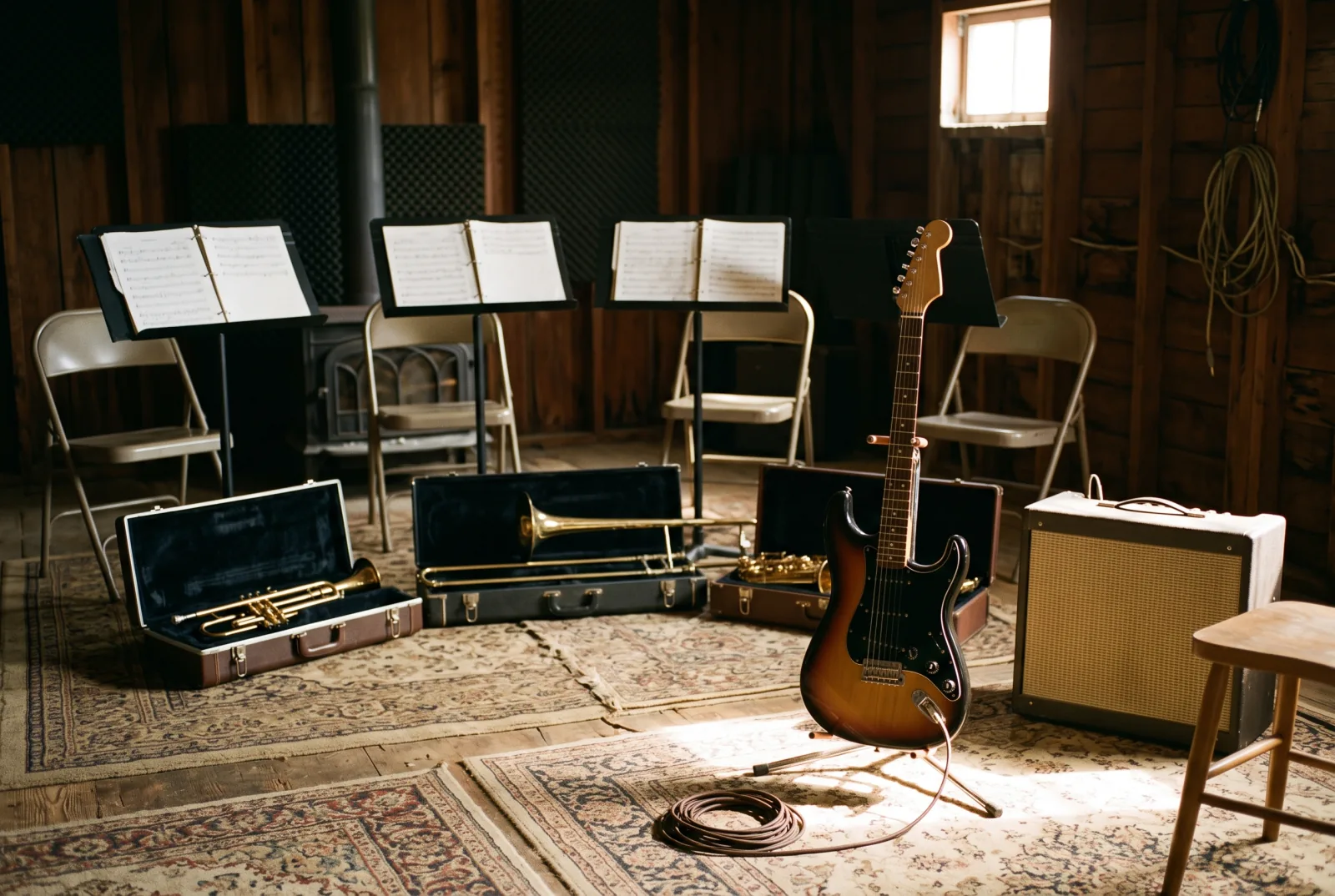
Ilustración: Rebobinados
When Chicago appeared at the end of the sixties, they did something almost nobody dared to do: they put trumpets, trombones and saxophones at the centre of a rock band. Not as an occasional ornament, but as the backbone of the sound. At a time when rock meant guitar, bass and drums, they brought in a horn orchestra and made it sound powerful, modern, indispensable. That strange gamble turned them into one of the best-selling American bands in history, with a career spanning more than half a century.
The horns as identity
"25 or 6 to 4", "Saturday in the Park", "If You Leave Me Now", "Hard to Say I'm Sorry", "You're the Inspiration": Chicago's catalogue is enormous and ranges from rock with furious brass to the tenderest ballads, nearly all of them with the voice of Peter Cetera. They could do one thing and the other, and in both they used those horns that made them unmistakable. Nobody sounded like Chicago, because nobody had built their entire identity on a brass section playing riffs that in any other band would have belonged to a guitar.
Selling millions of records with such an unorthodox formula, and sustaining it for decades, is a feat. Chicago proved that you could widen what a rock band was allowed to be, and that the audience would follow if it was done well.
The genius almost nobody remembers
And here is the hidden jewel of their story. In Chicago's early years there was a guitarist named Terry Kath, and he was such an extraordinary musician that his name should be far more famous than it is. The legend — repeated by members of the band — has it that Jimi Hendrix, no less, heard him play and said that Kath was a better guitarist than he was. For the greatest guitarist in history to say that about someone else gives you the measure of the talent that was there.
Kath had a fire and a technique that were sometimes buried under the band's friendly image, but anyone who listens to his solos understands what Hendrix was talking about. He was Chicago's secret weapon, the one who gave weight and rawness to a group that many saw as merely melodic.
Terry Kath died in 1978, at thirty-one, in an accident: he was handling a gun he believed to be unloaded, and it was not. An absurd, avoidable death that took one of the most gifted guitarists of his generation in an instant, because of a mistake. The band was devastated and came close to breaking up. They carried on, but that kind of talent is not replaceable.
What to remember
Chicago was the band that dared to put a horn section at the heart of rock and with that became one of the best-selling and longest-lasting in the United States, with classics ranging from brass-driven rock to the most beloved ballads. And in its early years it was hiding Terry Kath, a guitarist whom Jimi Hendrix considered better than himself, lost far too soon in an absurd accident.
Remember them this way: we remember them for the horns and the ballads, and that is fine, because that is what made them enormous. But do not forget the name Terry Kath. When the best guitarist in the world says that someone else is better than he is, that someone deserves to be remembered.
Sources
Chicago, American rock band formed in Chicago in 1967 (initially as Chicago Transit Authority), known for making a horn section a central element of its sound and for being one of the best-selling American bands in history. Its hits include "25 or 6 to 4", "Saturday in the Park", "If You Leave Me Now", "Hard to Say I'm Sorry" and "You're the Inspiration". Guitarist Terry Kath, greatly admired — according to accounts from the band, Jimi Hendrix considered him superior to himself — died on 23 January 1978, aged thirty-one, from an accidental gunshot while handling a gun he believed to be unloaded. Peter Cetera has his own profile in this series. Profile compiled for Rebobinados with fact-checking; interpretations of the meaning of the work are offered as the author's reading. No song lyrics are reproduced, for copyright reasons. Information drawn from Wikipedia, Guitar World, Louder, WFUV and other coverage.
Keep rewinding
10s
pop
Bruno Mars
Eleven names in the credits
"Uptown Funk" came out on 10 November 2014 with six writers and today it has eleven. In February 2015 The Gap Band's publisher filed a claim over "Oops Up Side Your Head" in YouTube's copyright system —there was never a lawsuit— and on 28 April five names were added, with 17 % of the publishing. It happened weeks after the "Blurred Lines" verdict, and the song had been fourteen weeks at number one.
00s
pop
André Rieu
It was not from the jazz suite
The waltz with which André Rieu reached half the world is not from Shostakovich's Suite for Jazz Orchestra No. 2: it is from the Suite for Variety Orchestra, which the composer did not assemble, and it was born in 1956 as music for a Soviet film about settlers in Kazakhstan. The error comes from a misprint in volume 10 of the complete works (Muzyka, Moscow, 1984), corrected only in 2001. And the title "The Second Waltz" was invented by his wife, because the real one did not sell.
90s
pop
Daniela Mercury
She took the neighbourhood out of the song
"O Canto da Cidade" was written by Tote Gira, a composer from Nordeste de Amaralina who recorded the demo on a borrowed cassette, marking the beat on the door of a refrigerator; Mercury's team almost threw the tape away. She shares the credit because she deleted the references to the Pelourinho so that the song would serve all of Brazil. The album, from 20 September 1992, sold more than 2 million copies and nationalised axé. But she did not invent it: the name was a journalist's insult in 1987.
Rewind with us
Comments · 0
No one has commented yet. Open the conversation.