
Chubby Checker
They let go of each other's hands
By Rebobinados · Published on September 26, 2026
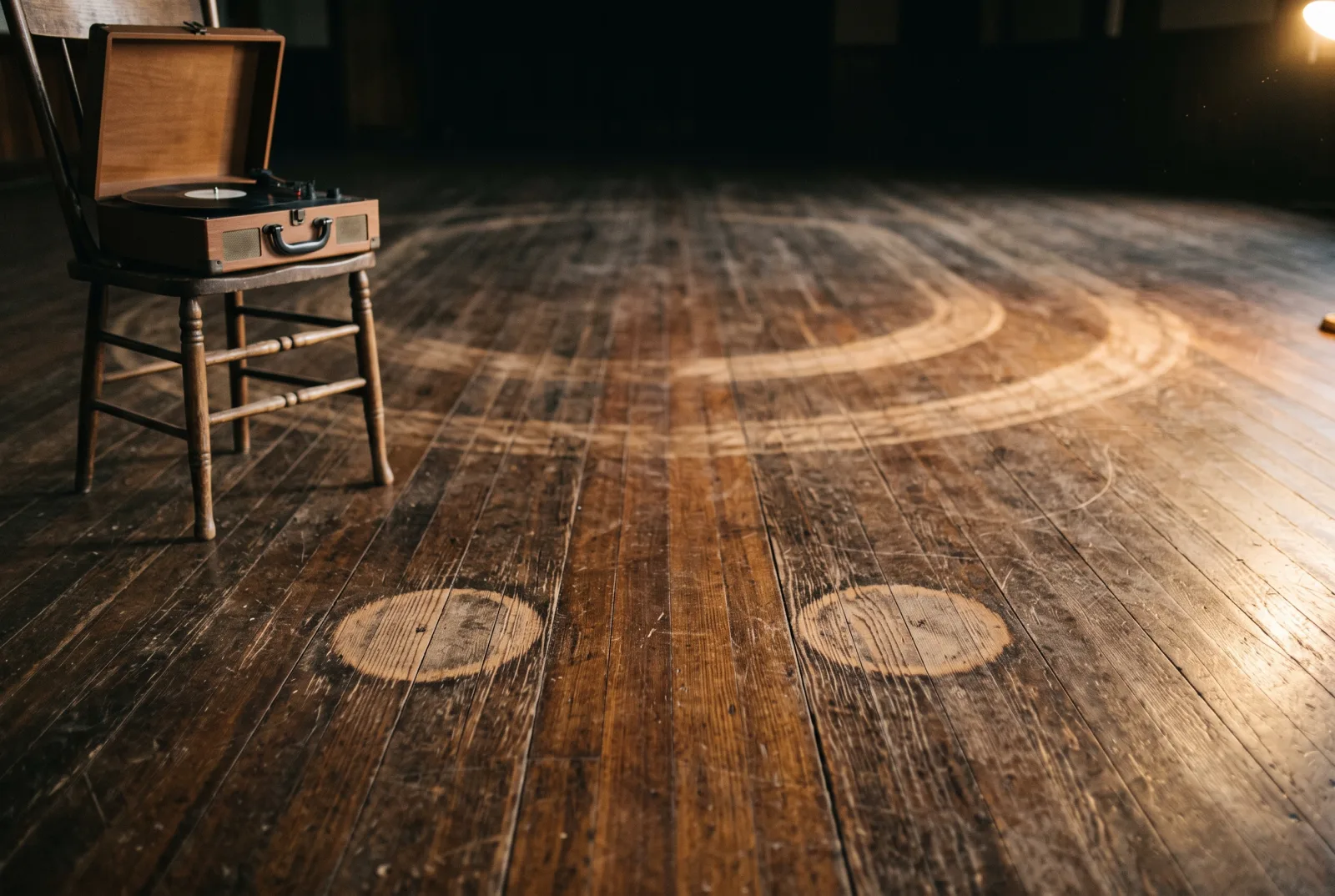
Ilustración: Rebobinados
Chubby Checker was not the best singer of his day, nor the deepest.
He did something rarer: he changed the way humanity dances.
With one song, "The Twist", and one simple movement —swivelling your hips as if you were putting out a cigarette with your foot while drying your back with a towel— he set off, in 1960, the first global dance craze of the rock era.
He is still alive, he is eighty-four years old, and his mark is deeper than it looks.
Hands let go
It is worth saying first whose song it is, because almost nobody does: he did not write "The Twist". Hank Ballard wrote it, recorded it with the Midnighters on 11 November 1958 and put it out in January 1959, as the B-side of "Teardrops on Your Letter".
Checker recorded his version in 1960. What he brought was not the song: it was the dance.
Before "The Twist", partner dancing worked in one way only: holding on.
To dance, two people had to touch each other, take each other by the hands and by the waist, move in a coordinated way following steps. That meant knowing how to dance, and it also meant contact and permission.
"The Twist" installed the opposite: each one on their own, facing the other but without touching, with no steps to learn.
This has to be said precisely, because it tends to be overstated. It was not the first time in history that a couple let go of each other: the Charleston and the shimmy of the twenties were already danced apart, and the breakaway of the lindy hop separated the dancers from the thirties onwards —the chronicles of the Savoy Ballroom, in fact, described the women dancers "doing the twist" as they broke away—.
What Checker did was something else, and it is no small thing: he made dancing without contact the norm.
It was the first mass dance craze of the rock era in which the couple stopped touching, and from then on that was how people danced for ever. At any party or club on the planet, today, people dance the way he taught.
Number one twice
And there is a record that is worth telling properly, because it gets repeated wrongly everywhere.
"The Twist" reached number one on the Hot 100 on 19 September 1960, for one week. Afterwards the craze seemed to pass.
But in January 1962 the song climbed back up to number one, this time pushed by the adult public, who had discovered the dance later, starting at the Peppermint Lounge in Manhattan.
For almost fifty-nine years it was the only song on the Hot 100 to reach number one in two separate runs, until Mariah Carey's "All I Want for Christmas Is You" repeated the feat in December 2020.
There is a difference that strengthens Checker's case: his was a reissue of the single, a new phenomenon; Mariah's is the seasonal recurrence of the same release.
He was not a one hit
Another thing that gets repeated wrongly: that Chubby Checker had a single song.
He had two number ones. "Pony Time" reached the summit in 1961 and stayed there three weeks, triple what "The Twist" managed on its first run.
And he added five more top 10s: "Limbo Rock" second, "Slow Twistin'" third, "The Fly" seventh, "Let's Twist Again" eighth and "Popeye the Hitchhiker" tenth. "Let's Twist Again" won the Grammy for best rock and roll recording in May 1962.
Seven top 10s is not a one hit. What happened is that a single song eclipsed everything else.
The name was a joke
He was called Ernest Evans, the son of a tobacco grower from South Carolina, raised poor in Philadelphia, where as a boy he shined shoes and worked in a poultry and produce market.
There they gave him the name "Chubby", on account of his build: it was given to him by one of his bosses at the market.
And when he was about to record he needed a stage name. It was given to him by Barbara Clark, the wife of the presenter Dick Clark, after hearing him do an impression of Fats Domino.
She put together the whole play on words: if that one was Fats Domino, this one would be Chubby Checker. Chubby instead of fat, and checkers instead of dominoes.
Ernest Evans entered history with a name that was a teasing nod to another star.
What to remember
Chubby Checker is proof that sometimes a single song, if it strikes the right chord, changes the culture more than other people's entire careers.
Put on "The Twist" or "Let's Twist Again", and you are going to hear early rock and roll, cheerful, made to move the body, from the same years in which Elvis reigned on the radio, and you are going to be listening to the moment when the world learned to dance apart.
It took him sixty-five years to enter the Rock and Roll Hall of Fame, in 2025, which called him the king of the dance crazes of the sixties. He had campaigned for it for decades, with a paid advertisement in Billboard: I want my flowers while I am alive, it said, because I cannot smell them when I am dead.
He did not go to the ceremony. The trophy was handed to him earlier, on 27 July 2025, at a concert in Des Plaines, Illinois, more than three months before the 8 November gala in Los Angeles.
And the concert that night was no accident of scheduling: he asked his manager to book it for that date.
Every time somebody dances alone, in their own way, facing another person, with no steps and without touching, they are doing what Chubby Checker taught the world in 1960.
His revolution is still being danced every night, everywhere.
Sources
Chubby Checker, real name Ernest Evans (Spring Gully, South Carolina, 3 October 1941), American singer and dancer, son of a tobacco farmer and raised in south Philadelphia, where he shined shoes and worked at the Fresh Farm Poultry and Produce Market. His nickname "Chubby" was given to him by one of his bosses at that market; the full stage name was devised by Barbara Clark, wife of the presenter Dick Clark, after hearing him imitate Fats Domino, as a play on words based on that name. His recording of "The Twist" (1960) is a version of a song written and originally recorded by Hank Ballard and the Midnighters in November 1958 and released in January 1959 as a B-side; Ballard's version reached number twenty-eight. "The Twist" reached number one on the Billboard Hot 100 on 19 September 1960 and again in January 1962, driven by the adult public from the Peppermint Lounge in Manhattan onwards. On that record it is worth being precise: it was the first song to reach number one on the Hot 100 in two separate runs and for almost fifty-nine years the only one, until Mariah Carey's "All I Want for Christmas Is You" repeated it in December 2020; Checker's case corresponded to a reissue of the single and Carey's to the seasonal recurrence of the same release. Checker was not a one-hit artist: he had a second number one with "Pony Time" (1961, three weeks) and five additional top 10s —"Limbo Rock" (2), "Slow Twistin'" (3), "The Fly" (7), "Let's Twist Again" (8) and "Popeye the Hitchhiker" (10)—. "Let's Twist Again" won the Grammy for Best Rock and Roll Recording on 29 May 1962. As for the dance, it is worth not making it absolute: there were precedents of dancing without contact —the Charleston, the shimmy and the breakaway of the lindy hop, documented at the Savoy Ballroom around 1928— and the defensible formulation is that "The Twist" was not the first dance in which couples let go of each other, but the one that made dancing without contact the norm. He entered the Rock and Roll Hall of Fame in the Performer category in 2025, announced on 27 April and with a ceremony on 8 November in Los Angeles, which he did not attend: the trophy was handed to him on 27 July 2025 at a concert in Des Plaines, Illinois, a date he had deliberately had his manager book; the museum's profile describes him as "the king of the dance crazes of the sixties". He had campaigned for his induction, including a full-page advertisement in Billboard in 2001. Externally authored text, edited and verified for Rebobinados. Interpretations of the meaning of his work are offered as the author's reading. No song lyrics are reproduced, for copyright reasons. Information drawn from Britannica, Biography, the Rock & Roll Hall of Fame, Billboard, the Encyclopedia of Greater Philadelphia and other coverage.
Keep rewinding

10s
pop
Bruno Mars
Eleven names in the credits
"Uptown Funk" came out on 10 November 2014 with six writers and today it has eleven. In February 2015 The Gap Band's publisher filed a claim over "Oops Up Side Your Head" in YouTube's copyright system —there was never a lawsuit— and on 28 April five names were added, with 17 % of the publishing. It happened weeks after the "Blurred Lines" verdict, and the song had been fourteen weeks at number one.

00s
pop
André Rieu
It was not from the jazz suite
The waltz with which André Rieu reached half the world is not from Shostakovich's Suite for Jazz Orchestra No. 2: it is from the Suite for Variety Orchestra, which the composer did not assemble, and it was born in 1956 as music for a Soviet film about settlers in Kazakhstan. The error comes from a misprint in volume 10 of the complete works (Muzyka, Moscow, 1984), corrected only in 2001. And the title "The Second Waltz" was invented by his wife, because the real one did not sell.

90s
pop
Daniela Mercury
She took the neighbourhood out of the song
"O Canto da Cidade" was written by Tote Gira, a composer from Nordeste de Amaralina who recorded the demo on a borrowed cassette, marking the beat on the door of a refrigerator; Mercury's team almost threw the tape away. She shares the credit because she deleted the references to the Pelourinho so that the song would serve all of Brazil. The album, from 20 September 1992, sold more than 2 million copies and nationalised axé. But she did not invent it: the name was a journalist's insult in 1987.
Rewind with us
Comments · 0
No one has commented yet. Open the conversation.