
Decade 00s · Rhythm disco dance
Daft Punk
Hiding so you'll be seen
By Rebobinados · Published on September 1, 2026
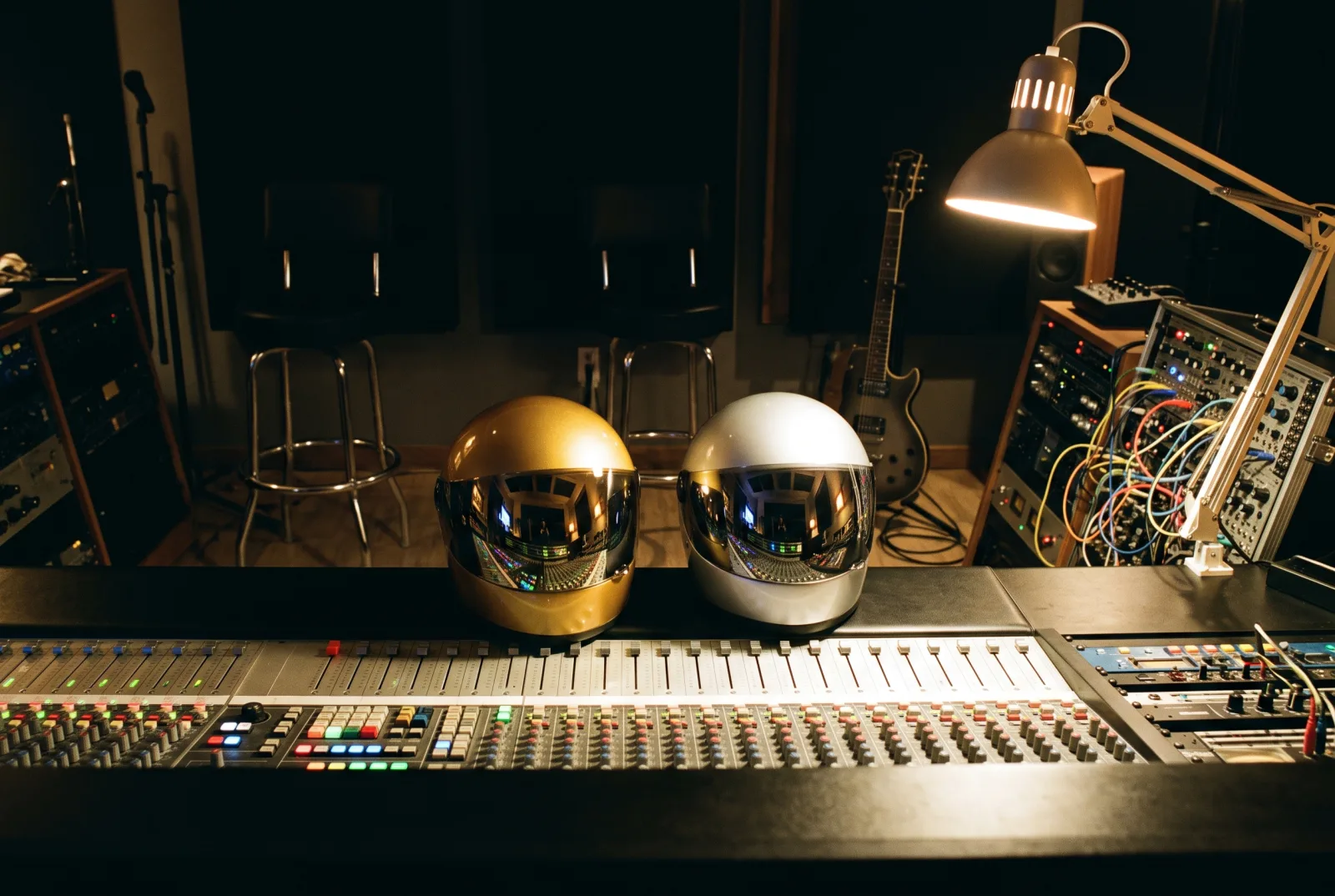
Ilustración: Rebobinados
Daft Punk did something that goes against every instinct of fame: they became one of the most famous acts on the planet without ever showing their faces.
The French duo — Thomas Bangalter and Guy-Manuel de Homem-Christo — ended up always appearing in robot helmets, one silver, the other gold.
Behind that anonymity they took electronic music out of the nightclub ghetto and put it at the centre of world pop.
They split up on 22 February 2021.
Hiding so you will be seen
The helmets were not a marketing trick: they were a philosophy.
They did arrive late, though. They made their debut in 2001, with "Discovery". Through the whole "Homework" era, between 1996 and 2000, they covered up with black bags over their heads and cheap Halloween masks.
They told another version: that at 9.09 in the morning on 9 September 1999 their sampler exploded and, when they came round, they had turned into robots.
In a world where stars compete to show more and more of themselves — the face, the life, the body, everything — they did the opposite. And they gained two things.
The first, artistic: with no face, they let the music and the robot image speak for themselves, without the distraction of two famous guys. The mystery became part of the work.
The second, and more human: freedom. They could lead a normal everyday life, because nobody recognised them in the street. They were among the most celebrated musicians in the world and they could go out for bread without anyone looking at them.
They had found a way to have the fame of their music without the sentence of personal fame. The robots were known all over the planet; the men, invisible.
It is one of the most intelligent moves in the history of pop: turning anonymity into the most recognisable brand of all.
Taking electronic music out of the underground
In the nineties, electronic dance music lived mainly in nightclubs and illegal parties. It was music to dance to, faceless and without songs people sang.
Daft Punk transformed it. They gave it emotion, melody, nostalgia.
Their record "Discovery", from 2001, with "One More Time" and "Harder, Better, Faster, Stronger", was electronic music that moved you and that people sang along to. They fused the sound of the machines with seventies disco, with funk, with pop, and created something warm inside the robotic.
There is a debt there worth naming. The brass riff of "One More Time" comes from "More Spell on You", a 1979 track by Eddie Johns, a Liberian singer who recorded in the Paris of the seventies.
Johns does not appear in the credits of "Discovery". The sample is licensed and the royalties go to the label that bought the catalogue in 1995. Johns, after a stroke, spent more than a decade homeless in Los Angeles.
The most famous duo in the world for having no face built its biggest hit on a voice whose owner appears nowhere.
Their influence was total. Even Kanye West took "Harder, Better, Faster, Stronger" and turned it into "Stronger", in 2007; they played together at the Grammys the following year.
Before Daft Punk, electronic music was the background of the party. After them, it became the centre of the stage.
The crowning, with real musicians
And here is the beautiful paradox of their peak.
In 2013, the robots who had made their whole career with machines decided to do the opposite for their major work. They recorded "Random Access Memories" with musicians playing live, in five studios in Los Angeles, New York and Paris, seeking the human warmth that machines do not give.
They called in legends, among them the guitarist Nile Rodgers, whose funky guitar is the heart of "Get Lucky", sung by Pharrell Williams.
The result was historic: the record won the Grammy for Album of the Year and "Get Lucky" the one for Record of the Year. No record born of electronic dance music had managed it before.
It is often said that they were the first "purely electronic" act to win it, and the phrase contradicts itself: that record was made with a drummer, a bassist and guitarists playing in a room.
The French robots, to reach the very top, had to embrace the most human thing of all. They won eight Grammys in total.
The ending, in silence
True to themselves, they did not announce their split with a press release or an interview.
In February 2021 they posted an eight-minute video called "Epilogue", with images from their film "Electroma", from 2006. The two robots walk through a desert. One stops, takes off his jacket and shows the other the self-destruct button he carries on his back. He asks him to press it.
The other obeys, walks on, and behind him his companion explodes.
At the end, the caption: 1993-2021. Not a word.
They said goodbye as they had lived: without showing their faces, letting the image say what had to be said.
Two years later, in April 2023, Bangalter gave interviews with his face uncovered to present "Mythologies", a ballet score of his own. With the duo dissolved, the helmet was no longer needed.
What is worth remembering
Daft Punk are the proof that sometimes hiding is the best way to be seen.
Put on "One More Time", "Harder, Better, Faster, Stronger", "Get Lucky" or "Instant Crush", and you will hear electronic music with a heart: machine music made to move you, which pulled a whole genre out of the shadows.
Two Frenchmen who gave up what almost every artist most wants — to be recognised — and in exchange won total freedom and a mystery that multiplied their legend.
For twenty-five years we never really knew what their faces looked like, and it did not matter. They left us something better.
Behind the helmets there were, the whole time, two humans looking for the soul in the machine. And they found it.
Sources
Daft Punk, a French electronic music duo formed in Paris in 1993 by Thomas Bangalter and Guy-Manuel de Homem-Christo, who met at secondary school in 1987 and previously had an indie rock band, Darlin', alongside Laurent Brancowitz, later in Phoenix. Celebrated for the robot helmets — Bangalter's silver, De Homem-Christo's gold — which they adopted in 2001 with "Discovery"; between 1996 and 2000, the "Homework" era, they covered their heads with bags and cheap masks. They cultivated anonymity as part of their identity and as a way of preserving their private lives. They released four studio albums: "Homework" (1997), "Discovery" (2001, with "One More Time" and "Harder, Better, Faster, Stronger", the latter sampled by Kanye West on "Stronger" in 2007), "Human After All" (2005) and "Random Access Memories" (17 May 2013), recorded with live musicians in five studios in Los Angeles, New York and Paris between 2008 and 2012, with collaborators such as Nile Rodgers, Pharrell Williams, Giorgio Moroder and Julian Casablancas. "Random Access Memories" won the Grammy for Album of the Year in 2014 and its single "Get Lucky" the one for Record of the Year; no album arising from electronic dance music had achieved this before, although it is worth avoiding the usual formula of "first purely electronic act", which contradicts the nature of that record, made with live instrumentalists. The duo won eight Grammy awards out of fourteen nominations. They split up on 22 February 2021 by means of a video of almost eight minutes titled "Epilogue", assembled from images of their film "Electroma" (2006), in which one of the robots takes off his jacket, shows the other the self-destruct button he carries on his back and asks him to activate it; the video closes with the caption "1993-2021". Nile Rodgers has a profile of his own in this series. Externally authored text, edited and verified for Rebobinados. Interpretations of the meaning of their work are offered as the author's reading. No song lyrics are reproduced, for copyright reasons. Information drawn from Billboard, NPR, Wikipedia, Mixmag and other coverage.
Keep rewinding
90s
disco dance
Era
The fake Latin was written by an expert witness
The pseudo-Latin lyric of "Ameno" is co-credited to Guy Protheroe, director of the English Chamber Choir, who also sings it and is a forensic musicologist: the expert witness The New York Times profiled on 11 October 2016 as the man they call when two tunes sound alike. And Era was not born in a studio: the choral piece from "Les Visiteurs" (27 January 1993) reappeared on the first album, recorded with what the film paid for.
90s
disco dance
Enigma
The same mistake twice
The Munich choir's suit over the Gregorian chants on "Sadeness" was closed with a settlement in August 1991, a public apology from Virgin included. "Return to Innocence" came out in December 1993 with the chant of an Amis couple from Taitung recorded solely for cultural preservation: Difang and Igay Duana found out because some friends heard their voices on the radio, sued in California with the International Olympic Committee among the defendants and settled in July 1999.

80s
disco dance
Modern Talking
Half the duo went on at Viña del Mar
In February 1988 the Quinta Vergara announced Modern Talking, but only Thomas Anders walked onto the stage: the contract predated the 1987 break-up. And the duo was never two. The falsetto of the chorus was sung by Rolf Köhler, Michael Scholz, Detlef Wiedeke and Birger Corleis, without appearing in any credits, while Dieter Bohlen mouthed along. They sued in Berlin and collected one hundred thousand marks in 2001, but the case was about samples: no court ever ruled on who sang what.
Rewind with us
Comments · 0
No one has commented yet. Open the conversation.