
Decade 90s · Rhythm disco dance
Enigma
The same mistake twice
By Rebobinados · Published on October 10, 2026
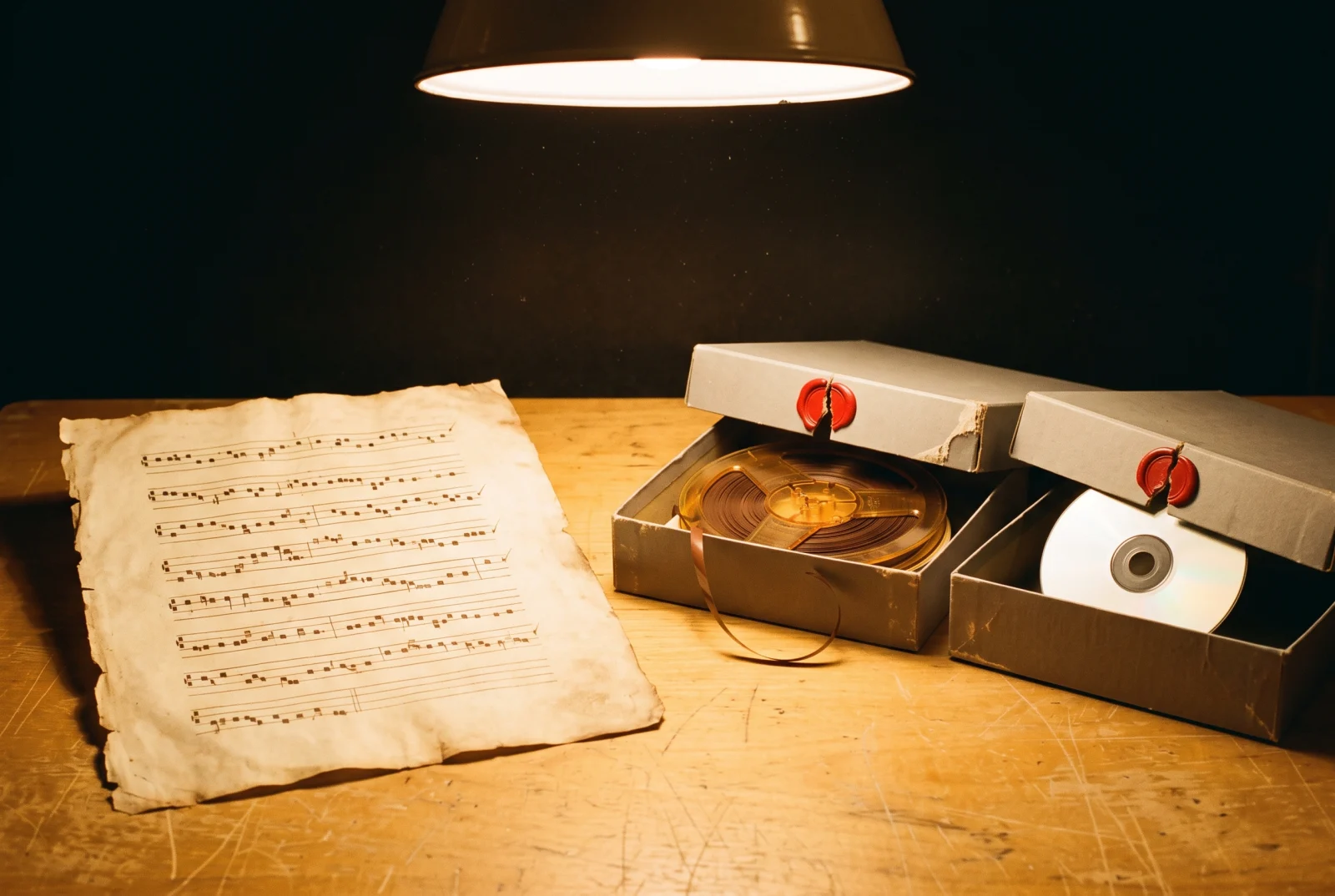
Ilustración: Rebobinados
Enigma is not a band, and the line that puts it best is not the project's own: "Enigma is not a band — it is a project undertaken by one person", reads the FAQ of The Enigma Archives, the fan archive Gavin Stok has run since 1995. The person is Mihai Crețu, Germanised as Michael Cretu, born in Bucharest on the eighteenth of May 1957. The popular account grants him one court case, the one brought by the Taiwanese singers on "Return to Innocence", who claimed their credit and ended up obtaining it. What the account does not tell is that that one was the second. The first had been settled years earlier, over the same thing and with a public apology from his record company included, so the lesson the Taiwanese case is credited with teaching him had already been taught. Cretu made the same conceptual mistake twice, three years apart, and the legal distinction that explains it fits in one sentence: the repertoire was in the public domain, the recording was not.
Bucharest, Ibiza and a Gregorian chant he had already tried
The craft came from earlier and from far away. Piano from the age of five and a half; in 1965 he entered the music lyceum in Bucharest; in 1968, five months of study in Paris; in 1975, at eighteen, he left Romania and settled in Bad Homburg, in West Germany; in 1978 he graduated in composition from the Frankfurt Academy of Music, with distinction. What came afterwards was studio work: keyboards and arrangements on productions by Frank Farian, Boney M. material included; three albums of his own, Moon, Light & Flowers in 1979, Legionäre in 1983 and Die Chinesische Mauer in 1985; the co-founding of Moti Special in 1981; his first gold award as a producer in 1980; the co-production of Mike Oldfield's Islands in 1987, and it was Oldfield, according to the project's own account, who encouraged him to set up something of his own. And, above all, the career of Sandra Ann Lauer: he produced "(I'll Never Be) Maria Magdalena" for her, her first international number one, in 1985, and ended up married to her.
Enigma's formula did not appear out of nowhere either. Cretu had already put Gregorian chant over a pop backing three years earlier, on Sandra's "Everlasting Love". Frank Peterson worked on the first album, credited as F. Gregorian, and left as soon as it was finished to found Gregorian, a project with the same recipe; and in 1992 Deep Forest would do the same with African and South American sound archives. Saying that Enigma brought together what nobody had brought together does not hold up. What does hold up is more precise and is no less of an achievement: he was the first to take that mixture to number one on a planetary scale, and the one who set its grammar.
"Sadeness (Part I)" came out on the first of October 1990, and the title is a pun almost nobody takes apart: it alludes to the Marquis de Sade, Donatien Alphonse François de Sade, and the lyric interrogates him. The idea came from Cretu and his manager, Jürgen Thürnau. The whispers in French are Sandra's. In the United Kingdom and in Australia the single was issued retitled "Sadness Part 1", because the record companies preferred the dictionary spelling. It was number one in fourteen countries —Germany, the United Kingdom, France, Austria and Sweden among them—, number five on the Billboard Hot 100 and number one on Dance Club Play in the United States, with more than five million copies sold. The album, MCMXC a.D., reached number one in Britain and number six on the Billboard 200, where it stayed for two hundred and sixty-two weeks according to Wikipedia's count: more than five years on the chart.
The Munich choir recognised its own voice
The Gregorian chant on "Sadeness" and on "Mea Culpa" was not a recording made for the album. It had been taped in Bavaria between the seventh and the ninth of January 1976, by the Capella Antiqua München choir under the direction of Konrad Ruhland, and the most recognisable track is the antiphon "Procedamus in pace!". The choir heard itself in a worldwide hit and went to court.
Here is the distinction that is worth the whole article. The choir could not sue for copyright, because the Gregorian repertoire is in the public domain: nobody owns a medieval liturgical chant. It sued under personality rights, the German Persönlichkeitsrecht, alleging that Cretu had deformed its voices, that the group felt personally offended by the misuse of its work, and demanding, as well as money, a written apology. The technical evidence was explained by BMG/Ariola's lawyer, Christian Klein: every human voice has characteristics of its own that cannot be reproduced exactly, and a frequency analysis yields a graph that is almost like a fingerprint. The public domain covered the work. It did not cover the people who had sung it, nor the owners of the tapes.
The settlement was reached out of court and became known by a curious route: Polydor's lawyer, Stefan Belfert, revealed it at a POPKOMM seminar on the twenty-fourth of August 1991, and Billboard published it on the fourteenth of September. The bulk of the money went to the choir for the damage to its personality; smaller sums went to Polydor and to BMG/Ariola for the unauthorised use of the masters. Virgin officially apologised to the original artists and licensed the tapes after the fact. There is a detail of ownership that almost nobody tells: what was sampled on "Mea Culpa" belonged to the choir, while the worldwide rights to what was used on "Sadeness" were held by BMG/Ariola, so the Gregorian chant on the album did not come from a single place. And it is worth saying exactly what that was: a settlement, not a judgment. No judge declared anybody guilty.
Over the same months the project's other hook came apart, the anonymity, which lasted weeks and not years. While journalists were attributing "Sadeness" to Mike Oldfield or to Alan Parsons, two people from Frankfurt sued Cretu's record company alleging that the idea of crossing Gregorian chant with hip hop grooves had been stolen from them. They lost, and in losing they uncovered the names of Michael Cretu and Sandra. This episode has to be told with the caution it deserves: it rests on the music press of the time and on the project's fan archive, not on a court file. Even so, Cretu went on signing as Curly M.C.
Some friends recognised it on the radio
The Cross of Changes was released on the sixth of December 1993, recorded at the A.R.T. Studios in Ibiza —studio and home at once—, with seven months of production and one million four hundred thousand advance orders. A week later, on the thirteenth of December, "Return to Innocence" came out. The song everybody remembers as the most his own is, on the inside, an assembly of other people's pieces: the first eight seconds are nothing but a traditional Taiwanese chant, which comes back across more than half the track; the male lead voice belongs to Andreas Harde, a twenty-six-year-old singer from Munich credited as Angel; and the drums are a sample of the break from Led Zeppelin's "When the Levee Breaks". What is Cretu's is the assembly, which is no small thing: number three in the United Kingdom, number four on the Hot 100 and number one in more than twelve countries.
The chant belongs to a married couple. Difang Duana, Chinese name Kuo Ying-nan, a farmer and traditional singer, and his wife Igay Duana, Kuo Hsiu-chu, of the Amis people of the Taitung region, in Taiwan. The piece is a traditional Amis composition of the palang type, "Sapiliepah a Radiw", which the various editions translate in three different ways: "Elders' Drinking Song", "Jubilant Drinking Song" and "Weeding and Paddyfield Song No. 1". Cretu sampled a CD published by a French state institution that presented the chant as anonymous; the recording came from an ethnomusicological documentation campaign in which the Kuos sang so that their culture would be put on record, not so that anybody would sell it.
What follows was said by their lawyer and is the heart of all this: the Kuos made that recording solely for purposes of cultural preservation, at no point did they give anybody permission to commercialise their song, and they did not find out what had happened until some friends recognised their voices on the record and congratulated them. Put without lawyers: an elderly couple from Taitung learned that their voices opened a worldwide hit because somebody heard them on the radio.
They sued in the United States District Court for the Central District of California. The list of defendants grew to some twenty —Cretu, Enigma, Capitol-EMI Music, Charisma Records of America, Mambo Music, Virgin Schallplatten, Sony Music Group, Virgin Records America— and among them was the International Olympic Committee. The firm that represented them, Oppenheimer Wolff & Donnelly, took the case on a contingency basis, something unusual at the firm, and its partner E. Patrick Ellisen explained why: what they saw there was the repetition, on an international scale, of what had happened in the United States in the late fifties and in the sixties, when record companies basically stole rhythm and blues songs from black artists who were sometimes impoverished and unworldly and turned them into great hits, without recognition and with minimal or no reward for the creators. He added that, when the Kuos approached Cretu and the record companies, they were told in essence that, since they are not rich or famous, there is nothing they can do to protect their rights.
The hearing was in Los Angeles on the fourth of March 1999. Capitol-EMI's lawyers maintained that the Kuos could not claim ownership of what was a traditional folk song, and that is how the substance of the matter was framed: whether an oral culture can own its repertoire. Cretu, for his part, stated that he believed the recording was in the public domain and that he had not knowingly infringed anything, which is exactly the defence that had collapsed on him in 1991. On the twenty-third of June 1999 the parties settled out of court: an undisclosed sum, credit to the Duanas on every later edition, royalties and platinum discs. With part of the money the couple set up a scholarship for Amis children. Here too there was a settlement and not a judgment.
It was not the Atlanta anthem, it was the advert
The Olympic punchline is told wrongly everywhere. "Return to Innocence" was not the anthem of the Atlanta 1996 Games. The official song was "Reach", by Gloria Estefan, co-written with Diane Warren and performed at the closing ceremony; the official theme was "Summon the Heroes", by John Williams, instrumental, with the Atlanta Symphony Orchestra; and Celine Dion sang "The Power of the Dream" at the opening. Enigma's was the music of the promotional campaign: it plays in the television advert for the Games and it went on to the commemorative CD. The press release from the Kuos' firm does write that the International Olympic Committee adopted it as the theme song, but that is plaintiff's language. And the irony is not lost by being precise, quite the opposite: the International Olympic Committee ended up in the dock as a co-defendant for using, in the campaign for a Games, a recording taken without permission from two elderly people of an indigenous community.
There is also an asymmetry worth naming. In 1991 Virgin apologised publicly. In the Amis case there is no documented public apology from Cretu: the only thing on the record is his statement that he believed the recording was in the public domain. He hardly gives interviews, he has never toured and he has never given a lengthy interview about the matter. And the credit to the two ethnographic records that appeared on the first European pressing of The Cross of Changes disappeared, according to the project's own archive, from the later reissues and from the Trilogy box.
The plaintiffs did get to have their good years. Difang released Circle of Life in 1998, produced by Dan Lacksman, the one from Deep Forest, the project Enigma was compared to for precisely the same reason; then came Across the Yellow Earth, awarded Best Ethnic Music Album at the eleventh Golden Melody Awards. Difang died on the twenty-ninth of March 2002, of septicaemia, after his health deteriorated following the bite of a venomous centipede in October 2001 and with years of diabetes behind him; the member of parliament May Chin called him a "national treasure". Igay died on the sixteenth of May of the same year, of breast cancer. Enigma, meanwhile, was going down: from the British number one of the first two albums to number twelve for Le Roi est mort, vive le Roi! in 1996 and to number one hundred and twenty-two on the Billboard 200 for The Fall of a Rebel Angel in 2016, the eighth and last to date.
What to remember
Enigma sold some seventy million records and piled up more than a hundred gold and platinum certifications with a formula that consisted, essentially, of assembling other people's recordings over a dance beat. Two of those recordings had been taken without permission, and both ended up in a lawsuit. The first, over the Gregorian chants on "Sadeness": settlement closed in August 1991, a public apology from Virgin and a retroactive licence for the tapes. The second, over the Amis chant on "Return to Innocence", a single from December 1993: settlement on the twenty-third of June 1999, with permanent credit, royalties and platinum discs for Difang and Igay Duana. Three years went by between the lesson and the repeat offence.
What is worth keeping is the legal distinction, because it is the one almost nobody makes. The Gregorian repertoire was in the public domain and the Amis chant was a traditional piece with no known author; the specific recordings, on the other hand, had an owner, and behind each one there were people with a voice of their own that could not be repeated —that was literally what a lawyer demonstrated with a frequency analysis in 1991—. German law explained it to Cretu by way of personality rights, and a federal court in California put it to him again three years later, with another people and the same problem. Neither of the two cases reached judgment: both were closed with a settlement, and out of both came the same belated recognition.
What remains, besides, is what no settlement gives back. Two elderly Amis from Taitung who had sung so that their culture would be put on record found out that their voices opened a worldwide hit because some friends heard them on the radio, and they had to go all the way to a court in Los Angeles —with the International Olympic Committee sitting among the defendants— for their names to appear on the album. When those first eight seconds of "Return to Innocence" play, before the borrowed drums and the voice from Munich come in, there is the only thing you really hear: Difang and Igay Duana singing, without knowing it, for the whole world.
Sources
Enigma is a German musical project founded in 1990 by Michael Cretu; it is not a band, but a solo project with hired collaborators. The formulation "Enigma is not a band — it is a project undertaken by one person" comes from the FAQ of The Enigma Archives (enigma-music.com), a fan site created and maintained by Gavin Stok since mid-1995 —it was called "The Official Enigma World Wide Web Site" until December 1997— and is not a statement by the project itself or by Cretu. Michael Cretu, real name Mihai Crețu and also credited as Curly M.C., was born on 18 May 1957 in Bucharest, Romania, to a Romanian father and an Austrian mother; he is alive. He studied piano from the age of 5 and a half, entered the Bucharest music lyceum in 1965, studied for 5 months in Paris in 1968, left Romania in 1975 at the age of 18 to settle in Bad Homburg (West Germany) and graduated in composition from the Frankfurt Academy of Music in 1978. Before Enigma he was a session musician and arranger for Frank Farian (Boney M. material included), released "Moon, Light & Flowers" (1979, Polygram), "Legionäre" (1983, Virgin) and "Die Chinesische Mauer" (1985, with an English-language version as "The Invisible Man"), co-founded Moti Special in 1981, won his first gold award as a producer in 1980, co-produced Mike Oldfield's "Islands" (1987) and produced Sandra, including her first international no. 1, "(I'll Never Be) Maria Magdalena" (1985). Married to Sandra Ann Lauer (b. 18 May 1962, the same day of the year as him); the wedding date differs between sources: 7 January 1988 according to Wikipedia, 7 February 1988 according to The Enigma Archives. Twin sons born in July 1995; divorce in November 2007. World Music Award 2002 for the best-selling German artist and 2 Grammy nominations, one of them for Best New Age Album for "Le Roi est mort, vive le Roi!" at the ceremony of 25 February 1998. Collaborators: Frank Peterson (samples, production and engineering on the first album only, credited as F. Gregorian; he later founded Gregorian), David Fairstein (lyrics), Sandra Cretu (vocals on the first four albums; uncredited on "MCMXC a.D."; retired from music in 1998), Andreas Harde "Angel"/"Angel X" (male lead voice on "Return to Innocence"), Jens Gad, Peter Cornelius, Louisa Stanley, Ruth-Ann Boyle, Elizabeth Houghton and Andru Donalds; manager, Jürgen Thürnau. "Sadeness (Part I)" was released on 1 October 1990 (Virgin): no. 1 in 14 countries, among them Germany, the United Kingdom, France, Austria and Sweden; no. 1 in the United Kingdom in the week of 13 January 1991, one week at the top and 12 on the chart after entering on 15 December 1990; no. 5 on the Billboard Hot 100 and no. 1 on Dance Club Play in the United States; platinum in Germany and Sweden; more than 5 million copies according to the single's entry (more than 7 million according to the album's). The title is a pun on the Marquis de Sade (Donatien Alphonse François de Sade, 1740-1814), devised by Cretu and Jürgen Thürnau; the whispers in French are Sandra's; in the United Kingdom and Australia it was issued as "Sadness Part 1". The album "MCMXC a.D." came out on 3 December 1990 in Europe according to the album's entry —Wikipedia's discography gives 10 December— and on 12 February 1991 in the United States (Charisma): no. 1 in the United Kingdom, no. 3 in Germany, no. 6 on the Billboard 200; 262 weeks on the Billboard 200 according to Wikipedia and 282 according to uDiscover Music; 4× platinum RIAA (certification of 19 May 1999), 3× platinum in the United Kingdom, 2× platinum in Germany, Australia and Switzerland; some 12 million copies worldwide by 1994. The Gregorian chant used on "Sadeness (Part I)" and "Mea Culpa" was recorded in Bavaria between 7 and 9 January 1976 by the Capella Antiqua München choir, directed by Konrad Ruhland (a detail from a letter by Thürnau and Cretu of March 1995); the most recognisable track is the antiphon "Procedamus in pace!". The source record is in dispute: Wikipedia points to "Paschale Mysterium" (dated 1976 in one entry and 1977 in another), the credits of the "Trilogy" box (1998) cite "Gregorianische Gesänge" and "Paschale Mysterium", and the FAQ of The Enigma Archives maintains that, after the legal action, it was established that the bulk came from the CD "Die Gregorianischen Gesänge" (Philips Germany, ref. 426 838-2). The Capella/Kapelle Antiqua München choir sued Michael Cretu and Virgin Germany not for copyright —the Gregorian repertoire is in the public domain— but for personality rights (Persönlichkeitsrecht), alleging deformation of its voices and demanding financial compensation and a written apology; Polydor Germany and BMG/Ariola, holders of the masters, also brought claims. BMG/Ariola's lawyer, Christian Klein, rested the evidence on frequency analysis of the human voice, comparable to a fingerprint. It was established that what was sampled on "Mea Culpa" belonged to the choir and that the worldwide rights to what was used on "Sadeness (Part I)" were held by BMG/Ariola. The out-of-court settlement —financial compensation, an official apology from Virgin and a retroactive licence for the masters— was revealed by Polydor's lawyer, Stefan Belfert, at a POPKOMM seminar on 24 August 1991, and "Billboard" published it on 14 September 1991. It was a settlement, not a judgment. Wikipedia dates that litigation to 1994, which is late and wrong. The project's anonymity lasted weeks: two private individuals from Frankfurt sued Cretu's record company alleging plagiarism of the idea of crossing Gregorian chant with hip hop grooves, lost, and the proceedings uncovered the names of Michael Cretu and Sandra; this episode is recorded only in translated music press ("Enigma — The Answer", Music Mag, January 1994) and in the archive of The Enigma Archives, with no court document. "The Cross of Changes" was released on 6 December 1993 (Virgin; Charisma in the United States), credited to "Enigma 2", recorded at the A.R.T. Studios in Ibiza with 7 months of production and 1.4 million advance orders: no. 1 in the United Kingdom (entry on 19 February 1994, 52 weeks), no. 5 in Germany, no. 9 on the Billboard 200; 2× platinum in the United States, United Kingdom, Australia and Canada; some 8 million worldwide and more than 2 million in the United States. The single "Return to Innocence" was released on 13 December 1993: no. 3 in the United Kingdom (entry on 29 January 1994, 14 weeks), no. 4 on the Billboard Hot 100, no. 2 on Modern Rock Tracks, no. 1 in Ireland, Israel, Norway, Sweden and Zimbabwe, no. 1 in more than twelve countries and gold in the United States; video directed by Julien Temple. Its male lead voice is that of Andreas Harde, from Munich, 26 at the time, credited as Angel; Sandra sings backing vocals; the first 8 seconds are nothing but the Amis chant, which comes back across more than half the track; the drums are a sample of the break from Led Zeppelin's "When the Levee Breaks", the same one Cretu had used on the "Fading Shades" remix of "Mea Culpa". The performers of the chant are Difang Duana, Chinese name Kuo Ying-nan (20 March 1921 – 29 March 2002, septicaemia after the bite of a venomous centipede in October 2001, aggravated by years of diabetes), a farmer and traditional singer, and his wife Igay Duana, Chinese name Kuo Hsiu-chu (9 August 1922 – 16 May 2002, breast cancer), of the Amis people of the Taitung region, Taiwan. The piece is a traditional Amis composition of the palang type, "Sapiliepah a Radiw", translated in three different ways depending on the edition: "Elders' Drinking Song", "Jubilant Drinking Song" and "Weeding and Paddyfield Song No. 1". The origin of the recording has conflicting versions: the dominant account places it in 1988 in Paris, at the festival of indigenous dance and music of Asia-Pacific organised by the ethnomusicologist Hsu Tsang-houei and recorded by the Maison des cultures du monde, an institution of the French ministry, published as anonymous material on the CD "Polyphonies vocales des aborigènes de Taïwan"; the press release from the Kuos' firm dates it "probably in 1978 or 1979", by Hsu Tsang-houei himself, with publication on an album of the Chinese Folk Art Foundation reissued in France years later. What is not in dispute is that the Kuos sang for purposes of cultural preservation, that they never authorised anybody to commercialise the recording and that they learned of the hit because some friends recognised their voices. Kuo Ying-nan and Kuo Hsiu-chu sued in the U.S. District Court, Central District of California; the filing dates diverge between sources, so only the year of the settlement is asserted here. Initial defendants: Michael Cretu, Enigma, Capitol-EMI Music, Charisma Records of America, Mambo Music, Virgin Schallplatten and the International Olympic Committee; the suit was expanded to 20 defendants, among them Sony Music Group and Virgin Records America, according to the firm's press release of 28 December 1998. Plaintiffs' firm: Oppenheimer Wolff & Donnelly, San Jose office, with partner E. Patrick Ellisen and associate Emil C. Chang, at the instance of the Taiwanese lawyer Huang Hsiu-lan, taking the case on a contingency basis. Hearing in Los Angeles on 4 March 1999. Out-of-court settlement announced on 23 June 1999 in a joint statement by Virgin Records and the Kuos put out over Business Wire —"Taiwanese Settle Lawsuit Claiming Their Original Composition Was Stolen; They Will Now Set Up Foundation"—, although the academic literature (Nancy Guy, "Trafficking in Taiwan Aboriginal Voices", 2002) dates it generically to July: undisclosed sum, credit to the Duanas on every later edition, royalties and platinum discs; with part of the money the couple created a scholarship for Amis children. It was a settlement, not a judgment. Capitol-EMI's lawyers maintained that the Kuos could not claim ownership of a traditional folk song; Cretu stated that he believed the recording was in the public domain and that he had not knowingly infringed any rights. The financial terms of the settlement are confidential and there are no verifiable figures for the royalty split or for earlier payments for use of the recording. "Return to Innocence" was not the anthem of the Atlanta 1996 Olympic Games: the official song was "Reach" by Gloria Estefan, co-written with Diane Warren and performed at the closing ceremony; the official theme was "Summon the Heroes" by John Williams, instrumental, with the Atlanta Symphony Orchestra; Céline Dion sang "The Power of the Dream" at the opening. "Return to Innocence" was the music of the Games' promotional campaign —it appears on Wikipedia as the "Promotional Video Theme Song" of Atlanta 1996—, played in the television advert and went on to the commemorative CD; that the IOC "adopted it as the theme song" is an assertion by the plaintiff side, and the IOC was one of the defendants. The credit to "Polyphonies vocales des aborigènes de Taïwan" and to "Mongolia Musique Vocale et Instrumentale" appears on the first European pressing of "The Cross of Changes" and not on the later reissues or on the "Trilogy" box, according to The Enigma Archives. There is no documented public apology from Cretu in the Amis case; the 1991 apology was issued by Virgin. Difang released "Circle of Life" in 1998, produced by Dan Lacksman, of Deep Forest (Rock Records; Japanese ref. RCCA-2013), and "Across the Yellow Earth" (the sources give 1999 and 2001), Best Ethnic Music Album at the 11th Golden Melody Awards; the member of parliament May Chin called Difang a "national treasure". The rest of Enigma's discography: "Le Roi est mort, vive le Roi!" (20 November 1996; no. 3 Germany, no. 12 United Kingdom, no. 25 Billboard 200, platinum in the United States), "The Screen Behind the Mirror" (14 January 2000; no. 2 Germany, no. 7 United Kingdom, no. 33 Billboard 200), the compilation "LSD: Love Sensuality Devotion — Greatest Hits" (November 2001, no. 29 United Kingdom), "Voyageur" (30 September 2003; no. 6 Germany, no. 46 United Kingdom, no. 94 United States; last album with Sandra's vocals), "A Posteriori" (22 September 2006; no. 16 Germany, no. 95 United States), "Seven Lives Many Faces" (19 September 2008; no. 15 Germany, no. 92 United States) and "The Fall of a Rebel Angel" (11 November 2016; no. 10 Germany, no. 40 United Kingdom, no. 122 United States), the eighth and last as of October 2026, with no new album announced. Enigma's total sales: some 70 million records and more than 100 gold and platinum certifications; Cretu's productions add up to some 100 million. Profile compiled for Rebobinados with fact-checking; interpretations of the meaning of the work are offered as the author's reading. No song lyrics are reproduced, for copyright reasons. Information drawn from "Billboard" (Ellie Weinert, "'Sadeness' Creator Settles Sample Suit", 14 September 1991), the Oppenheimer Wolff & Donnelly press release via Entertainment Wire (San Jose, 28 December 1998), the joint statement by Virgin Records and the Kuos via Business Wire (23 June 1999), "Music Mag" ("Enigma — The Answer", January 1994, translation by Hartmut Keller), the "Taipei Times" (30 March 2002), the FAQ and news archive of The Enigma Archives, the Official Charts Company, the RIAA, uDiscover Music, insidethegames, the project's official site and Wikipedia.
Keep rewinding
90s
disco dance
Era
The fake Latin was written by an expert witness
The pseudo-Latin lyric of "Ameno" is co-credited to Guy Protheroe, director of the English Chamber Choir, who also sings it and is a forensic musicologist: the expert witness The New York Times profiled on 11 October 2016 as the man they call when two tunes sound alike. And Era was not born in a studio: the choral piece from "Les Visiteurs" (27 January 1993) reappeared on the first album, recorded with what the film paid for.

80s
disco dance
Modern Talking
Half the duo went on at Viña del Mar
In February 1988 the Quinta Vergara announced Modern Talking, but only Thomas Anders walked onto the stage: the contract predated the 1987 break-up. And the duo was never two. The falsetto of the chorus was sung by Rolf Köhler, Michael Scholz, Detlef Wiedeke and Birger Corleis, without appearing in any credits, while Dieter Bohlen mouthed along. They sued in Berlin and collected one hundred thousand marks in 2001, but the case was about samples: no court ever ruled on who sang what.

70s
disco dance
Kraftwerk
Twenty-seven years over two seconds
In 1997 Moses Pelham took two seconds of "Metall auf Metall" for a Sabrina Setlur song. Ralf Hütter and other members of Kraftwerk sued in 1999 in their personal capacity: 27 years, Germany's Bundesverfassungsgericht, two CJEU judgements and one repealed article later, the Bundesgerichtshof ruled against them on 3 September 2026. Florian Schneider died in 2020 while still a main plaintiff. For "Planet Rock", Tommy Boy had settled at a dollar a copy.
Rewind with us
Comments · 0
No one has commented yet. Open the conversation.