
Decade 70s · Rhythm disco dance
Kraftwerk
Twenty-seven years over two seconds
By Rebobinados · Published on October 7, 2026
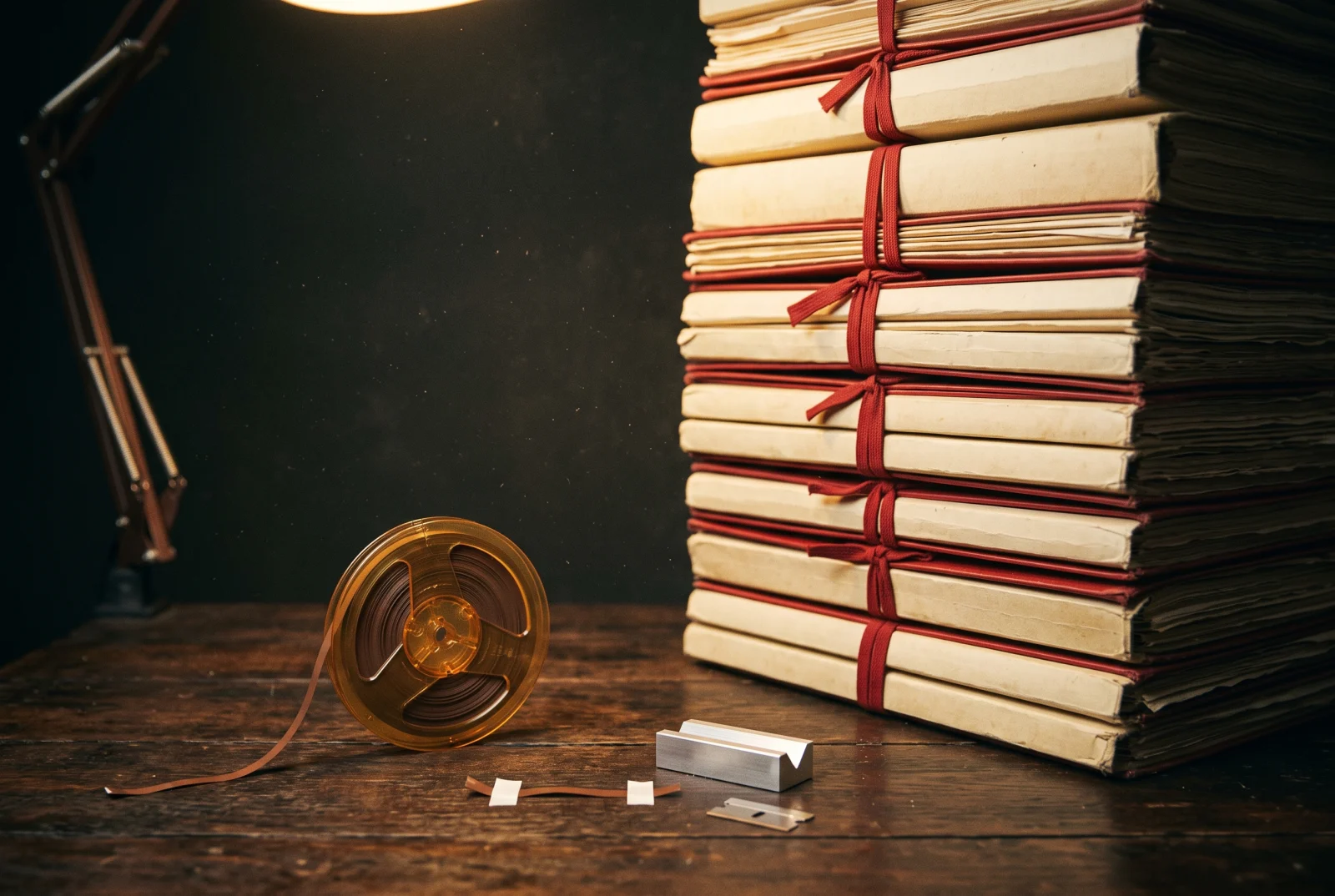
Ilustración: Rebobinados
The group from whose music half of sampling culture was born spent twenty-seven years in court over two seconds of sound, and lost. In 1997 the producer Moses Pelham took a two-second rhythmic loop from "Metall auf Metall", slowed it down a little, set it spinning and laid it underneath "Nur mir", by the German rapper Sabrina Setlur; before the court he stated that he had found the sequence in his sound archive. Ralf Hütter and other members of Kraftwerk sued him in 1999, not as a band but in their personal capacity, as phonogram producers. The case passed through the Bundesverfassungsgericht, Germany's constitutional court, twice through the Court of Justice of the European Union, forced along the way the repeal of an entire article of the German copyright act, and ended on the third of September 2026, when the Bundesgerichtshof, Germany's federal supreme court, ruled that those two seconds were lawful as pastiche.
There were two, and they came from another group
It is worth beginning at the end, because the beginning is told crooked as well. Kraftwerk was not founded by four Germans at the start of the seventies: it was founded by two, in 1970, in Düsseldorf. Ralf Hütter, born in Krefeld on the twentieth of August 1946, on keyboards and voice, and Florian Schneider-Esleben, born in Öhningen on the seventh of April 1947, on electronically treated flute. They had met in 1968 as students, first at the Remscheid Academy and then at the Robert Schumann Hochschule in Düsseldorf, and by the time they settled on the new name they had already released an album together with a third man: Tone Float, the only album by Organisation —full name, Organisation zur Verwirklichung gemeinsamer Musikkonzepte—, produced by Konrad "Conny" Plank for RCA Victor. The date wobbles: Wikipedia places it in June 1970 and the Recording Academy itself in 1969. Their last performance under that name was in April 1970.
The quartet everyone remembers is not from the start of the decade either. Between 1970 and 1974 Kraftwerk was a revolving door through which at least eleven different musicians passed: four drummers in 1970 alone, plus Klaus Dinger and Michael Rother, who left to found Neu!, the bassist Eberhard Kranemann, the guitarist Houschäng Nejadépour and the painter Emil Schult, who would end up as the house lyricist and visual author without ever being a musician in the group. Wolfgang Flür joined on electronic percussion in 1973; Karlheinz "Karl" Bartos arrived in February 1975 to replace Klaus Röder, the guitarist who still plays on Autobahn. Only then, in 1975, did the four of them exist.
Autobahn was the fourth album, not the first: before it come Kraftwerk (1970), Kraftwerk 2 (1972) and Ralf und Florian (1973). It came out in November 1974 on Philips, with a title track of almost twenty-three minutes —twenty-two minutes and forty-seven seconds according to the album's entry, forty-three according to the song's— and in Germany it went largely unnoticed. What set it off was a Chicago radio station that played the import single. In February 1975 an edit of three minutes and twenty-eight seconds was released for radio; it reached number twenty-five on the Billboard Hot 100 and eleven in Britain, and the album reached number five on the Billboard 200 on the third of May 1975, with twenty-two weeks on the chart, and four in the United Kingdom. Rolling Stone and the Village Voice reviewed it badly: they said it was inferior to what Wendy Carlos and Mike Oldfield were doing.
Four thousand marks a face
The first to understand what that was about were two Englishmen living in Germany. David Bowie adopted the group's language on Low and "Heroes", translated their self-definition —industrielle Volksmusik— as "the folk music of the factories" and titled "V-2 Schneider" after Florian, an instrumental released on the twenty-third of September 1977. Earlier, in 1976, he had offered them the opening slot on his Station to Station tour, and Kraftwerk declined. The lyrics of "Trans-Europe Express" name him and Iggy Pop, and from those encounters comes the best domestic detail in the group's whole history: Iggy said in a documentary that he and Schneider went off together to buy asparagus.
The mannequins, on the other hand, were not a metaphor: they were an industrial commission. In late 1977 the group travelled by train to Munich, to the Obermaier mannequin factory, where each of them was photographed, their faces were modelled in plasticine and the heads were cast in plastic. They cost four thousand marks each.
They were unveiled at the press conference presenting Die Mensch-Maschine / The Man-Machine, released on the twenty-eighth of April 1978, held in Paris: the four dummies with the faces of the four musicians, electronics at brutal volume, red light and free vodka. The evening ended with the journalists arranging the mannequins in compromising positions. It is from that album, and no other, that "The Robots" and "The Model" come; the one usually confused with it is Computerwelt / Computer World, from the eleventh of May 1981, which is where "Computer Love" is. The lyrics of "The Model" are credited to Hütter, Bartos and Emil Schult, the graphic artist, who wrote them while in love with a model; according to the ox-fanzine interview cited by Wikipedia, he had also composed music for it, too guitar-driven for the group's concept, which Bartos and Hütter rewrote.
And from there comes the fact almost nobody gets right: Kraftwerk's British number one is a double A-side single pairing a song from 1978 with another from 1981. EMI released "Computer Love" in the United Kingdom on the twenty-ninth of June 1981 with "The Model" as the B-side; it entered the chart on the eleventh of July at number sixty, stalled at thirty-six and fell away. But the radio stations were playing the B-side, so on the seventh of December 1981 the label reissued the record, turning it into a double A-side, "The Model"/"Computer Love". It re-entered on the twenty-sixth of December at fifty and climbed to number one on the chart of the sixth of February 1982. A single week: it was knocked off by "Town Called Malice" by The Jam, which entered straight at number one. By the time it reached the top it had accumulated fifteen weeks on the chart across its two runs and was seven weeks into the re-entry. The pull-through was complete: The Man-Machine, which in 1978 had got no higher than fifty-three, climbed to number nine on the albums chart, Trans-Europe Express entered on that same sixth of February at forty-nine, and a remix of "Showroom Dummies" reached twenty-five on the twentieth of February.
A dollar for every copy sold
What early hip-hop did with Kraftwerk was not sampling them to the bone either, and the man who denies it is Afrika Bambaataa himself. "Planet Rock", the founding record, produced by Arthur Baker and released by Tommy Boy in 1982, does not carry a Kraftwerk sample: John Robie reinterpreted the melody by hand on a Micromoog and a Prophet-5. "A lot of people think we sampled Kraftwerk but it's just not true", said Bambaataa; "John Robie was a bad-ass synthesizer player, so he was just good in playing stuff, that it sounded like they sampled the record". The right verb is interpolate, or recreate.
The rest of the session is just as handmade. The group did not have a Roland TR-808, so they found one advertised in The Village Voice: man with drum machine, twenty dollars a session. They played the fellow, whose name was Joe, Kraftwerk's "Numbers" and asked him to reprogram that pattern on the 808, along with the one from "Super Sporm" by Captain Sky; the second was Bambaataa's idea, precisely because he was worried people would think they were copying Kraftwerk.
That modesty held right to the end. The group was nervous about how Kraftwerk would react and had developed a melodic line of its own so as not to use the German one. It was Tom Silverman, the head of Tommy Boy, who stepped in and insisted they use the melody from "Trans-Europe Express" against the musicians' judgement; the discarded melody ended up on "Play At Your Own Risk", by Planet Patrol, recorded on the same tape. Nobody asked anybody for permission. When Kraftwerk found out, they approached the label, and Silverman agreed to pay them a dollar for every copy sold, raising the price of the single to cover it. There was no lawsuit, there was a deal.
And it sold. "Planet Rock" went gold in the United States, the first for the group and for the label, reached number forty-eight on the Hot 100, four on Hot Soul Singles and three on Dance/Disco, and founded an entire genre, electro. Robert Palmer called it in The New York Times, in 1983, "perhaps the most influential black pop record of 1982". The rappers, meanwhile, detested the track: Baker said it was not that they hated it, they despised it, and Mr. Biggs refused to rap over it.
Detroit calls for the same caution. Juan Atkins, who sampled "Hall of Mirrors" and "Numbers" on Cybotron's "Clear" in 1983, plays the story down in the first person: "A lot of people thought that I listened to Kraftwerk and then started doing what I was doing, but it was basically parallel", though he does admit the influence was there on "Alleys of Your Mind". The contrast that matters comes later: when Coldplay wanted to use a fragment of "Computer Love" on "Talk", in 2005, Chris Martin wrote to the group to ask permission and got it. With Tommy Boy it was settled for a dollar a copy. Moses Pelham they pursued for twenty-seven years.
Twenty-seven years in the courts
The suit was filed before the Landgericht in Hamburg, the city's regional court, in 1999, under case number 308 O 90/99, invoking articles 85 and 97 of the German copyright act: the rights of the phonogram producer, not those of the composer. That explains who appears as plaintiffs. It is not "Kraftwerk" as a brand: it is Hütter and other members of the group, in their personal capacity, seeking an injunction and damages.
At first they won. On the eighth of October 2004 the Hamburg court ruled in their favour and on the seventh of June 2006 the higher court dismissed the defendants' appeal. On the twentieth of November 2008 the Bundesgerichtshof set that judgement aside for defective reasoning and sent the matter back —it was not a win for Pelham on the merits, though some European headline told it that way—, the Hamburg court ruled for Kraftwerk again in 2011 and the Bundesgerichtshof confirmed it in December 2012. The first real defeat came on the thirty-first of May 2016, when the Bundesverfassungsgericht, Germany's constitutional court, overturned the ruling in the name of artistic freedom, expressly recognising the role of sampling in hip-hop culture.
In the meantime, the group had broken apart. Florian Schneider left Kraftwerk in November 2008, twelve years before he died; his last performance with the group had been in November 2006, in Spain, he did not take part in the 2008 world tour and he was replaced on stage by Stefan Pfaffe, the video technician. The news was made public on the sixth of January 2009, and that same year Hütter said in The Guardian that Schneider had not really been involved in the group for a great many years and that they were not in touch. He did remain, however, one of the main plaintiffs. He died on the twenty-first of April 2020, in Düsseldorf, at seventy-three, of cancer, with the case still open; the death became known on the sixth of May and the press of that day gave conflicting versions of the exact day. His daughter Claudia confirmed it on Instagram on the eighth of May.
On the twenty-ninth of July 2019, in between, the Court of Justice of the European Union had handed down the judgement that every headline called a Kraftwerk victory: a sample, however brief, is a reproduction and needs a licence, unless it is used modified and unrecognisable to the ear. In the same decision it declared article 24 of the German act, the one on "free use", incompatible with the European directive, and Germany repealed it in the 2021 reform, which introduced in its place the harmonised limitations, among them that of pastiche. It was that new exception that finished the case off. The Hamburg court held in April 2022 that in 1997 there had been no infringement, that between 2002 and 2021 there had been, and that from 2021 the use was lawful; on the fourteenth of April 2026 the Court of Justice defined pastiche as the work that evokes another, existing one while showing clear differences and entering into a recognisable artistic dialogue, and on the third of September 2026 the Bundesgerichtshof dismissed the plaintiffs' appeal. It is not the longest sampling case in history —nobody has measured that—, but it is the longest and most influential in Europe and the one that settled European doctrine on the matter.
What to remember
Kraftwerk were two before they were four, the classic quartet lasted fifteen years and of the four inducted into the Rock and Roll Hall of Fame in 2021 —Bartos, Flür, Hütter and Schneider— only one has died. Their British number one is a single from 1981 reissued as a double A-side so that a song from 1978 could win. Their most influential record in hip-hop does not contain a second of their music: it contains a melody of theirs played by hand by someone else, imposed by the head of the label against the judgement of the musicians themselves.
And the final irony is documented down to the case number. The group whose music set sampling culture in motion pursued two seconds of sound for twenty-seven years, reached its country's constitutional court and twice the European court, forced along the way a change in German law that ended up repealing the very article it was relying on, and lost six years after the death of one of the two men who signed the complaint. When that metallic loop from "Metall auf Metall" plays, there it is: two seconds that cost a quarter of a century of courtrooms and that, with Tommy Boy, would have been settled for a dollar.
Sources
Kraftwerk is a German electronic music group founded in Düsseldorf in 1970 by Ralf Hütter (b. 20 August 1946, Krefeld) and Florian Schneider-Esleben (b. 7 April 1947, Öhningen), who met in 1968 as students at the Remscheid Academy and the Robert Schumann Hochschule in Düsseldorf. They had previously released "Tone Float" as Organisation (Organisation zur Verwirklichung gemeinsamer Musikkonzepte), produced by Konrad "Conny" Plank for RCA Victor: Wikipedia dates the album to June 1970 and grammy.com to 1969. Between 1970 and 1974 at least 11 musicians passed through the group, among them Klaus Dinger and Michael Rother, later Neu!, and Klaus Röder, who plays on "Autobahn". Wolfgang Flür joined in 1973 and Karl Bartos (b. 31 May 1952, Marktschellenberg) in February 1975, completing the classic quartet. Flür is alive (he released "Times" in 2025) and so is Bartos (memoir on Omnibus Press, 2022). "Autobahn" (Philips, November 1974; the discography gives 1 November; Vertigo in the US, January 1975) was the fourth album; the title track runs 22:47 according to the album article and 22:43 according to the song's. The single (February 1975) is a 3:28 edit, with a British edition of 3:06: no. 25 Billboard Hot 100, no. 11 United Kingdom, no. 9 Germany. The album reached no. 5 on the Billboard 200 on 3 May 1975, with 22 weeks on the chart, and no. 4 in Britain. It was driven by a Chicago radio station that played the import single; "Rolling Stone" and "Village Voice" reviewed it negatively in 1975. David Bowie released "V-2 Schneider" on 23 September 1977 on "Heroes" and had offered Kraftwerk the opening slot on his "Station to Station" tour in 1976; the group declined (Richard Witts, "Kraftwerk: Music Non-Stop", Continuum, 2012). "Trans-Europe Express" was released in March 1977 (Kling Klang/EMI/Capitol) and includes "Metall auf Metall" (2:11). In late 1977 the Obermaier firm, of Munich, made the group's mannequins, modelling their faces in plasticine, at 4,000 marks each; they were unveiled at the press conference presenting "Die Mensch-Maschine / The Man-Machine" (28 April 1978) held in Paris. "The Robots" (6:10) and "The Model / Das Model" (3:38) belong to that album; "Computer Love" (7:15) is from "Computerwelt / Computer World" (11 May 1981). "The Model" is credited to Hütter, Bartos and Emil Schult. EMI released "Computer Love" in the United Kingdom on 29 June 1981 with "The Model" as the B-side: it entered on 11 July at no. 60 and stalled at no. 36. The reissue as a double A-side of 7 December 1981 re-entered on 26 December at no. 50 and reached no. 1 on the chart of 6 February 1982, for one week, with 15 weeks accumulated across the two runs and 21 in total (Official Charts, EMI 5207; BPI gold). It was displaced by "Town Called Malice" by The Jam. "The Man-Machine" climbed to no. 9 in Britain in February 1982 (no. 53 in 1978), "Trans-Europe Express" entered on 6 February at no. 49 and the remix of "Showroom Dummies" reached no. 25 on 20 February. "Planet Rock", by Afrika Bambaataa & the Soul Sonic Force, produced by Arthur Baker and released by Tommy Boy in 1982 (TB 823, 6:25), contains no Kraftwerk samples: John Robie reinterpreted the melody on a Micromoog and a Prophet-5, and the pattern from "Numbers" was reprogrammed on a Roland TR-808 hired through an advertisement in "The Village Voice" at 20 dollars a session, along with the one from "Super Sporm" by Captain Sky. Tom Silverman, of Tommy Boy, imposed the use of the melody from "Trans-Europe Express"; the discarded melody went to "Play At Your Own Risk" by Planet Patrol. There was no prior permission and no lawsuit: Silverman agreed to pay Kraftwerk one dollar for every copy sold and raised the price of the single. "Planet Rock" went gold in the US, no. 48 Hot 100, no. 4 Hot Soul Singles, no. 3 Dance/Disco and no. 53 United Kingdom; Robert Palmer called it in "The New York Times" (1983) "perhaps the most influential black pop record of 1982". Juan Atkins sampled "Hall of Mirrors" and "Numbers" on Cybotron's "Clear" (1983) and has stated that his work was "basically parallel" to Kraftwerk's. Coldplay asked permission before using "Computer Love" on "Talk" (2005). The "Metall auf Metall" litigation: in 1997 Moses Pelham used a 2-second loop on "Nur mir", by Sabrina Setlur; Ralf Hütter and other members of Kraftwerk sued in 1999 in their personal capacity, as phonogram producers, before the Landgericht Hamburg (308 O 90/99), invoking §§85 and 97 UrhG. Judgements: LG Hamburg 8 October 2004 (for Kraftwerk); OLG Hamburg 7 June 2006 (5 U 48/05); BGH 20 November 2008 (I ZR 112/06, set aside for defective reasoning and remitted); OLG Hamburg August 2011; BGH December 2012 (I ZR 182/11); Bundesverfassungsgericht 31 May 2016 (1 BvR 1585/13, set aside in the name of artistic freedom); CJEU 29 July 2019 (C-476/17, opinion of Advocate General Szpunar of 12 December 2018, declaring §24 UrhG incompatible with Directive 2001/29/EC); BGH 30 April 2020 (I ZR 115/16); OLG Hamburg 28 April 2022 (no infringement in 1997 —final—, infringement between 22 December 2002 and 6 June 2021, and lawful use from 2021); BGH 14 September 2023 (fresh referral, C-590/23); opinion of Advocate General Emiliou of 17 June 2025; CJEU 14 April 2026 (definition of pastiche); BGH 3 September 2026 (I ZR 74/22, press release no. 162/2026: the sampling is lawful as pastiche, §51a UrhG; the plaintiffs' appeal is dismissed). The German copyright reform of 2021 repealed §24, citing this litigation in its explanatory memorandum; a second constitutional complaint, 1 BvR 948/23, remains pending. Florian Schneider left Kraftwerk in November 2008 —his last performance with the group was in November 2006, in Spain, and he was replaced on stage by the video technician Stefan Pfaffe—, and the departure was made public on 6 January 2009. He died on 21 April 2020 in Düsseldorf, aged 73, of cancer, according to a statement issued by Sony Music citing Ralf Hütter; the news was published on 6 May 2020 and his daughter Claudia confirmed it on Instagram on 8 May. The type of cancer is not documented, and some sources from those days pointed to late April rather than the 21st. Other data: Grammy Lifetime Achievement Award in 2014 (honorary award, announced on 14 January 2014); competitive Grammy for Best Dance/Electronic Album for "3-D The Catalogue" on 28 January 2018; "Tour de France Soundtracks" (4 August 2003) was no. 1 in Germany and is the last studio album and the last with Schneider; Rock and Roll Hall of Fame in 2021 in the Early Influence category, with Bartos, Flür, Hütter and Schneider —the latter posthumously—, presented by Pharrell Williams, after six previous nominations as Performer. Profile compiled for Rebobinados with fact-checking; interpretations of the meaning of the work are offered as the author's reading. No song lyrics are reproduced, for copyright reasons. Information drawn from Official Charts, the Bundesgerichtshof press release no. 162/2026, the rulings of the Landgericht and the Oberlandesgericht in Hamburg, the Bundesverfassungsgericht and the Court of Justice of the European Union, the Recording Academy, the Rock and Roll Hall of Fame, Tate, The Guardian, BBC News, Rolling Stone, Der Spiegel, FAZ, WDR, Billboard, Resident Advisor, Electronic Sound, WDET and Wikipedia in English and German.
Keep rewinding
90s
disco dance
Era
The fake Latin was written by an expert witness
The pseudo-Latin lyric of "Ameno" is co-credited to Guy Protheroe, director of the English Chamber Choir, who also sings it and is a forensic musicologist: the expert witness The New York Times profiled on 11 October 2016 as the man they call when two tunes sound alike. And Era was not born in a studio: the choral piece from "Les Visiteurs" (27 January 1993) reappeared on the first album, recorded with what the film paid for.
90s
disco dance
Enigma
The same mistake twice
The Munich choir's suit over the Gregorian chants on "Sadeness" was closed with a settlement in August 1991, a public apology from Virgin included. "Return to Innocence" came out in December 1993 with the chant of an Amis couple from Taitung recorded solely for cultural preservation: Difang and Igay Duana found out because some friends heard their voices on the radio, sued in California with the International Olympic Committee among the defendants and settled in July 1999.
80s
disco dance
Modern Talking
Half the duo went on at Viña del Mar
In February 1988 the Quinta Vergara announced Modern Talking, but only Thomas Anders walked onto the stage: the contract predated the 1987 break-up. And the duo was never two. The falsetto of the chorus was sung by Rolf Köhler, Michael Scholz, Detlef Wiedeke and Birger Corleis, without appearing in any credits, while Dieter Bohlen mouthed along. They sued in Berlin and collected one hundred thousand marks in 2001, but the case was about samples: no court ever ruled on who sang what.
Rewind with us
Comments · 0
No one has commented yet. Open the conversation.