
Gloria Estefan
She danced again
By Rebobinados · Published on September 27, 2026
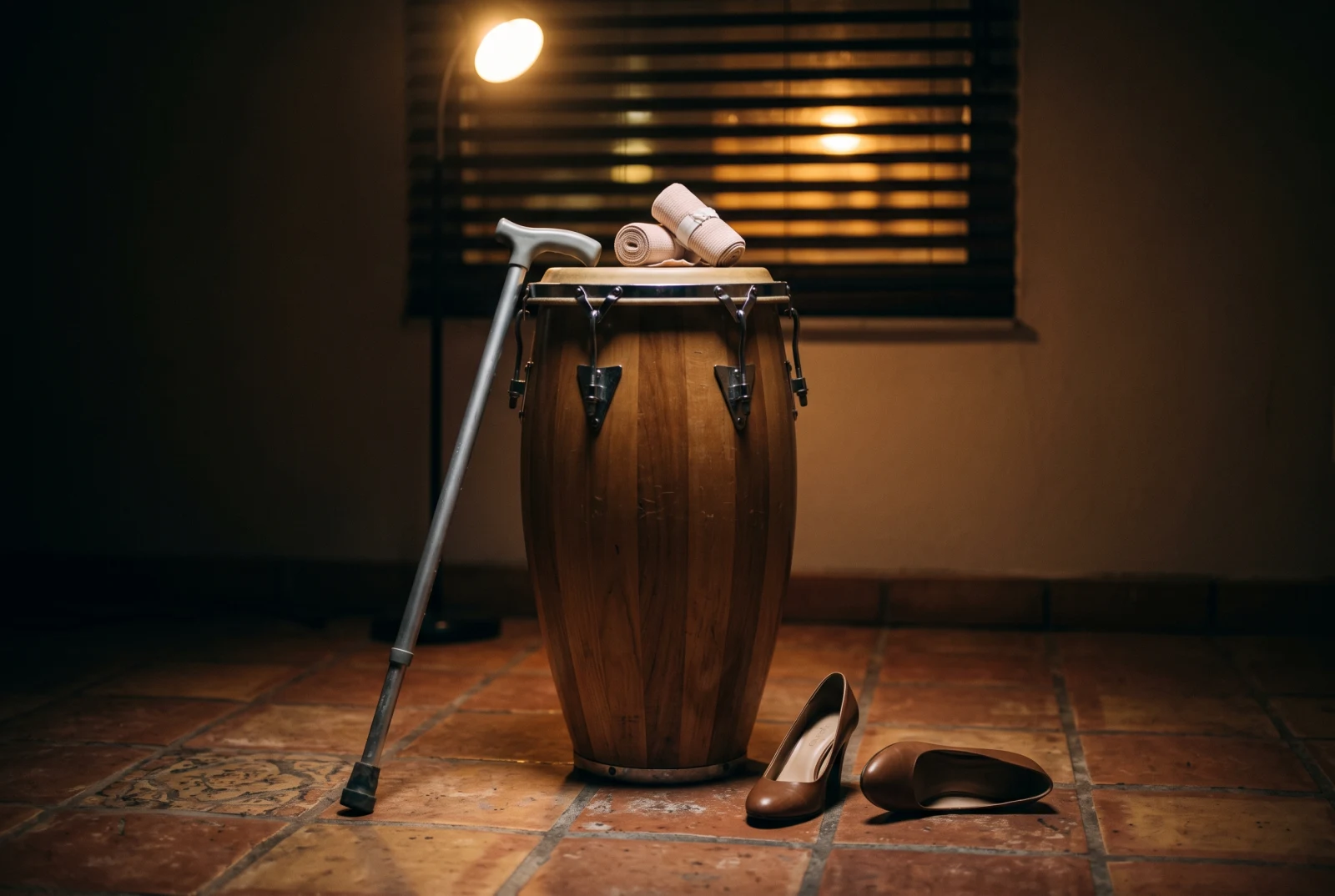
Ilustración: Rebobinados
The bus did not crash. It was standing still. On 20 March 1990, at around ten past twelve in the day, on Interstate 380 near Tobyhanna, Pennsylvania, the vehicle Gloria Estefan was travelling in had been stopped in traffic for a while because of an earlier accident. It was snowing. She was asleep in a bunk. A tractor-trailer coming up behind rammed it and pushed it into another truck. The distinction looks like a detail and it isn't: almost every version of this story starts out wrong, and ends up telling a miracle where there was a fracture, an operation and ten months of work.
The house before the music
Gloria María Milagrosa Fajardo was born in Havana on 1 September 1957 and arrived in Miami as a child with her family. Her father, José Fajardo, had been a bodyguard to Fulgencio Batista's wife. In April 1961 he took part in the Bay of Pigs landing — April 1961, not 1962, as several sources date it — and was imprisoned for almost two years, until the exchange of December 1962.
He later fought in Vietnam, and on his return developed multiple sclerosis attributed to exposure to Agent Orange. He died in 1980. For much of her adolescence, Gloria was his carer. That is the background everything else comes out of, and it says more than any adjective about her character.
The group that changed its name when she joined
In 1975 she joined the Miami Latin Boys, Emilio Estefan's group, whom she would go on to marry. And here is a fact that is almost always erased: the group renamed itself Miami Sound Machine precisely when she joined. It was not that she was hired into an already famous band; it was that the band came to be called something else because it now had a singer.
"Conga", from 1985, is the moment that becomes visible to the rest of the planet. On the Hot 100 it only reached number ten, a modest figure for a song everyone knows. What matters is on another chart, or rather on four: it was the first single in history to enter Billboard's pop, dance, R&B and Latin charts simultaneously. That is the thesis of her career, measured by Billboard. After it came "Rhythm Is Gonna Get You", "1-2-3", "Words Get in the Way", and two American number ones before the accident: "Anything for You", in 1988, and "Don't Wanna Lose You", in 1989. The name Miami Sound Machine, moreover, had already been retired in 1989, before the accident.
What the doctors said, and what she told
The fracture was of a vertebra at the thoracolumbar junction, with subluxation. The spinal cord was not severed. She was operated on on 22 March in a four-hour surgery and two rods were fitted, plus screws and hooks; on the material there are sources that say steel and sources that say titanium, so it is better not to assert it.
Here is the correction that changes the story most. The line that gets repeated — "the doctors weren't sure she would walk again" — was not said by the doctors. Before operating they stated that her chances were excellent and that paralysis would be extremely rare. The surgeon Michael Neuwirth predicted a full recovery in three to six months and said she would be able to do everything, including dance. The business about the edge of the wheelchair is a later account by Estefan herself, told by her over the years, and that is how it has to be attributed: Estefan has said that she feared she would not walk again. That is a different thing from a medical prognosis, and treating it as if it were the same turns a piece of rehabilitation work into a supernatural intervention.
She came back in January 1991, at the American Music Awards, and on 1 March of that year she played her first concert at the Miami Arena. Less than a year after the blow, within the timeframe her surgeon had estimated. It is no less impressive for having been predictable: the painful part she did all the same.
What to remember
"Coming Out of the Dark" was number one on 30 March 1991, and this too is worth stating precisely: it was her third American number one, not the first. She co-wrote it with Emilio Estefan and Jon Secada. That a song about coming out of the dark should reach the summit right afterwards is a beautiful coincidence, but the career had already been built before the bus, and that is precisely the reason she was able to return to it.
What Gloria Estefan really did is in the four charts of "Conga" and in a group that changed its name to make room for her. She opened up a market that until then treated Latin music as a separate category, she did it in two languages and she went on afterwards with albums entirely in Spanish, starting with Mi Tierra, which gave her her first Grammy in 1994. Her story is not that of a woman saved by a miracle. It is that of a daughter who looked after her father, a singer who gave a band its name and a patient who did the whole course of rehabilitation.
Sources
Gloria Estefan, born Gloria María Milagrosa Fajardo on 1 September 1957 in Havana, emigrated to Miami as a child. Her father, José Fajardo (1933-1980), was a bodyguard to Fulgencio Batista's wife, took part in the Bay of Pigs invasion in April 1961 and remained imprisoned for almost two years until the prisoner exchange of December 1962; he subsequently fought in Vietnam and developed multiple sclerosis attributed to exposure to Agent Orange, during which his teenage daughter was his carer. In 1975 Gloria joined the Miami Latin Boys, Emilio Estefan's group, whom she married; the group adopted the name Miami Sound Machine as a result of her joining. "Conga" (1985) reached number ten on the Billboard Hot 100 and was the first single to appear simultaneously on Billboard's pop, dance, R&B and Latin charts. "Anything for You" (1988) and "Don't Wanna Lose You" (1989) reached number one on the Hot 100. The name Miami Sound Machine stopped being used in 1989. On 20 March 1990, at around 12:10, the tour bus was stopped on Interstate 380 near Tobyhanna, Pennsylvania, because of an earlier accident, when it was rammed from behind by a tractor-trailer that pushed it into another heavy vehicle, with snow on the road. She suffered the fracture of a vertebra at the thoracolumbar junction, with subluxation, without severing of the spinal cord. She was operated on on 22 March in a four-hour procedure in which two rods were implanted, along with screws and hooks; sources differ on the material used. Before the surgery the doctors described her chances as excellent and described eventual paralysis as extremely rare; the surgeon Michael Neuwirth predicted a full recovery within three to six months and stated that the patient would be able to do everything, including dance. The accounts of her fear of not walking again come from later statements by Estefan herself. She reappeared publicly at the American Music Awards in January 1991 and gave her first concert on 1 March 1991 at the Miami Arena. "Coming Out of the Dark", co-written with Emilio Estefan and Jon Secada, reached number one on the Hot 100 on 30 March 1991 and was her third number one on that chart. She won her first Grammy award in 1994 for the album "Mi Tierra". Profile compiled for Rebobinados with fact-checking; interpretations of the meaning of the work are offered as the author's reading. No song lyrics are reproduced, for copyright reasons. Information drawn from Billboard, Associated Press, Los Angeles Times, People, Wikipedia and other coverage.
Keep rewinding

10s
pop
Bruno Mars
Eleven names in the credits
"Uptown Funk" came out on 10 November 2014 with six writers and today it has eleven. In February 2015 The Gap Band's publisher filed a claim over "Oops Up Side Your Head" in YouTube's copyright system —there was never a lawsuit— and on 28 April five names were added, with 17 % of the publishing. It happened weeks after the "Blurred Lines" verdict, and the song had been fourteen weeks at number one.

00s
pop
André Rieu
It was not from the jazz suite
The waltz with which André Rieu reached half the world is not from Shostakovich's Suite for Jazz Orchestra No. 2: it is from the Suite for Variety Orchestra, which the composer did not assemble, and it was born in 1956 as music for a Soviet film about settlers in Kazakhstan. The error comes from a misprint in volume 10 of the complete works (Muzyka, Moscow, 1984), corrected only in 2001. And the title "The Second Waltz" was invented by his wife, because the real one did not sell.

90s
pop
Daniela Mercury
She took the neighbourhood out of the song
"O Canto da Cidade" was written by Tote Gira, a composer from Nordeste de Amaralina who recorded the demo on a borrowed cassette, marking the beat on the door of a refrigerator; Mercury's team almost threw the tape away. She shares the credit because she deleted the references to the Pelourinho so that the song would serve all of Brazil. The album, from 20 September 1992, sold more than 2 million copies and nationalised axé. But she did not invent it: the name was a journalist's insult in 1987.
Rewind with us
Comments · 0
No one has commented yet. Open the conversation.