
Eagles
The door that opens
By Rebobinados · Published on September 7, 2026
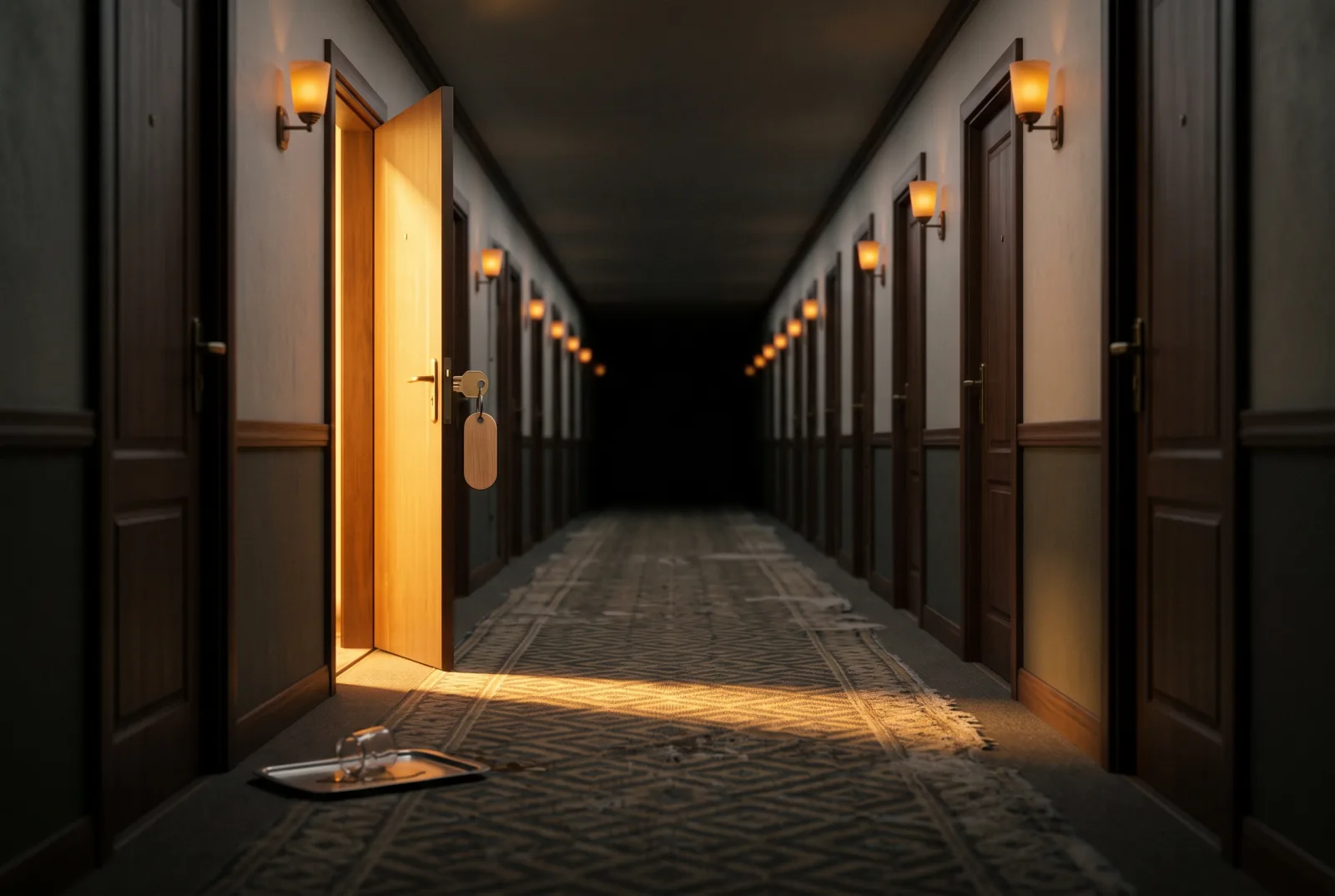
Ilustración: Rebobinados
The Eagles built their fame singing the Californian paradise: the sun, the road, the girls, the easy life.
And then they wrote their masterpiece about the other side of that paradise.
A song everybody knows and almost nobody quite understands
"Hotel California" tells, on the surface, something simple. A tired traveller stops at a roadside hotel, beautiful and seductive. He is received with luxury and with a party.
And little by little something goes wrong. The paradise turns out to be a trap: a place you can check out of whenever you like, but that you never manage to leave.
The album came out on 8 December 1976. The song as a single, on 22 February 1977, and it reached number one in May. It won the Grammy for record of the year.
The music is Don Felder's; the lyrics are Don Henley's and Glenn Frey's. Worth stating, because Felder's credit tends to get lost, and because it matters later.
What the band explained and what it did not
It is often said that the Eagles have never explained the song and that this is why it is eternal. That is only half true.
Henley has been fairly explicit about the general subject, and he has repeated it for decades: it is a song about the dark side of the American dream and about excess. He has also described it as a journey from innocence to experience, and he has flatly rejected the satanic readings and the idea that it is about a real hotel.
What he has deliberately kept in shadow are the specific lines. About one of the most debated of them he said it has nothing to do with alcoholic drinks, that it is a sociopolitical statement, and that it can have a million interpretations.
In other words: they explained the subject, not the symbols. And there lies the difference. Knowing what a song is about and not knowing what each line means is exactly the recipe for every generation to find something new in it.
Frey put it another way: they decided to do something strange, just to see if they could.
The night in Long Beach
The band broke up in 1980, and not in the abstract.
On 31 July that year, in Long Beach, California, Glenn Frey and Don Felder spent the entire concert threatening each other between songs. It is known as the "long night at Wrong Beach".
It usually gets told as a legend. It is not: it is documented.
Asked whether they would ever play together again, Don Henley said they would when hell froze over.
They came back in 1994, fourteen years later. They called the album and the tour "Hell Freezes Over".
The numbers, with their qualification
Their greatest-hits record, "Their Greatest Hits (1971-1975)", is the best-selling album in American history according to industry certification, ahead of "Thriller".
Worldwide, on the other hand, "Thriller" rules. Both things are true, and it is worth saying which is which.
Glenn Frey died on 18 January 2016. Randy Meisner, the founding bassist, in July 2023. The band is still active, with a farewell tour scheduled through 2026.
What to remember
The Eagles are the proof that the best songs about a place are written by whoever knows it too well.
Put on "Hotel California" and listen to the ending: that guitar duel between Joe Walsh and Don Felder that is still being studied note by note, forty years on.
But listen as well to what is being told. This is a band that sold millions singing the California dream, saying the dream was a room you cannot get out of.
Remember them like this: not as the kings of sunlit rock, but as the ones who, at the summit of that dream, had the clear-sightedness to tell what lay underneath.
Sources
Eagles, band formed in Los Angeles in 1971 by Glenn Frey, Don Henley, Bernie Leadon and Randy Meisner; Don Felder joined in 1974 and Joe Walsh in 1975. The album "Hotel California" was released on 8 December 1976; the title track was issued as a single on 22 February 1977, reached number one on the Billboard Hot 100 in May of that year and won the Grammy for record of the year in 1978. The music is by Don Felder and the lyrics by Don Henley and Glenn Frey. It should be made clear that the band has indeed explained the general subject of the song: Henley has repeatedly described it as a work about the dark side of the American dream and about excess, and as a journey from innocence to experience, rejecting the satanic interpretations and the existence of a real hotel; what he has deliberately left open is the meaning of specific lines. The band broke up in 1980 after the concert of 31 July in Long Beach, California, during which Glenn Frey and Don Felder exchanged threats between songs, an episode known as the "Long Night at Wrong Beach". Asked about a possible reunion, Don Henley answered that it would happen when hell froze over; the group reunited in 1994 with the album and tour "Hell Freezes Over". "Their Greatest Hits (1971-1975)" is the best-selling album in the history of the United States according to RIAA certification, ahead of "Thriller"; worldwide, "Thriller" holds first place. Glenn Frey died on 18 January 2016 and Randy Meisner in July 2023. The band entered the Rock and Roll Hall of Fame in 1998 and remains active, with a farewell tour scheduled through 2026. Externally authored text, edited and verified for Rebobinados. Interpretations of the meaning of their work are offered as the author's reading. No song lyrics are reproduced, for copyright reasons. Information drawn from Wikipedia, Billboard, the RIAA, Rolling Stone and other press coverage.
Keep rewinding
10s
pop
Bruno Mars
Eleven names in the credits
"Uptown Funk" came out on 10 November 2014 with six writers and today it has eleven. In February 2015 The Gap Band's publisher filed a claim over "Oops Up Side Your Head" in YouTube's copyright system —there was never a lawsuit— and on 28 April five names were added, with 17 % of the publishing. It happened weeks after the "Blurred Lines" verdict, and the song had been fourteen weeks at number one.
00s
pop
André Rieu
It was not from the jazz suite
The waltz with which André Rieu reached half the world is not from Shostakovich's Suite for Jazz Orchestra No. 2: it is from the Suite for Variety Orchestra, which the composer did not assemble, and it was born in 1956 as music for a Soviet film about settlers in Kazakhstan. The error comes from a misprint in volume 10 of the complete works (Muzyka, Moscow, 1984), corrected only in 2001. And the title "The Second Waltz" was invented by his wife, because the real one did not sell.
90s
pop
Daniela Mercury
She took the neighbourhood out of the song
"O Canto da Cidade" was written by Tote Gira, a composer from Nordeste de Amaralina who recorded the demo on a borrowed cassette, marking the beat on the door of a refrigerator; Mercury's team almost threw the tape away. She shares the credit because she deleted the references to the Pelourinho so that the song would serve all of Brazil. The album, from 20 September 1992, sold more than 2 million copies and nationalised axé. But she did not invent it: the name was a journalist's insult in 1987.
Rewind with us
Comments · 0
No one has commented yet. Open the conversation.