
Eminem
Saying it before the other guy
By Rebobinados · Published on September 9, 2026
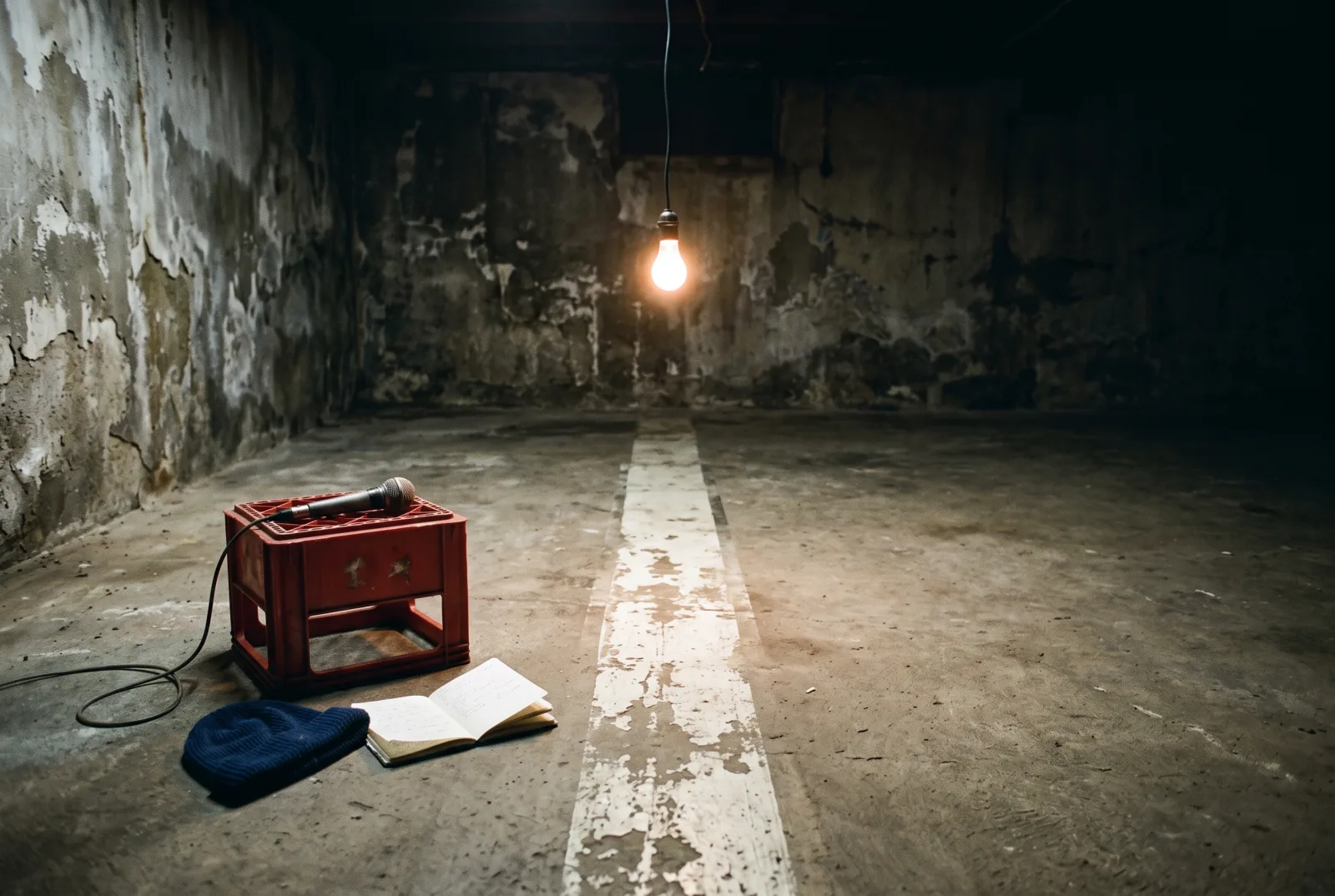
Ilustración: Rebobinados
There is a scene in "8 Mile", the 2002 film Eminem starred in, that explains his entire career.
It is the final battle. Two rappers, one microphone, a crowd that decides. The rival has easy ammunition: the other guy is white, he is poor, he lives in a trailer, his life is a mess.
And then the white kid, instead of waiting for the blow, lands it himself. He says every one of his miseries before the other man can use them. One by one, out loud, in front of everybody.
When he finishes, the rival is left holding the microphone with nothing to say.
Naming your weaknesses before your enemy does
It is fiction — the character is called Jimmy Smith, not Marshall Mathers, and that battle never happened — but the strategy is real, and it was his for thirty years.
Turning what ought to sink you into the first thing you say.
Marshall Bruce Mathers III was born in St. Joseph, Missouri, in 1972. His father walked out when he was a year and a half old; the letters the boy wrote him came back marked "return to sender". He moved constantly between Missouri and Michigan until, at twelve, he settled in the Detroit area, in a mostly black working-class neighbourhood.
The avenue that gives the film its title, 8 Mile, is the northern boundary of the city. To the south, Detroit: black and poor. To the north, the suburbs: white and comfortable.
He was on the poor side while being the colour of the other side. He belonged to neither.
It is worth being precise
People repeat that he broke through an impassable barrier, that he was the white man who earned respect in hip-hop. That is not exact, and the exact version takes nothing away from him.
The Beastie Boys had already been accepted in hip-hop since the mid-eighties. There were white artists before him, for better and for worse — the counter-example of Vanilla Ice still stung.
What is true, and it is enormous, is something else: he is the white rapper with the greatest artistic and commercial standing in history, and the best-selling rapper in history full stop, with more than two hundred and twenty million records.
He did not open the door. He walked further through it than anyone.
The Oscar
In 2003, "Lose Yourself", the theme from "8 Mile", won the Oscar for best original song.
He was the first hip-hop artist to take it. The song spent twelve weeks at number one in the United States, a record for a solo rap track.
It is worth pausing on what that means. A genre that had spent twenty-five years being treated as noise off the street came in through Hollywood's front door, with a song about a poor kid in a Detroit basement who only gets one shot.
He did not go to collect it. He was asleep at home.
What it cost him
The character was violent and provocative on purpose. Slim Shady, his alter ego, said the unsayable, and he maintained it was a character, like an actor in a film.
It worked as art and it charged him as a person. The fame, the lawsuits, his real family exposed in lyrics that millions sang along to.
It ended in a severe addiction to prescription drugs that nearly killed him. He came out of it, and has been clean since 2008. Afterwards he wrote about that too, because it is the only thing he knows how to do with what hurts: say it first.
He is alive, he is fifty-three, and his last record was number one.
What to remember
Eminem is proof that technique and rage can become the same thing.
Put on "Lose Yourself", "Stan" or "Cleanin' Out My Closet" and you will hear someone doing something with words that almost nobody does: chaining them at a speed and with a precision that seem impossible, and using them to tell you things you would rather not hear.
But what really has to be remembered is the lesson of that battle. When someone has ammunition against you, the only way to disarm them is to say it yourself first.
Remember him like this: not as the white rapper, but as the one who understood before anyone else that shame, said out loud, stops being a weapon in someone else's hands.
Sources
Eminem, real name Marshall Bruce Mathers III, born in St. Joseph, Missouri, on 17 October 1972; he is still alive. His father left the family when he was about a year and a half old. After constant moves between Missouri and Michigan, he settled in the Detroit area at around twelve years old. 8 Mile Road is the northern boundary of the city of Detroit and separates the city — largely African American and impoverished — from the northern suburbs, historically white and better off. "8 Mile" (2002) is a semi-autobiographical, dramatised film; the protagonist is called Jimmy "B-Rabbit" Smith and the final battle is fiction, although getting ahead of the rival's insults is a real tactic in rap battles. "Lose Yourself" won the Oscar for best original song in 2003, the first awarded to a hip-hop artist, and spent twelve weeks at number one on the Billboard Hot 100. Eminem has won fifteen Grammy awards and is the best-selling rapper in history, with an estimated two hundred and twenty million records. It should be made clear, since the opposite is often stated, that he was not the first white rapper accepted in hip-hop: the Beastie Boys, who have their own piece in this series, had been accepted since the mid-nineteen-eighties. He overcame a severe addiction to prescription drugs and has been sober since 2008. His album "The Death of Slim Shady (Coup de Grâce)", from July 2024, reached number one on the Billboard 200. Externally authored text, edited and verified for Rebobinados. Interpretations of the meaning of his work are offered as the author's reading. No song lyrics are reproduced, for copyright reasons. Information drawn from Wikipedia, Billboard, the Academy of Motion Picture Arts and Sciences and other coverage.
Keep rewinding
90s
hip hop
Coolio
The number one that was really a lament
The biggest rap hit of 1995 was, deep down, a funeral: over the funereal strings of Stevie Wonder's "Pastime Paradise", a young man looks at his short, dead-end life. It won the Grammy and half the world sang it without listening closely to the words.
90s
hip hop
The Notorious B.I.G.
The greatest storyteller rap ever produced, silenced at 24
He could fit an entire life into a verse: rap lost its finest narrator at twenty-four, in a drive-by shooting nobody ever solved. He left two albums, and the second came out two weeks after the funeral with a title he had chosen beforehand.

10s
hip hop
Macklemore & Ryan Lewis
They reached number one with no label, and they used that number one for something
A song about buying used clothes in second-hand stores went to the very top of the American chart with no major record company behind it. And at the peak of that fame, the Seattle duo chose to spend it on "Same Love", while their state was voting on marriage equality.
Rewind with us
Comments · 0
No one has commented yet. Open the conversation.