
Huey Lewis and the News
The man who stopped hearing his own song
By Rebobinados · Published on September 27, 2026
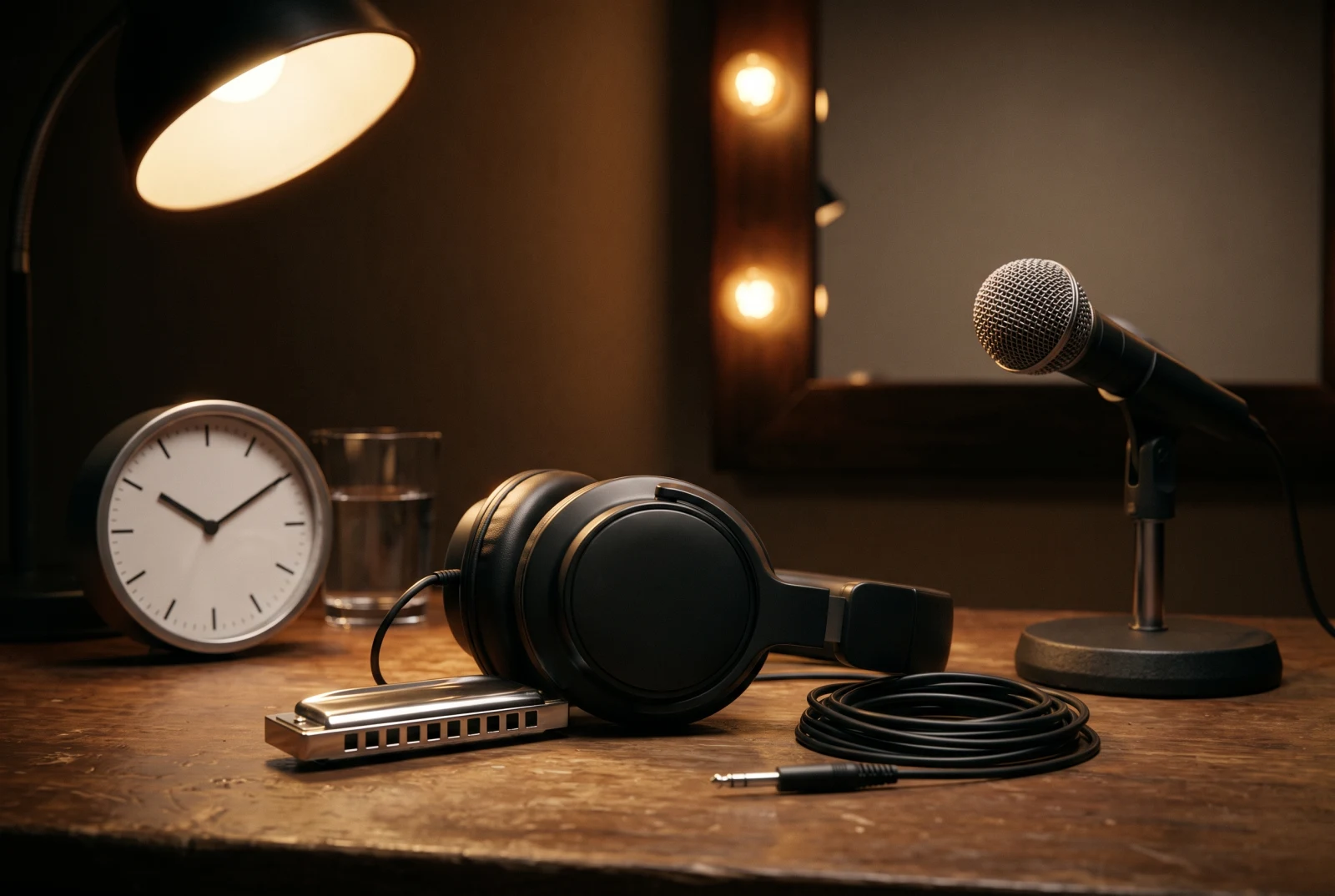
Ilustración: Rebobinados
On 27 January 2018, before a concert in Dallas, Huey Lewis lost his hearing all at once. It was not a slow deterioration or bad news that arrived in a consulting room: it was one day, one hour, a stage he could no longer walk onto. He made it public on 13 April of that year. What he said afterwards about those first months is considerably harder than the kindly version usually going around, and since he was the one who said it, it is better to repeat it in his words and not in ours.
Rock without a pose
Huey Lewis and the News came out of the San Francisco area and worked around a charismatic frontman who also played a devilish harmonica. The formula had no mystery to it: classic rock with roots in rhythm and blues, songs about ordinary things and no intention of changing the world. In a decade of synthesisers and impossible haircuts, they sounded like a bar band that plays well.
Sports, from 1983, put them at the top with a run of hits: "The Heart of Rock & Roll", "I Want a New Drug", "If This Is It". Two years later, Lewis was one of the voices called in for "We Are the World": he sings the last line of the bridge alongside Kim Carnes and Cyndi Lauper. Being in that room, in January 1985, was a fairly precise way of measuring where he stood.
The theme they turned down and the lawsuit that followed
Here is the band's best story, and the usual account leaves it out entirely. Huey Lewis and the News were offered the main theme of Ghostbusters first and they turned it down. The film's producers, meanwhile, had used "I Want a New Drug" as temporary music while editing. The theme ended up being written by Ray Parker Jr., and Lewis thought it sounded too much like his own.
He sued him for plagiarism. In 1985 they reached an out-of-court settlement with a confidentiality clause, and there the story should have ended. It didn't end: Lewis talked about the settlement on a VH1 programme and in 2001 Parker sued him for breaking the clause. The outcome of that second lawsuit is not public, and saying so is more honest than inventing an ending for it.
In the middle of all that, the band gave Back to the Future its best-known song. "The Power of Love" was their first number one in the United States and was nominated for an Oscar. Lewis also appears in the film, and the joke is better than it is usually told: he plays a member of the jury of the school Battle of the Bands, and what he turns down is Marty McFly's band playing a hard version of his own song.
What went away in January 2018
The chronology matters. Lewis had been diagnosed with Ménière's disease some twenty-five years earlier, in the mid-nineties, and had been having vertigo attacks for about thirty-five years. What happened in 2018 was something else: the sudden loss of hearing before that concert in Dallas. He himself plays down the diagnosis and prefers to describe it his own way: he has said that it isn't really a disease, but a syndrome based on symptoms.
About what came afterwards he spoke with a frankness that is better not softened. He stated that the diagnosis ruined everything and that in the first two months he was suicidal. The fortitude with which many describe his reaction did exist, but it came afterwards, not instead of that. Telling it the other way round takes from a man the testimony he decided to give.
The deafness became total. A cochlear implant gave him back speech, not music: he has said that music is no longer part of his life. He hasn't toured since 2018. The man who recorded "The Power of Love" and "The Heart of Rock & Roll" lives alongside them without being able to hear them.
What to remember
Huey Lewis and the News made rock without a pose in an era that rewarded the pose, and gave an eternal film a song that still works forty years later. Their best story, however, is not the one about the DeLorean: it is that of a band that said no to Ghostbusters, heard its own song in the film's edit and ended up in a lawsuit that produced a second lawsuit, twenty years later, for having talked about the first.
And then there is the other thing. A musician who lost his hearing one day in January, said out loud the worst of the two months that followed and still talks about it. That is not a cruel irony of fate or a lesson: it is a man telling the truth about something that happened to him. The songs are still intact, and he no longer hears them. Both things are true at the same time.
Sources
Huey Lewis and the News is an American rock band formed in the San Francisco Bay Area, led by Huey Lewis (vocals and harmonica). Their album "Sports" (1983) included "The Heart of Rock & Roll", "I Want a New Drug" and "If This Is It". Lewis took part in the recording of "We Are the World" (USA for Africa, January 1985), where he performs the final line of the bridge alongside Kim Carnes and Cyndi Lauper. The band was initially offered the main theme of the film "Ghostbusters" and turned it down; the producers used "I Want a New Drug" as temporary music during editing. Lewis sued Ray Parker Jr., author of the theme finally used, for plagiarism, and in 1985 the parties reached an out-of-court settlement with a confidentiality clause; after Lewis spoke about that settlement on a VH1 programme, Parker sued him in 2001 for breach of the clause, litigation whose outcome is not public. "The Power of Love" (1985), composed for "Back to the Future", was their first number one in the United States and received an Oscar nomination; in the film Lewis appears as a member of the jury of the school Battle of the Bands who turns down the audition of Marty McFly's band, which performs a version of that same song. Lewis was diagnosed with Ménière's disease around the mid-1990s, some twenty-five years before 2018, and has reported some thirty-five years of vertigo attacks; he himself has stated that it is not really a disease but a syndrome based on symptoms. On 27 January 2018 he suddenly lost his hearing before a concert in Dallas and made it public on 13 April of that year. He has stated that the diagnosis ruined everything and that during the first two months he had suicidal ideation. The hearing loss became total; a cochlear implant restored his comprehension of speech but not his perception of music, and he has stated that music is no longer part of his life. He has not toured since 2018. Profile compiled for Rebobinados with fact-checking; interpretations of the meaning of the work are offered as the author's reading. No song lyrics are reproduced, for copyright reasons. Information drawn from Rolling Stone, Billboard, CBS News, Variety, Wikipedia and other coverage.
If you or someone you know is going through a crisis, in Chile you can call *4141 free of charge and 24 hours a day, the Ministry of Health's suicide-prevention line.
Keep rewinding

10s
pop
Bruno Mars
Eleven names in the credits
"Uptown Funk" came out on 10 November 2014 with six writers and today it has eleven. In February 2015 The Gap Band's publisher filed a claim over "Oops Up Side Your Head" in YouTube's copyright system —there was never a lawsuit— and on 28 April five names were added, with 17 % of the publishing. It happened weeks after the "Blurred Lines" verdict, and the song had been fourteen weeks at number one.

00s
pop
André Rieu
It was not from the jazz suite
The waltz with which André Rieu reached half the world is not from Shostakovich's Suite for Jazz Orchestra No. 2: it is from the Suite for Variety Orchestra, which the composer did not assemble, and it was born in 1956 as music for a Soviet film about settlers in Kazakhstan. The error comes from a misprint in volume 10 of the complete works (Muzyka, Moscow, 1984), corrected only in 2001. And the title "The Second Waltz" was invented by his wife, because the real one did not sell.

90s
pop
Daniela Mercury
She took the neighbourhood out of the song
"O Canto da Cidade" was written by Tote Gira, a composer from Nordeste de Amaralina who recorded the demo on a borrowed cassette, marking the beat on the door of a refrigerator; Mercury's team almost threw the tape away. She shares the credit because she deleted the references to the Pelourinho so that the song would serve all of Brazil. The album, from 20 September 1992, sold more than 2 million copies and nationalised axé. But she did not invent it: the name was a journalist's insult in 1987.
Rewind with us
Comments · 0
No one has commented yet. Open the conversation.