
Jorge González
What I've Eaten and Danced
By Rebobinados · Published on August 31, 2026
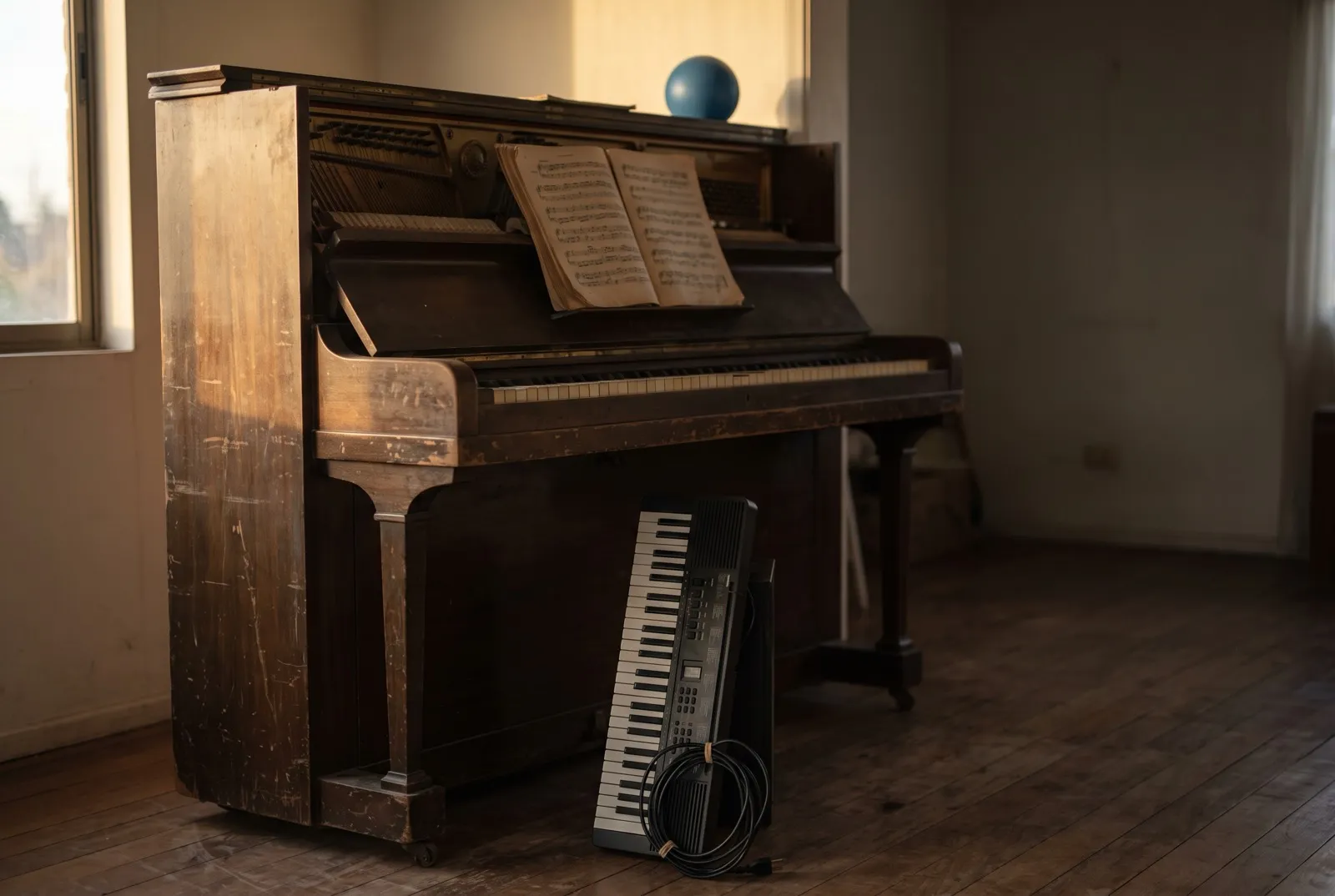
Ilustración: Rebobinados
After years away from the cameras, Jorge González — probably the most important figure Chilean rock has produced — chose to give a long interview, in his own home, to Cristián "Chico" Pérez's programme "El cuarto de música". The first thing they asked about was his health. "Very much alive," he answered. What follows is a portrait built from that conversation and from the work: González telling his own story, which is how he tells it best.
He taught himself
His father turned up one day with a fourth-hand piano a church was throwing out, and he started pulling chords off the pages of the magazine El Musiquero, with no teacher. "I never had a teacher," he says. He had been reading since he was four, "whatever fell into my hands", until "the coup came, they put a tax on books" and suddenly he could only read what he could afford after paying to cross the city to a bookshop. His taste had no borders: Chicago and Kiss, Nicola di Bari and Miguel Bosé, Raffaella Carrà. Whatever reached his ear was welcome in. His first favourite song, at eleven, was Chicago's "If You Leave Me Now": "That song drove me crazy, and it still does."
An X-ray of a country
With Los Prisioneros — him, Claudio Narea and Miguel Tapia, three kids from San Miguel — he did not simply protest: he took an X-ray of a country. "El baile de los que sobran" is not a shout, it is a diagnosis: young people who do everything they are supposed to, study, behave, and discover on the way out that the system has no place for them. González had a rare capacity to read a society and hand it back to itself, sung, so clearly that it hurt.
A view from class
That view was, above all, a class view, and it came from where he came from. When the band went out to play across the continent, he says, "the story of the humble kids from San Miguel didn't exist over there, the Pinochet excuse was no use", and they had to prove the songs stood up on their own: "We fought it out as equals" with musicians from big countries used to exporting artists. In Chile they toured without sponsorship, losing money in order to sound good, while other bands went out backed by a soft drink brand that, he notes with his black humour, was "run by the cops, by Pinochet". And behind it all was Carlos Fonseca, his school classmate turned manager: "Without him, Los Prisioneros as we know them did not exist. He was the one who worked out that this thing could make money." Carlos, the engine.
The fight was never envy
He applied that class lens to everything, including his peers. True to his habit of saying what he thinks even when it stings, in that same interview he let loose a sharp reading of eighties Argentine rock. He asked why those musicians, who had lived through their own dictatorship, came to play in a Chile under dictatorship "and cleaned up", and answered that it was because they came from the upper class, "a bunch of posh kids". Two things are worth separating there. One is a real historical fact: during the Falklands war, the Argentine dictatorship restricted English-language music on the radio, and that gave rock in Spanish a push; "that made their career", he says. The other is his class generalisation, which is his opinion, debatable and arguably unfair, since many of those rockers were persecuted by the regime and rejected it. His theory goes further, and gets fierce: he says Argentina's great reference is Borges, "and the guy was a terrible reactionary", while Chile's is Neruda, "who was nothing of the sort"; that Argentine intellectuals were pure artifice, against a Neruda or a Nicanor Parra who were "colloquial, about simple things". Whether or not he is right, the remark reveals something about him: his quarrel with Soda and with Charly was never envy, it was class and it was project. When he fires at the posh, González is defending where he comes from.
The album that came out of a betrayal
Then the band buckled, in a story that reads like a soap opera. González became involved with Claudia Carvajal, the wife of Narea, his guitarist and friend since school; the tangle broke the friendship and the band. Both told it afterwards, each in his own way, and they do not even agree on what it was. Out of that rupture came "Corazones", in 1990, which in practice was his first solo album even though it carried the group's name. There is the swerve that explains him: from the social analyst of "Pateando piedras" he went straight into love, heartbreak and the resentment of extreme wounds. The man who had X-rayed a society spent a whole album X-raying his own injury. It is one of the great pop albums in Spanish, and it was born of a betrayal between friends.
Never repeating himself
What followed was a career of not repeating himself. Tired of "having to be number one to live off music" — "number five doesn't live off music any more", he says — and fed up with how the label promoted his solo debut, he did something very much his own: he set out to record an album that could not be promoted. That was "El futuro se fue", which he played almost entirely alone and went to mix at Peter Gabriel's studio in England, salvaging songs he had recorded on barely two tracks. He tore up a lucrative contract in search of freedom. He put house and cumbia into Chilean pop before anyone else — the epiphany came on a tour of Colombia, when Fonseca brought back a house compilation from Europe and "it blew my mind".
The treehouse
And in the middle of all that sits "Mi casa en el árbol", from the album the label wanted to launch as an export product: a song about wanting a house up a tree, a refuge, a place where nobody bothers him. The irony is perfect: the industry pushing him as a pop star, and the song at the centre asking to disappear. And that is what he did. In 2001 he reunited Los Prisioneros — his own idea, after coming out of rehab in Cuba, broke — and they filled the Estadio Nacional twice. His Cuban therapist had warned him that submitting himself to that pressure again was "the worst thing an addict can do". He did it anyway; financially, he says, "it was fantastic". The reunited band recorded new albums before he went back, once again, to his own thing. He was clear about it: "Los Prisioneros never repeated a style in another song."
Play the way you play now
A few years ago he broke a leg in Valdivia and spent six months in bed. He does not tell it as a tragedy. "I was happy to have come out alive; I felt sufficiently revived. Being alive is not nothing." He laughs at a doctor who gave him a few months to live: "I knew for sure I wasn't going to die of anything." And out of that convalescence came, by an unexpected route, his new music. The therapy for his hand was squeezing a little ball — "not stimulating at all", he protests — until he sat down at a keyboard. He contacted Colombina Parra, who had always said she liked his music. "I told her, I can't play like I used to. And she said: play the way you play now. That changed my life." He started making songs again, with fewer drums, barer, composing from this body rather than the old one. The creator found a way to keep creating.
What I've eaten and danced
At the end of the interview he was asked to sum up his life. "What I've eaten and what I've danced, nobody can take from me," he said. And he placed himself, without false modesty, on the big list: "There's Violeta, there's Víctor, there's Jorge." But he immediately added the lucid caveat: while Violeta and Víctor were alive, "nothing was done for them, nobody thought they were that good, which is a mistake"; whereas he is being recognised while alive, and that disconcerts him: "I thought that sort of thing only happened to the dead." He closed, of course, with a joke: "I'm a Marxist, but of the Marx kind" — meaning Groucho, his idol.
That is Jorge González, and that is why he is a cult figure. He wrote the songs that X-rayed a generation, turned a private catastrophe into one of the great pop albums in Spanish, walked away from fame to do exactly what he wanted, and when his body changed, he learned to play the way he plays now. Go and listen to him, and not only to Los Prisioneros: listen to that strange, free solo work that almost nobody let be anything other than "the ex-Prisionero". You will hear one of the greats doing, always, exactly as he pleased.
Sources
Profile based on the career of Jorge González (Santiago, 6 December 1964), leader and songwriter of Los Prisioneros, and on his interview with Cristián "Chico" Pérez for the programme "El cuarto de música" (2025), his return to television after years away; the full conversation is available on video. The quoted phrases come from that interview, cited briefly and lightly edited for reading without altering their meaning. Works referenced: "La voz de los '80" (1984), "Pateando piedras" (1986), "La cultura de la basura" (1987), "Corazones" (1990, essentially his first solo album, produced by Gustavo Santaolalla; its lyrics were shaped by his relationship with Claudia Carvajal, then married to Claudio Narea, which precipitated Narea's departure from the band; both have given differing accounts, Narea in "Los Prisioneros: biografía de una amistad" and González in his autobiography "Héroe"); his self-titled solo debut (1993, including "Mi casa en el árbol"); "El futuro se fue" (1994); and his electrocumbia and electropop projects (Gonzalo Martínez, Los Updates). Los Prisioneros reunited in 2001 with two concerts at the Estadio Nacional and released new albums ("Los Prisioneros", 2003; "Manzana", 2004). Historical note: during the Falklands war (1982) the Argentine dictatorship restricted English-language music on the radio, which boosted rock in Spanish; González's class generalisation is his own opinion and is debatable, given that many Argentine rockers were persecuted by the regime and rejected it. No song lyrics are reproduced, for copyright reasons. Additional data from Wikipedia, MusicaPopular.cl, La Tercera and other press coverage.
Keep rewinding

10s
pop
Bruno Mars
Eleven names in the credits
"Uptown Funk" came out on 10 November 2014 with six writers and today it has eleven. In February 2015 The Gap Band's publisher filed a claim over "Oops Up Side Your Head" in YouTube's copyright system —there was never a lawsuit— and on 28 April five names were added, with 17 % of the publishing. It happened weeks after the "Blurred Lines" verdict, and the song had been fourteen weeks at number one.

00s
pop
André Rieu
It was not from the jazz suite
The waltz with which André Rieu reached half the world is not from Shostakovich's Suite for Jazz Orchestra No. 2: it is from the Suite for Variety Orchestra, which the composer did not assemble, and it was born in 1956 as music for a Soviet film about settlers in Kazakhstan. The error comes from a misprint in volume 10 of the complete works (Muzyka, Moscow, 1984), corrected only in 2001. And the title "The Second Waltz" was invented by his wife, because the real one did not sell.

90s
pop
Daniela Mercury
She took the neighbourhood out of the song
"O Canto da Cidade" was written by Tote Gira, a composer from Nordeste de Amaralina who recorded the demo on a borrowed cassette, marking the beat on the door of a refrigerator; Mercury's team almost threw the tape away. She shares the credit because she deleted the references to the Pelourinho so that the song would serve all of Brazil. The album, from 20 September 1992, sold more than 2 million copies and nationalised axé. But she did not invent it: the name was a journalist's insult in 1987.
Rewind with us
Comments · 0
No one has commented yet. Open the conversation.