
Juan Gabriel
What is visible needs no asking
By Rebobinados · Published on September 11, 2026
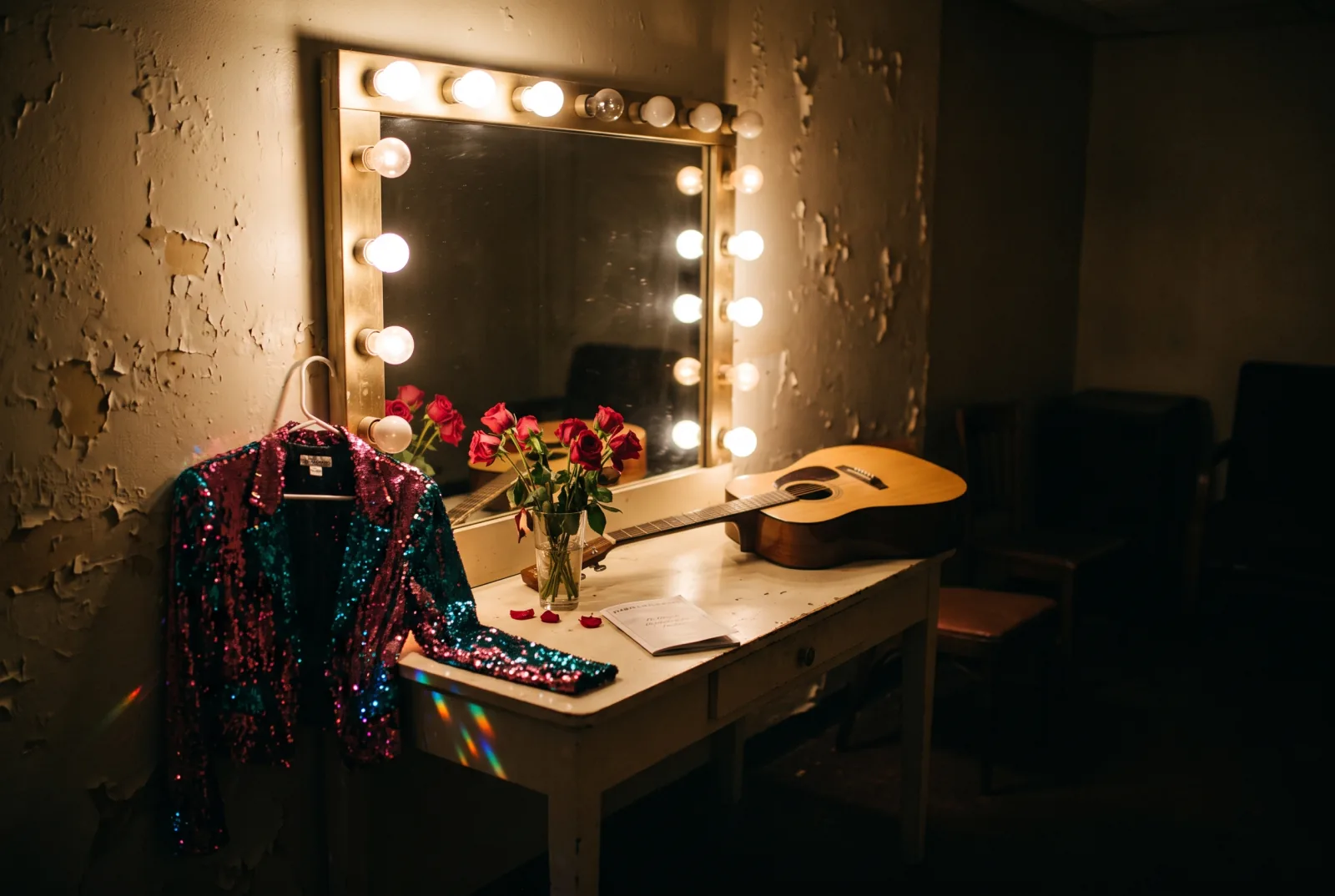
Ilustración: Rebobinados
In Mexico and much of Latin America, when somebody dies there is a good chance that at some point during the wake a person will break into "Amor Eterno". No record company put it there. It arrived on its own, because people decided that was the song. And it was written by a man who as a child had been placed in a juvenile home in Ciudad Juárez.
His name was Alberto Aguilera Valadez. The world knew him as Juan Gabriel.
The name carries both men who marked him
He was born on 7 January 1950 in Parácuaro, Michoacán, the youngest of ten children of farm workers. His father ended up committed to a psychiatric hospital, and his mother took the family to Ciudad Juárez and went to work as a maid. She could not manage them all. Alberto spent eight years inside El Tribunal, a home for minors, where he grew close to a music teacher named Juan Contreras. At thirteen he ran away and went to live with him for a year. That is where he wrote his first song.
When he had to invent a stage name he took the "Juan" from that teacher and the "Gabriel" from his father, Gabriel Aguilera. Say it slowly, because it deserves a pause: he put on himself, for life, the man who taught him and the man who vanished. The one who was there and the one who was missing, in the same name.
Out of that came the most prolific and best-selling songwriter in Latin music: some eighteen hundred songs and over a hundred million records.
Turning an absence into common ground
"Querida" was number one in Mexico for a whole year. There is "Hasta Que Te Conocí", "El Noa Noa" — named for the Juárez cabaret where he started singing — and "Se Me Olvidó Otra Vez". But the case that explains everything is "Amor Eterno", the song he wrote after his mother's death.
Look at what happened there, because it is not the usual thing. A man writes about his specific grief, his own, for his own mother. And instead of remaining his grief, the song becomes the place where a whole continent puts theirs. Millions of people who never met Victoria Valadez sing it at their own funerals. In 2024 the Library of Congress added that recording to the National Recording Registry, the archive of things a country decides to keep forever.
That is the operation Juan Gabriel repeated all his life. He took his abandonment, his poverty and his loneliness — things that had hurt him and him alone — and left them out there for anyone to use.
The door at Bellas Artes
In 1990 he did something that was supposed to be impossible for someone like him: he performed at the Palacio de Bellas Artes in Mexico City, the temple of high culture, the stage reserved for opera and classical music, where popular song was looked down upon. He was the first non-classical artist to play there. He filled three shows and the proceeds went to the National Symphony Orchestra.
The maid's son walked in through the front door of a building that had not been built for him, and left it open behind him.
The other door: rock
And there is a second door, less often told, which interests us particularly at Rebobinados.
Juan Gabriel never made rock and never sang in English. His world was the ballad, the ranchera, the bolero and mariachi, always in Spanish. In Latin American rock circles in the eighties and nineties, admitting you liked Juan Gabriel was close to class treason. Until in 1991 Maldita Vecindad recorded "Querida" as ska, on El Circo, and were showered with accusations of selling out and of fakery for daring.
Others followed. Aterciopelados did "He venido a pedirte perdón" with electric guitars. Rock versions of his songs appeared in several countries. And in 2008 Juan Gabriel, far from taking offence, invited several of those artists to his concerts at the Auditorio Nacional and applauded them from his own stage.
There is a proof of quality in that which admits no argument. A song that can survive being turned into ska, rock or punk without breaking is a well-built song: the melody sits so well and the emotion is so true that genre is barely the clothing. When a scene that despised your music ends up playing it with distortion, and you celebrate it, the song has stopped being yours. It belongs to everyone. It is more or less what happens to rock when it crosses a language and keeps working.
What is visible needs no asking
And then there is the other thing, which in Mexico weighed as much as the music. Juan Gabriel was flamboyant: sequins, silks in Mexican pink and turquoise, his head thrown back, the dancing, the unapologetic tenderness. All of it in one of the most macho cultures imaginable. A country that in theory should have rejected him fell in love with him instead.
He never explained himself, never hid, and never confirmed anything. When a journalist pressed him about his sexuality, he answered with a line that lasted forever: "Lo que se ve no se pregunta, mijo" — what is visible needs no asking, son. It is not an evasion. It is a position: he owed nobody a statement, and he did not give one, with an elegance that is still hard to match. He was, simply and completely, himself, and that is precisely why a continent loved him.
He died on 28 August 2016 in Santa Monica, California, of a heart attack, aged sixty-six, a day after a full concert in Los Angeles. All of Mexico stopped to mourn him.
He had already given his answer to death: as long as somebody sings his songs, Juan Gabriel will still be alive. And that is exactly what happens. Today, in some kitchen, at some party, at some wake, somebody puts on "Querida" or "Amor Eterno" and a whole room feels it in the chest. The abandoned boy from Juárez turned his pain into the emotional language of a continent. He handed us his wounds made into songs and asked for one thing in return. Let us keep singing them.
Sources
Alberto Aguilera Valadez, known as Juan Gabriel ("Juanga", "El Divo de Juárez"), was born on 7 January 1950 in Parácuaro, Michoacán, and died on 28 August 2016 in Santa Monica, California, aged 66, of a heart attack, a day after a concert in Los Angeles. He was the youngest of ten children of farm workers; his father was committed to a psychiatric hospital and his mother took the family to Ciudad Juárez, where she worked as a maid. Alberto spent eight years at the El Tribunal boarding institution, where he formed a close bond with the teacher Juan Contreras; at thirteen he ran away and lived with him for a year, a period in which he wrote his first song. His stage name honours Contreras ("Juan") and his father, Gabriel Aguilera Rodríguez. He wrote approximately 1,800 songs and sold over 100 million records. Among his songs: "Amor Eterno", "Querida" (number one in Mexico for a year), "Hasta Que Te Conocí", "El Noa Noa" — named for the Ciudad Juárez cabaret where he began — and "Se Me Olvidó Otra Vez". The Library of Congress selected his recording of "Amor Eterno" for the National Recording Registry in 2024; the attribution of the song to his grief for his mother, Victoria Valadez, is the account given unanimously by the press and by the artist himself. In 1990 he performed at the Palacio de Bellas Artes in Mexico City and was the first non-classical artist to appear there; he gave three sold-out shows whose proceeds went to the National Symphony Orchestra. Asked about his sexuality he replied: "Lo que se ve no se pregunta, mijo". Juan Gabriel did not record rock or sing in English, but his songs were covered by Latin American rock bands: Maldita Vecindad recorded "Querida" as ska on the album "El Circo" (1991) and Aterciopelados made their version of "He venido a pedirte perdón"; in 2008 Juan Gabriel invited several of those artists to his concerts at the Auditorio Nacional. Interpretations of the meaning of his work are offered as the author's reading. No song lyrics are reproduced, for copyright reasons. Information drawn from Wikipedia and press coverage.
Keep rewinding

10s
pop
Bruno Mars
Eleven names in the credits
"Uptown Funk" came out on 10 November 2014 with six writers and today it has eleven. In February 2015 The Gap Band's publisher filed a claim over "Oops Up Side Your Head" in YouTube's copyright system —there was never a lawsuit— and on 28 April five names were added, with 17 % of the publishing. It happened weeks after the "Blurred Lines" verdict, and the song had been fourteen weeks at number one.

00s
pop
André Rieu
It was not from the jazz suite
The waltz with which André Rieu reached half the world is not from Shostakovich's Suite for Jazz Orchestra No. 2: it is from the Suite for Variety Orchestra, which the composer did not assemble, and it was born in 1956 as music for a Soviet film about settlers in Kazakhstan. The error comes from a misprint in volume 10 of the complete works (Muzyka, Moscow, 1984), corrected only in 2001. And the title "The Second Waltz" was invented by his wife, because the real one did not sell.

90s
pop
Daniela Mercury
She took the neighbourhood out of the song
"O Canto da Cidade" was written by Tote Gira, a composer from Nordeste de Amaralina who recorded the demo on a borrowed cassette, marking the beat on the door of a refrigerator; Mercury's team almost threw the tape away. She shares the credit because she deleted the references to the Pelourinho so that the song would serve all of Brazil. The album, from 20 September 1992, sold more than 2 million copies and nationalised axé. But she did not invent it: the name was a journalist's insult in 1987.
Rewind with us
Comments · 0
No one has commented yet. Open the conversation.