
Keane
Rock without guitars
By Rebobinados · Published on September 17, 2026
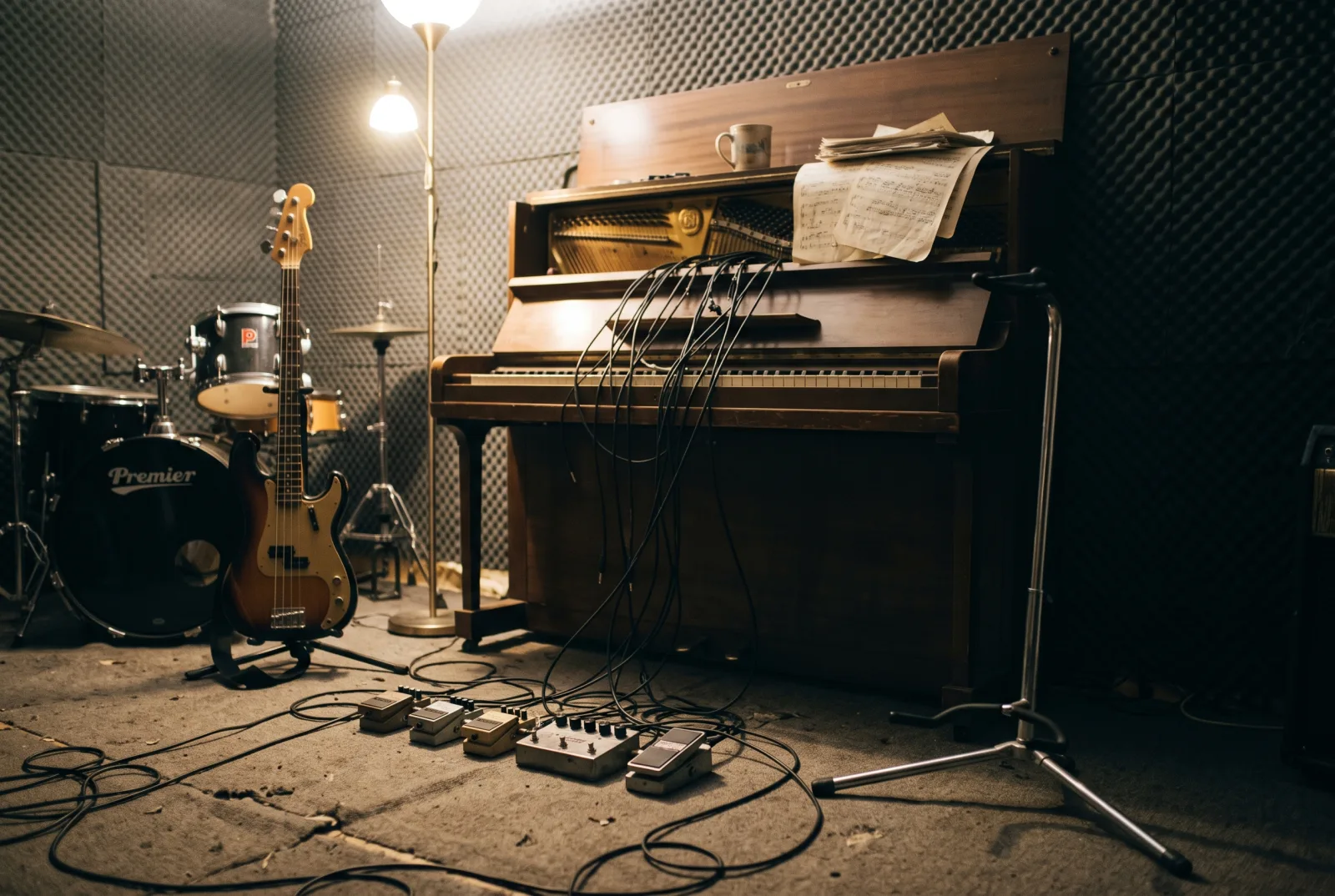
Ilustración: Rebobinados
Keane did two rare things that almost nobody does.
The first, musical: they became one of the biggest rock bands of the 2000s without using guitars.
The second, human: they are childhood friends who stayed together through fame, through colossal success and through an addiction that nearly broke all of them, and came out the other side without ceasing to love each other.
A piano instead of a guitar
Let us start with what made them unique.
In the early 2000s, when all of British rock was made with guitars, Keane took a brave decision: to do without them.
It is worth being precise, because the line gets repeated wrongly. It is not that there is nothing with strings: there is bass. What there is not, on their first two albums, is a single six-string guitar. Their producer, Andy Green, described it as a deliberate challenge: to make a record without guitars that still sounded like a band.
In their place, the heart of the group is Tim Rice-Oxley's piano, run through pedals, distortions and guitar amplifiers until it sounds enormous, epic, almost like an orchestra. The roar of a track like "Is It Any Wonder?" does not come from a guitar: it comes from a piano plugged into a guitar's gear.
Over that foundation, Tom Chaplin's voice: high, warm, able to climb to the sky with an emotion that raises the hairs on your arms.
It was not always that way. The band did have a guitarist, Dominic Scott, who left in 2001. When there were three of them left, instead of looking for a replacement, they decided to manage without him. Out of that absence came their identity.
"Hopes and Fears"
Their first album, from 2004, was a colossal success: number one in the United Kingdom, the second best-selling album in the country that year, the Brit for best British album, and almost three million copies in Britain alone.
And the songs explain why. "Somewhere Only We Know", "Everybody's Changing", "Bedshaped". They were songs about growing up, about friends who change, about the longing for a safe place to return to; melancholy and luminous at once.
"Somewhere Only We Know" has two origins worth separating. They stole the rhythmic pulse from "Heroes" by David Bowie —Rice-Oxley has said so: he wanted something that moved forward over a rhythm like that—. But the place in the lyric is real and specific: a patch of open ground in Battle, Sussex, where they played as boys.
Their first four albums reached number one in Britain. Alongside Coldplay, and following the path opened by Travis, Keane defined the sound of the decade's emotional stadium pop-rock.
The friendship, and the shadow
And here is the human heart of the story.
Tom Chaplin and Tim Rice-Oxley have known each other since they were babies: their mothers met in hospital. They went to school together, with drummer Richard Hughes, in the town of Battle.
And there is something moving in the way they work: Tim writes almost all the songs, and Tom sings them. Which means that for years Tom lent his voice and his emotion to his best friend's feelings. Two people so close that one sings what the other feels.
But sudden fame fell terribly heavily on Tom. In August 2006, in the middle of promoting the second album, he had to check into a clinic in London, and the band cancelled their North American tour.
He recovered and came back. But when the group went on hiatus, in early 2014, he relapsed, and it was worse. He told it plainly: by the end of 2014 he was playing Russian roulette, with drug binges of four or five days in a row. The worst point came the following year.
Tom's addiction came close to breaking not just the band, but a lifelong friendship.
The return
But the story has a good ending, of the kind you are grateful for.
Tom Chaplin managed to get out. He took distance, went to therapy, started a family, and in 2016 released a solo album, "The Wave", which reached number three in Britain and on which, for the first time, he was singing his own words, about his own fall and his own recovery. Not Tim's: his. It was his way of healing and of finding his voice.
And the loveliest part: the friends did not let go. They came back together in 2018, with a concert in Battle, the same old town, and in 2019 they released a new album.
The childhood friendship survived everything fame and illness threw at it. Chaplin has spoken openly about his struggle, and that honesty made him, for a lot of people, a man to respect not only as a singer, but as a person.
What to remember
Keane are proof that you can break the rules and come out ahead, and that a real friendship can withstand even the worst storms.
Put on "Somewhere Only We Know", "Everybody's Changing", "Bedshaped" or "Is It Any Wonder?", and you will hear a piano-driven pop-rock, epic and emotional, sung by one of the loveliest voices of its era over melodies that lodge in your memory.
And behind it you will find something more: the story of two friends from a small town who fulfilled the dream of their lives together, nearly lost it to an illness, and chose to look after each other until they got it back.
Few bands sound this lovely. And few rock stories are this human.
This piece mentions addiction. If you or someone you know is struggling with alcohol or drug use, help is available, and asking for it is an act of strength. In Chile, SENDA's Drugs and Alcohol helpline answers free of charge 24 hours a day on 1412.
Sources
Keane, English alternative rock band associated with Battle (East Sussex), made up of Tom Chaplin (vocals), Tim Rice-Oxley (piano, keyboards and main songwriter), Richard Hughes (drums) and Jesse Quin (bass, who had played with them since 2007 and was announced as an official member on 3 February 2011). Chaplin and Rice-Oxley have known each other since they were babies and studied together, with Hughes, at Vinehall School in Robertsbridge. Founding guitarist Dominic Scott left the band in 2001, and the group chose to carry on without guitar: their first two albums, "Hopes and Fears" (2004) and "Under the Iron Sea" (2006), were recorded without a six-string guitar —though with bass—, building the sound around a piano processed through guitar pedals and amplifiers; producer Andy Green described the absence of guitars as a deliberate production challenge, and the distorted sound of "Is It Any Wonder?" comes from pianos run through distortion pedals. Guitar reappears in the credits from "Perfect Symmetry" (2008). "Hopes and Fears" was number one in the United Kingdom, the second best-selling album in the country in 2004 and Brit Award for best British album in 2005; it is certified 10× platinum by the BPI, with more than 2.83 million copies in the United Kingdom and worldwide sales estimated at around 5.8 million, a figure with no certifying body behind it. Tim Rice-Oxley has said that for "Somewhere Only We Know" he had in mind the rhythmic pulse of "Heroes" by David Bowie, and that the place in the lyric is Manser's Shaw, a patch of open ground in Battle where he played as a child. The band's first four albums reached number one in Britain; "Cause and Effect" (2019) reached number two. Tom Chaplin entered The Priory clinic in London in August 2006, forcing the cancellation of the North American tour; after the band's break, in early 2014, he suffered a serious relapse that he described this way: "At the end of 2014, I was playing Russian roulette". He released the solo album "The Wave" (14 October 2016), number three in the United Kingdom, centred on his recovery. The band reunited in 2018, with a concert in Battle, and released "Cause and Effect" on 20 September 2019. Travis and Coldplay have profiles of their own on Rebobinados. Externally authored text, edited and verified for Rebobinados. Interpretations of the meaning of their work are offered as the author's reading. No song lyrics are reproduced, for copyright reasons. Information drawn from Wikipedia, Sound on Sound, Official Charts, Albumism, PRS for Music and other press coverage.
Keep rewinding
90s
indie
Portishead
A short film got them the record deal
Before the record they shot *To Kill a Dead Man*, eleven minutes of film noir written by the three of them: Geoff Barrow plays a sniper and Beth Gibbons a widow. That soundtrack got them the record deal, and the cover of *Dummy* is a still from the short. The rest is told wrong too: *Dummy* sold 3,600,000 copies and won the 1995 Mercury ahead of Oasis, Tricky and PJ Harvey. Three records in fourteen years, and eighteen without a fourth.
00s
indie
Peter Bjorn and John
The whistle was provisional
Björn Yttling whistled the melody of "Young Folks" as a placeholder, only so as not to forget it, and they decided to keep it. The single came out on 7 August 2006, with Victoria Bergsman as guest, and it was not no. 1 anywhere: no. 13 in the United Kingdom, no. 9 in Finland. Live it is whistled by Peter Morén, and the trio never broke up: nine albums.
00s
indie
Florence + the Machine
The catharsis had a name
The band formed in London in 2007 and "the Machine" comes from the keyboard player Isabella Summers. Florence Welch has said that she stopped eating at seventeen and that she stopped drinking around 2014: the catharsis in her music has a concrete content. She has five British number ones, the last with Everybody Scream (31 October 2025), nominated for the 2026 Mercury.
Rewind with us
Comments · 0
No one has commented yet. Open the conversation.