
Travis
The door under the rain
By Rebobinados · Published on September 17, 2026
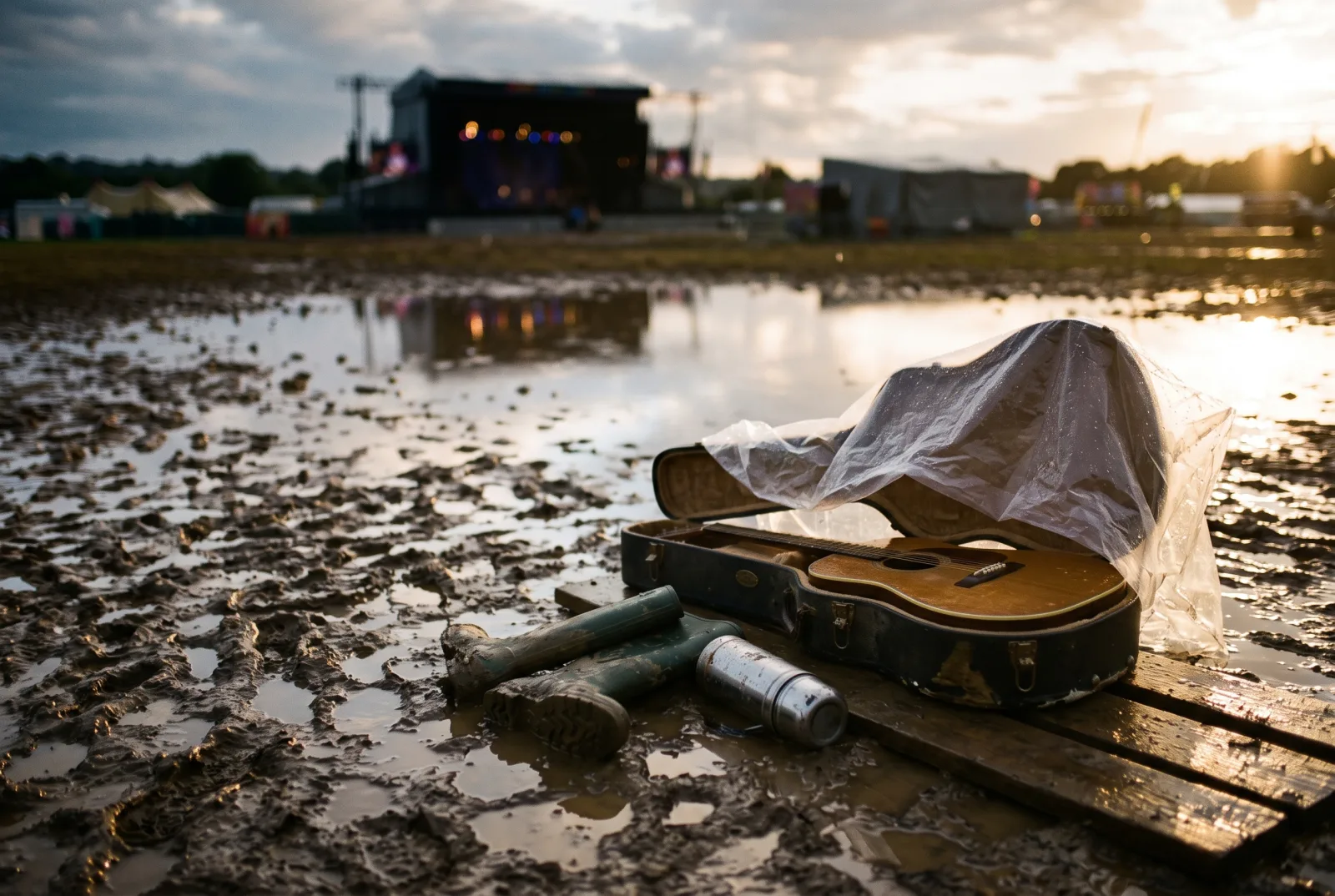
Ilustración: Rebobinados
There are bands that are enormous, and bands that, without being all that famous, change the course of music and open the door for the ones who come next.
Travis belong to the second kind, and it is an injustice that they are remembered less than they deserve.
These four Scots made a melodic, melancholy, warm pop-rock, with simple, moving songs that stay with you. And in doing so they drew the map that half a dozen giant bands would follow afterwards.
From Glasgow, and from another name
The band was born in Glasgow in the early nineties, but it was not called Travis: it was called Glass Onion, after the Beatles song.
Fran Healy —singer, guitarist and songwriter— joined in 1991, and with Andy Dunlop on guitar, Dougie Payne on bass and Neil Primrose on drums the line-up we know was in place. Halfway through the decade they moved to London and changed their name: Travis, after the character played by Harry Dean Stanton in "Paris, Texas", the Wim Wenders film.
At first they were a noisier, messier indie rock band, looking for their place in the middle of the britpop fever. Their first album caught Noel Gallagher's ear, and he personally asked for them to be taken on as support on Oasis's arena tour in 1997.
The turn towards what they would become is said to have come out of a bereavement: the sudden death of Fran Healy's grandfather, in 1994, which is supposed to have made him rethink the band and steer towards something purer and more emotional. It is worth saying that carefully, because that version appears in press profiles and not in Healy's own words.
Eleven weeks, or nine
Their big moment came in 1999 with their second album, "The Man Who".
It was a slow, persistent phenomenon, which is the most interesting thing about their commercial story: the album entered at number five, fell away, and kept climbing back for months. It gathered nine weeks at number one in Britain, in three separate runs, between August 1999 and March 2000.
It carried "Writing to Reach You", "Driftwood", "Turn", and above all "Why Does It Always Rain on Me?", a song at once melancholy and luminous that became their anthem. In the United Kingdom it has sold more than two and a half million copies.
And the song has a story of its own. Healy started it on holiday in Eilat, in southern Israel, where he had gone looking for winter sun on his accountant's advice. It rained on him all week. He only wrote the first verse there; he finished the rest six months later, in Madrid, at one in the morning.
The rain at Glastonbury
And then the thing everybody tells happened.
On 26 June 1999, Travis played the Other Stage at Glastonbury. It was one of those rare dry, sunny editions. And at some point in the set, when they reached the rain song, it began to rain.
The band have told it many times: that the sky opened right there and that it stopped when the song ended. It is worth saying that this precision is retrospective —the reports from the time do not pin it down, and the versions of where in the set it happened do not agree with each other—, but the downpour did happen, and the BBC broadcast it.
The most human part of it is that they noticed none of it. Healy said afterwards that they felt they had played a mediocre show, that it was their big chance and they had wasted it. Dunlop remembered that the crowd looked dejected and that it was raining, and that it was not remotely one of those moments where you think "this is historic".
They found out that same night, back in London, watching the BBC.
The grandparents of stadium pop
And here is what makes them historically important, beyond their own hits.
By the late nineties, the noisy, arrogant britpop was starting to fade. And Travis showed another way: a gentler rock, more introspective, more melodic and emotional, made of songs that talked about ordinary feelings with an honesty free of poses.
That template —warm guitars, sad, pretty melodies, a vulnerable singer, choruses to sing with a lump in your throat— was exactly the one Coldplay, Keane, Snow Patrol and so many others would carry into stadiums all over the world in the following decade.
Chris Martin put it plainly on BBC radio, introducing a new song of theirs in 2007: they are "the band that invented my band and lots of others".
Travis were not the biggest band of that wave. They were the one that started it. The ones who opened the door and let others walk through it into stadiums they never quite filled themselves.
What to remember
Travis are proof that sometimes the most influential band is not the most famous one, but the one that dared first to do something different.
Put on "Why Does It Always Rain on Me?", "Driftwood", "Turn" or "Sing", and you will hear a warm, melancholy pop-rock of simple, sincere songs that aged well because they never depended on a trend, but on something harder: moving people without tricks.
Four Scots who found an honest, tender sound and, without meaning to, handed a whole generation of bands the map to conquer the world.
When you listen to Coldplay or Keane, remember: the road was opened, quietly and in the rain, by these lads from Glasgow.
Sources
Travis, Scottish alternative rock band formed in Glasgow, which grew out of the earlier group Glass Onion (active since the early nineties and named after the Beatles song); Fran Healy (vocals, guitar and main songwriter) joined in 1991. The definitive line-up is completed by Andy Dunlop (guitar), Dougie Payne (bass) and Neil Primrose (drums); they took the name Travis in the mid-nineties, from the character Travis Henderson, played by Harry Dean Stanton in "Paris, Texas" (Wim Wenders, 1984). After their debut "Good Feeling" (1997), Noel Gallagher personally asked for them to support Oasis on the "Be Here Now" arena tour (1997), although the band signed with the Independiente label and not with Oasis. "The Man Who" (1999) gathered nine non-consecutive weeks at number one in Britain, spread across three runs between August 1999 and March 2000, having entered at number five; it is certified 9× platinum by the BPI, with more than 2.68 million copies in the United Kingdom, and its worldwide sales are estimated at around 3.5 million, a press figure with no certifying body behind it. The version in which Fran Healy redirected the band's sound after his grandfather's death in 1994 appears in press profiles —among them The Irish Times (2024)— and not in direct quotes from him. "Why Does It Always Rain on Me?" was begun by Healy during a holiday in Eilat, Israel, where he had travelled looking for sun and where it rained all week; he wrote only the first verse there and completed the song six months later in Madrid. At their performance on 26 June 1999 on the Other Stage at Glastonbury —a dry-weather edition— it began to rain during that song, an episode broadcast by the BBC; the precision that the rain started exactly on the first verse and stopped when the song ended comes from the band's later accounts and not from reports of the time, and the members themselves stated that at the moment they felt they had played a mediocre concert. Travis are frequently cited as forerunners of Coldplay, Keane, Snow Patrol and Elbow; Chris Martin described them on BBC Radio 1, on 19 January 2007, as "the band that invented my band and lots of others". They won three Brit Awards: British Album of the Year and British Group in 2000, and British Group in 2002. Externally authored text, edited and verified for Rebobinados. Interpretations of the meaning of their work are offered as the author's reading. No song lyrics are reproduced, for copyright reasons. Information drawn from Wikipedia, Official Charts, Music Week, The Guardian, The Irish Times and other press coverage.
Keep rewinding
90s
indie
Portishead
A short film got them the record deal
Before the record they shot *To Kill a Dead Man*, eleven minutes of film noir written by the three of them: Geoff Barrow plays a sniper and Beth Gibbons a widow. That soundtrack got them the record deal, and the cover of *Dummy* is a still from the short. The rest is told wrong too: *Dummy* sold 3,600,000 copies and won the 1995 Mercury ahead of Oasis, Tricky and PJ Harvey. Three records in fourteen years, and eighteen without a fourth.
00s
indie
Peter Bjorn and John
The whistle was provisional
Björn Yttling whistled the melody of "Young Folks" as a placeholder, only so as not to forget it, and they decided to keep it. The single came out on 7 August 2006, with Victoria Bergsman as guest, and it was not no. 1 anywhere: no. 13 in the United Kingdom, no. 9 in Finland. Live it is whistled by Peter Morén, and the trio never broke up: nine albums.
00s
indie
Florence + the Machine
The catharsis had a name
The band formed in London in 2007 and "the Machine" comes from the keyboard player Isabella Summers. Florence Welch has said that she stopped eating at seventeen and that she stopped drinking around 2014: the catharsis in her music has a concrete content. She has five British number ones, the last with Everybody Scream (31 October 2025), nominated for the 2026 Mercury.
Rewind with us
Comments · 0
No one has commented yet. Open the conversation.