
Decade 70s · Rhythm progresivo
King Crimson
The experiment that never stopped
By Rebobinados · Published on September 16, 2026
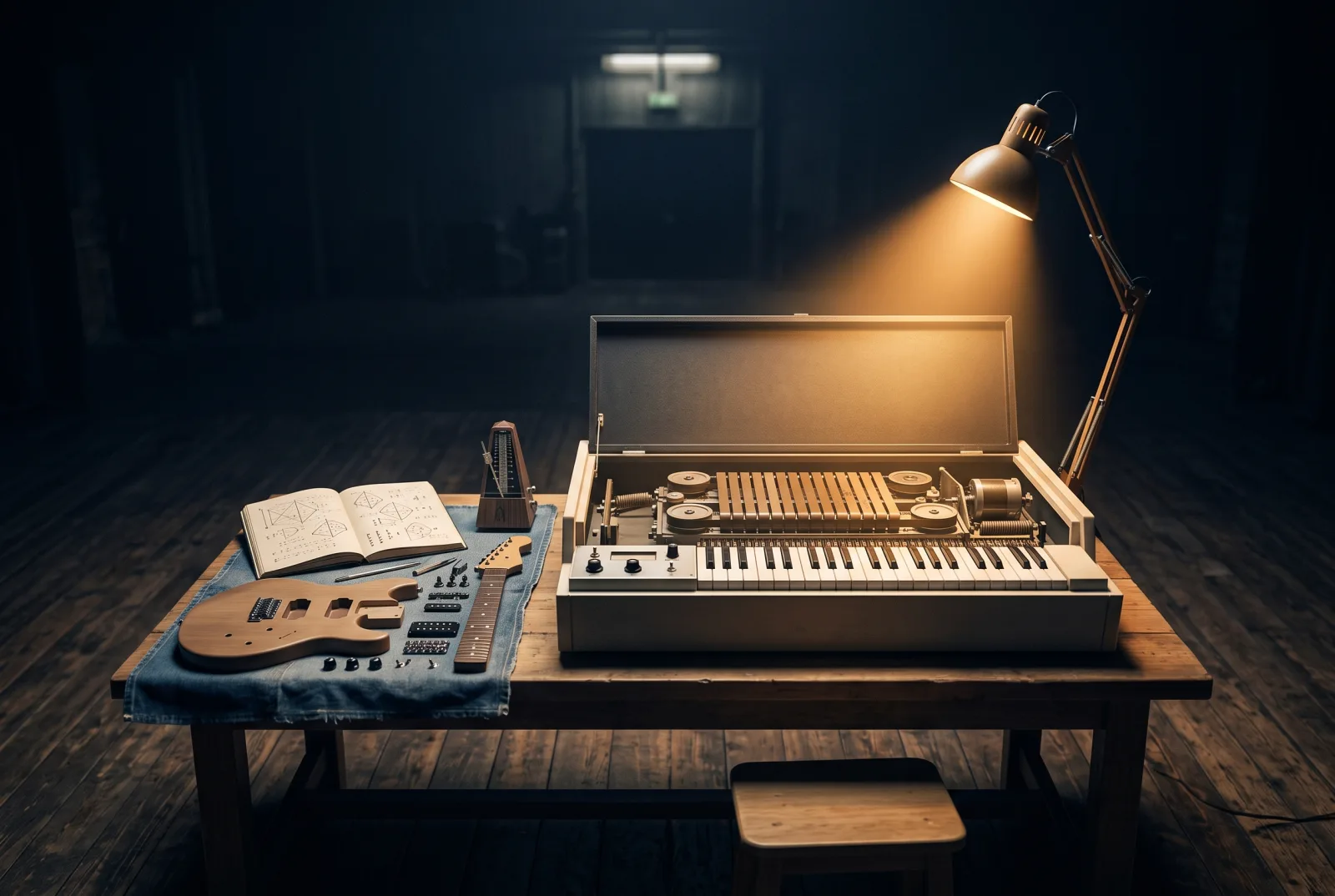
Ilustración: Rebobinados
King Crimson are not so much a band as an idea in motion.
For half a century, led by the guitarist Robert Fripp —the only constant member— they assembled and dismantled themselves over and over, changing musicians, sound and even genre, without ever repeating themselves.
They started out by practically inventing progressive rock, and spent the next five decades refusing to stay still.
The record that changed everything
It all began in London, in 1969, with "In the Court of the Crimson King", released on 10 October of that year.
For many, it is progressive rock's birth certificate.
What it did was audacious: it stripped rock of its blues foundation and replaced it with influences from classical music, jazz and folk, building long, complex, ambitious songs, with shifts of mood and tempo that nobody had attempted.
It opened with "21st Century Schizoid Man", a ferocious, distorted storm, half jazz and half metal before metal existed, whose lyrics prophesied a chaotic, schizophrenic twenty-first century. Seen from today, that prophecy is chilling.
And it closed with the majestic title song, wrapped in a sea of mellotron.
Even the cover, that face screaming in terror, became an icon. The album's advertising quoted Pete Townshend, of The Who, calling it "an uncanny masterpiece", and the phrase stuck to the record forever.
The laboratory
And here is what makes King Crimson a unique creature in rock.
Instead of finding a formula and repeating it, Fripp turned the band into a permanent laboratory. Every few years he dissolved it and rebuilt it with new musicians and new methods, like someone redoing an experiment from scratch.
There was the ferocious, improvising King Crimson of the seventies, with heavy, terrifying records like "Red". There was the eighties quartet, with interlocking guitars and almost electronic textures. There was, in the last decade of activity, a line-up that put three drummers in a row at the front of the stage.
Each era was not a variation on the one before: it was another band, solving a different musical problem with different materials.
They passed through prog, symphonic rock, jazz fusion, electronica and metal, and never made the same record twice.
The disciplined sorcerer
At the centre of it all there was always Robert Fripp, one of the most singular characters in rock.
A rigorous perfectionist, cerebral, almost monastic, famous for playing sitting on a stool, motionless, while the chaos went on around him.
Fripp talks about music and discipline in almost spiritual terms, founded his own label to control his work, and was, on top of that, a legendary collaborating guitarist: he played with David Bowie on "Heroes", with Brian Eno and with Talking Heads.
He is the kind of musician who treats a rock band the way a physicist treats his laboratory: with method, with rigour, and with a curiosity that never goes out.
And in recent years, to everyone's surprise, he became an endearing internet figure by recording hilarious cover versions with his wife, Toyah Willcox. The ascetic of prog, laughing at himself.
The long shadow
King Crimson were never much heard on the radio, and yet their shadow is enormous.
They influenced their contemporaries —Yes, Genesis— and later people as different as Bowie, Radiohead, Tool and The Mars Volta.
Rush, whom we have already visited, describe themselves in their own biography as equal parts Led Zeppelin, Cream and King Crimson.
They were a cult band, one of those that don't fill the radio but found entire genres.
The experiment that never stopped
King Crimson are the proof that a band can be an idea before it is a fixed group of people: a continuous experiment on what rock could become, held up not by a line-up but by the unbending vision of one man.
They invented progressive rock with a record that shook the world, and then spent fifty years refusing to repeat it, tearing the band down and putting it back together every time it threatened to get comfortable.
If you put on "21st Century Schizoid Man" or the song that gives "In the Court of the Crimson King" its name, you will hear the exact moment when rock decided it could be as complex and as ambitious as any classical work.
And behind it, Robert Fripp: the disciplined sorcerer who treated a rock band like a laboratory, and who never stopped running the experiment.
Sources
King Crimson, a British progressive rock band formed in London in 1968-1969 by Robert Fripp (guitar and leader), Michael Giles (drums), Greg Lake (bass and vocals; later in Emerson, Lake & Palmer), Ian McDonald (saxophone, flute, keyboards) and the lyricist Peter Sinfield; Fripp is the only constant member throughout their history. Their debut album, "In the Court of the Crimson King" (10 October 1969, Island), is considered one of the founding records of progressive rock; it includes "21st Century Schizoid Man", "Epitaph", "I Talk to the Wind", "Moonchild" and the title track. The Pete Townshend phrase calling it "an uncanny masterpiece" was used in the album's advertising and has no traceable primary source of outlet and date. The band is characterised by its constant reinvention, with changing line-ups and styles across the decades (prog, symphonic rock, jazz fusion, art rock, electronica and metal): among its stages, notable ones are the mid-seventies (with John Wetton and Bill Bruford; the albums "Larks' Tongues in Aspic" and "Red"), the eighties quartet (with Adrian Belew and Tony Levin, the album "Discipline"), the nineties "Double Trio" and the 2014-2021 line-up with three drummers. Fripp, known for his rigour and for playing seated, founded the label Discipline Global Mobile and collaborated with artists such as David Bowie ("Heroes", 1977; "Scary Monsters", 1980), Brian Eno ("(No Pussyfooting)", "Evening Star") and Talking Heads ("Fear of Music"); in recent years he gained popularity on the internet with the "Toyah & Robert's Sunday Lunch" videos, alongside his wife Toyah Willcox. His influence reaches Yes, Genesis, David Bowie, Radiohead, Tool and The Mars Volta, among many others. Externally authored text, edited and verified for Rebobinados. Readings of the meaning of their work are offered as the author's interpretation. No song lyrics are reproduced, for copyright reasons. Information drawn from Wikipedia, DGM Live, Britannica and other press coverage.
Keep rewinding
70s
progresivo
Jean-Michel Jarre
Twenty-five times in his whole life
His father was Maurice Jarre, three Oscars for "Lawrence of Arabia", "Doctor Zhivago" and "A Passage to India", and he left home when the son was 5: "we saw each other twenty or twenty-five times in our whole lives". *Oxygène* came out in December 1976, recorded in the former kitchen of his flat with a broken Mellotron, and sold some 18 million. Of his father's inheritance he received nothing: the European Court of Human Rights dismissed the case on 15 February 2024.
70s
progresivo
Roger Hodgson
The two wrists and the broken pact
"Dreamer" and "Breakfast in America" are his, written at nineteen, even though they are attributed to Rick Davies. In 1983 he left Supertramp with a verbal pact that Davies broke five years later, and in 1987 he fell from a loft and broke both wrists: he was told he would never play again. Davies died on 6 September 2025, at the age of 81.
70s
progresivo
Yes
The cathedrals and the borrowed name
The only American number one credited to Yes, "Owner of a Lonely Heart", was strictly speaking recorded by a different band: Chris Squire, Alan White, Tony Kaye and guitarist Trevor Rabin had put together a group called Cinema, and in June 1983 Atlantic executives suggested they call it Yes. Jon Anderson joined once the album was well under way.
Rewind with us
Comments · 0
No one has commented yet. Open the conversation.