
The Who
They smashed everything and wrote operas
By Rebobinados · Published on September 26, 2026
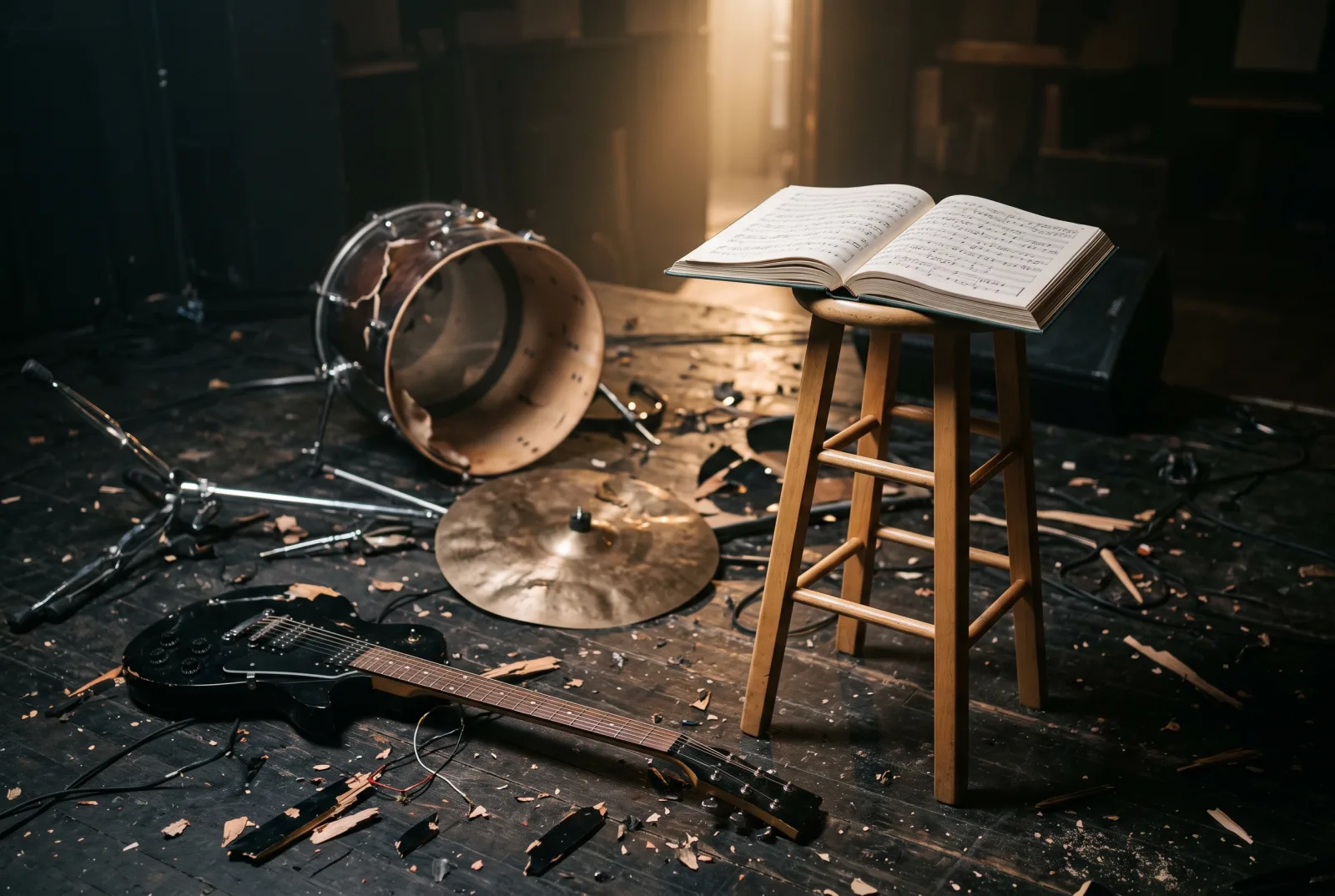
Ilustración: Rebobinados
The Who were one of the wildest, loudest and most ambitious bands in rock.
Coming out of sixties London, they started as a mod group — young men in neat suits on scooters — playing rhythm and blues, and ended up smashing up stages and raising rock to the category of opera.
They were, at the same time, the most violent band of their era and one of the most sophisticated. That contradiction is what makes them unique.
Four personalities at war
The first thing to understand is that they were four almost opposite men, and that together they produced an electric tension.
Roger Daltrey, the singer, who swung the microphone around by its cable like a lasso. Pete Townshend, the guitarist and the songwriting brain, a tormented intellectual who leapt into the air and swung his arm in huge circles as he played, like windmill sails.
John Entwistle, the bassist, still as a statue in the middle of the chaos, playing with a speed and a complexity nobody else had. And Keith Moon, the drummer, a human hurricane, perhaps the wildest and most creative in the history of rock, as unrestrained playing as he was living.
Four forces colliding. Out of that collision came their sound: aggressive, powerful, on the edge of getting out of hand.
Destruction as a show
What made them legendary even before they were famous was that they destroyed their instruments on stage.
At the end of the concerts, Townshend would smash his guitar against the floor and against the amplifiers until it was in pieces, and Moon would kick over his whole drum kit.
It was not an occasional trick. It was part of the show, night after night, an explosion of ritual violence that left the stage in rubble.
And it began by accident, in one specific place: in June 1964, at the Railway Hotel in Wealdstone, Townshend broke the headstock of his guitar against the low ceiling over the stage. The audience laughed. He decided, right there, to finish smashing it deliberately.
The following week, Moon knocked over his drum kit.
That destruction became their signature, and it marked every hard rock and punk band that came afterwards, from the Sex Pistols onwards. Every night they broke what cost any musician a fortune, because the gesture was worth more than the instrument.
The rock opera
But it would be a mistake to stop at the fury, because they did something no violent band had dared to dream of.
In 1969, Pete Townshend wrote "Tommy", a double album that told a complete story, with characters and a plot: that of a boy left deaf, blind and mute after witnessing a murder, abused by his cousin and sexually abused by his uncle, who ends up a mass idol.
Townshend wrote almost all of it, but not those two songs. "Cousin Kevin" and "Fiddle About" — the one about the beatings and the one about the abuse — he handed to John Entwistle, because he did not see himself capable of writing them. "Tommy's Holiday Camp" was credited to Keith Moon, whose idea it was, and "Eyesight to the Blind" is by Sonny Boy Williamson II.
It is worth being precise, because it is often said that they invented the rock opera and that is not exact: "S.F. Sorrow", by The Pretty Things, came out on 20 December 1968, five months earlier, and The Who themselves had already made a mini-opera, "A Quick One, While He's Away", in 1966.
What "Tommy" did do was to be the first one that really worked, the one that put the format on the map and raised rock from teenage dance music to a form capable of telling long and ambitious stories. Then came "Quadrophenia".
The same band that smashed its instruments like savages was capable of that. That double nature is their genius.
The night it was not a ritual
On 3 December 1979, at the Riverfront Coliseum in Cincinnati, the violence stopped being a stage gesture.
The tickets carried no assigned seat and few doors were open. The crush to get in killed eleven people, three of them schoolchildren, and injured twenty-six.
Nobody told the band until after the concert.
The lawsuits were closed by settlement and there were no criminal charges. Cincinnati banned general admission without assigned seats for twenty-five years, and many other cities did the same.
Dying before getting old
Their most famous anthem, "My Generation", from October 1965, contains a line that became the cry of rebellion of the whole youth of the sixties: hoping to die before getting old.
It was pure teenage provocation. And life, with cruel irony, half fulfilled it.
Keith Moon died on 7 September 1978, aged thirty-two, from an overdose of clomethiazole, a sedative he had been prescribed for the symptoms of alcohol withdrawal. He had thirty-two pills in his system, twenty-six of them undigested. The doctor who prescribed it did not know his habits.
He went before getting old, consumed by the same unbridled life that made him so great on stage.
John Entwistle, the immovable rock, died on 27 June 2002 at the Hard Rock Hotel in Las Vegas, on the eve of the start of a tour. He was fifty-seven and had severe heart disease; the coroner determined a heart attack brought on by cocaine.
Daltrey and Townshend carried on, and still carry on, bearing the name.
What is worth remembering
The Who are the proof that fury and intelligence can live in the same band and feed each other.
Put on "My Generation", "Baba O'Riley", "Won't Get Fooled Again" or "Pinball Wizard", and you will hear rock in its most powerful form: guitars that roar, drums that explode, an impossible bass, and a voice shouting the rage of being young.
But you will also hear an enormous ambition, that of men who were not content with making songs and wanted to tell stories.
They destroyed their instruments like barbarians and composed operas like masters. Few bands contained so much in so little.
Sources
The Who, an English rock band formed in London in 1964, with roots in The Detours around 1961 and a spell under the name The High Numbers, one of the most influential of the twentieth century. Their classic line-up (1964-1978) was Roger Daltrey (vocals), Pete Townshend (guitar and principal songwriter), John Entwistle (bass) and Keith Moon (drums). Emerging from the mod movement, they are celebrated for destroying their instruments on stage and for Townshend's "windmill" gesture as he played. The origin of that destruction is documented: in June 1964, at the Railway Hotel in Wealdstone, Townshend accidentally broke the headstock of his guitar against the low ceiling over the stage and, faced with the audience's reaction, smashed it deliberately; the following week Moon knocked over his drum kit. Their single "My Generation" (October 1965) reached number two in the United Kingdom. Regarding "Tommy" (1969), one frequent attribution is worth clarifying: it was not the first rock opera — "S.F. Sorrow", by The Pretty Things, was released on 20 December 1968, and The Who themselves had recorded the mini-opera "A Quick One, While He's Away" in 1966 — but rather the first to achieve mass success and consolidate the format; it was followed by "Quadrophenia" (1973). Among their great songs are also "Baba O'Riley", "Won't Get Fooled Again" and "Pinball Wizard". Keith Moon died on 7 September 1978, aged 32, from an overdose of clomethiazole (Heminevrin), a sedative prescribed for the symptoms of alcohol withdrawal, not a treatment for alcoholism; 32 pills were found in his system, 26 of them undigested. John Entwistle died on 27 June 2002, aged 57, at the Hard Rock Hotel in Las Vegas, on the eve of the start of a tour; the Clark County coroner determined a heart attack brought on by cocaine in a man with severe heart disease. They entered the Rock and Roll Hall of Fame in 1990. Externally authored text, edited and verified for Rebobinados. Interpretations of the meaning of their work are offered as the author's reading. No song lyrics are reproduced, for copyright reasons. Information drawn from Britannica, Wikipedia, Encyclopedia.com and other coverage.
Keep rewinding
90s
hard rock
Lenny Kravitz
He doesn't play that guitar
The riff of "Are You Gonna Go My Way" (9 March 1993) is not played by him: the guitar is Craig Ross's, the song is co-written with him and the Academy nominated them both for Best Rock Song in 1994. "Always on the Run" was written by Slash for Guns N' Roses. And one of his four straight male rock Grammys, the one of 23 February 2000, he won with "American Woman", by The Guess Who, from which he removed the guitar solo.
60s
hard rock
Steppenwolf
The motorcycle was a Ford Falcon
The century's biker anthem was not written by the band that sings it, and it was not about a motorcycle: Mars Bonfire wrote "Born to Be Wild" as a folk ballad about his battered Ford Falcon, and he had left the group in June 1967, before the name Steppenwolf existed. "The Pusher" is Hoyt Axton's, Easy Rider dropped it in as a temporary track, and the single stalled at no. 2 on the Hot 100 in 1968.
00s
hard rock
Thirty Seconds to Mars
The seven-year law
In August 2008, EMI sued them for thirty million dollars for breaching a 1999 contract they had signed before releasing a single record. They defended themselves with a Californian employment law that voids contracts of more than seven years, closed a settlement on 28 April 2009 and signed with the same label again. The Guinness record they ended up with is not a box-office one: it is three hundred and nine concerts on a single tour.
Rewind with us
Comments · 0
No one has commented yet. Open the conversation.