
Sex Pistols
Two and a half years
By Rebobinados · Published on September 16, 2026
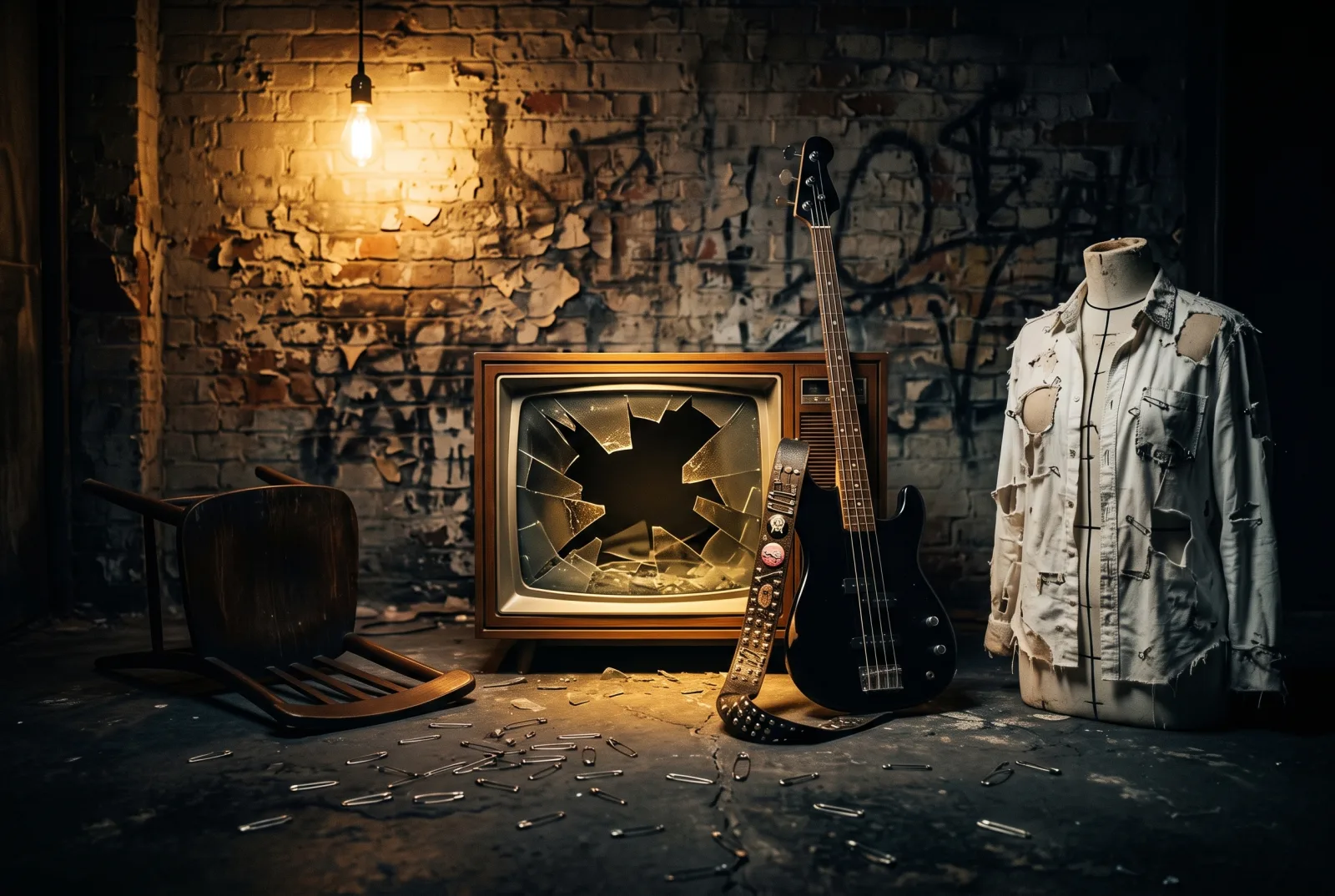
Ilustración: Rebobinados
The Sex Pistols barely existed.
They lasted two and a half years, put out a single album, and their reputation for chaos and provocation always ran ahead of their music.
And yet, in that short while, they lit the fuse of British punk and changed music, fashion and youth culture forever.
They are the proof that attitude and provocation can be as powerful as craft.
A band put together
The first thing to understand is that the Sex Pistols were, to a large extent, a band put together on purpose.
Behind them was Malcolm McLaren, a man who ran —with the designer Vivienne Westwood— a provocative clothes shop in London, called SEX.
McLaren took a group of kids —Steve Jones on guitar, Paul Cook on drums, Glen Matlock on bass— and went looking for a singer for them.
They spotted the chosen one in 1975 hanging around the shop in a Pink Floyd T-shirt he had customised by hand: he had written "I HATE" above the band's name and scratched out the eyes of the faces on the sleeve. His name was John Lydon, and he became Johnny Rotten.
McLaren dressed them in the clothes from his shop, pointed them at everything, and built a scandal machine out of them.
How much of all that was genuine rebellion and how much was a marketing move is still argued over today: McLaren always boasted that it was a great swindle mounted by him; Rotten insists the rage was real. It was probably both things at once.
The moral panic
And the scandal worked as few ever have in history.
On 1 December 1976 they went on a British early-evening television programme, replacing Queen at the last minute, and swore live in front of the presenter Bill Grundy. The whole country was outraged the next day.
They released "Anarchy in the UK". And in May 1977 came the bomb: "God Save the Queen", a song that called the monarchy a fascist regime, put out just as England was celebrating twenty-five years of Elizabeth II's reign.
The BBC and almost every radio station banned it. Even so it climbed to number two on the official chart —number one on the NME's— amid accusations, which persist to this day, that the count had been rigged so it wouldn't reach the top that particular week.
They tried to play it on a boat on the river Thames in the middle of the royal celebrations, on 7 June, and the whole thing ended with eleven arrests, McLaren among them, though not the musicians.
It was a real moral panic.
Their only album, "Never Mind the Bollocks, Here's the Sex Pistols", came out in October 1977, went to number one and is one of the most influential punk records there is. They inspired an army of bands —the Clash, and so many others that formed after seeing them play— and blew punk wide open across the United Kingdom.
The two poles
A comparison fits here, because Rebobinados has already visited the other pole of punk.
If the Ramones, in New York, made a punk that was fast, deliberately dumb, almost cheerful, the Sex Pistols made the other kind: political, furious, scandalous, with the monarchy and British society as its target.
Two ways of starting the same revolution, one on each side of the Atlantic.
The self-destruction
But the Sex Pistols fell apart as fast as they appeared.
On 14 January 1978, at the last concert of a chaotic tour of the United States, at the Winterland in San Francisco, Johnny Rotten closed the show by asking the audience whether they ever got the feeling they'd been cheated. And he walked off. That was the end.
And here comes the saddest part, the one that has to be told carefully.
A year earlier, Matlock had been replaced on bass by Sid Vicious, who was the perfect embodiment of the punk attitude but who could barely play: on the record you only hear him on two tracks, and the guitarist recorded the rest of the bass.
Sid sank into heroin along with his girlfriend, Nancy Spungen. On 12 October 1978, Nancy was found stabbed to death in the room at New York's Chelsea Hotel where they were living, and Sid was charged with her murder.
Out on bail, on 2 February 1979, Sid died of a heroin overdose. He was twenty-one.
The case was never solved, and Sid Vicious was left as punk's doomed martyr, the tragic face of the whole movement.
Two and a half years
The Sex Pistols are a scandal that turned into a revolution.
A band assembled by a shop owner, with a sneering kid out front, playing barely competent but ferocious songs that terrified a nation and freed a generation.
They said what couldn't be said, and for that they were banned, arrested, spat at, and made immortal.
Johnny Rotten's sneer and Sid Vicious's doomed walk became the very image of punk.
If you put on "God Save the Queen", "Anarchy in the UK" or "Pretty Vacant", you will hear the sound of everything polite and safe going up in flames: two and a half years that rearranged British culture, and a warning, in Sid, of how quickly the flame consumes the ones who become its symbol.
Sources
Sex Pistols, a British punk rock band formed in London in 1975, one of the most influential in history despite a brief career of some two and a half years. It grew out of an earlier group formed by Steve Jones (guitar) and Paul Cook (drums); it was shaped by the manager Malcolm McLaren, who ran the SEX clothes shop with the designer Vivienne Westwood, and who recruited as vocalist John Lydon ("Johnny Rotten"), whom Bernard Rhodes saw in August 1975 wearing a Pink Floyd T-shirt customised by hand with the words "I HATE" and the eyes scratched out. The original line-up was completed by the bassist Glen Matlock, replaced in February 1977 by Sid Vicious (John Simon Ritchie), of little ability as a musician —he only plays on "Bodies" and "God Save the Queen"; Matlock recorded "Anarchy in the U.K." and Jones the rest— but central to the band's image. They gained notoriety after swearing live on Thames TV's "Today" programme, with Bill Grundy, on 1 December 1976, where they appeared replacing Queen. Their single "God Save the Queen" (27 May 1977) described the monarchy as a "fascist regime", was banned by the BBC and most radio stations and coincided with Elizabeth II's Silver Jubilee; it reached number two on the official chart and number one on the NME's, amid never-settled accusations that the count had been manipulated. The attempt to play it on a boat on the Thames, on 7 June 1977, ended with eleven arrests, McLaren among them, but not the musicians. Their only studio album, "Never Mind the Bollocks, Here's the Sex Pistols", reached number one in Britain on 28 October 1977 and is considered seminal to punk. The band broke up on 14 January 1978 at the Winterland in San Francisco, at the end of a US tour, when Rotten closed the concert with the line "Ever get the feeling you've been cheated?". McLaren later presented the story as "The Great Rock 'n' Roll Swindle". Nancy Spungen, Sid Vicious's girlfriend, was found stabbed to death at New York's Chelsea Hotel on 12 October 1978; Sid was charged with her murder and died of a heroin overdose on 2 February 1979, aged 21, without the case ever being resolved. Externally authored text, edited and verified for Rebobinados. Readings of the meaning of their work are offered as the author's interpretation. No song lyrics are reproduced, for copyright reasons. Information drawn from Wikipedia, Official Charts, London Museum and other press coverage.
Keep rewinding
80s
punk
Billy Idol
His two anthems failed when they came out
"Rebel Yell" came out on 12 January 1984 and reached no. 46 on the Hot 100 and no. 62 in the United Kingdom; "White Wedding" got no further than no. 36 and did not chart in the United Kingdom in 1982. The two of them only reached no. 6 in Britain in the 1985 reissues, and "Dancing with Myself" never entered the Hot 100. His only no. 1 was a live "Mony Mony" from 1987 that knocked off Tiffany, whose hit was another Tommy James cover.
90s
punk
Fiskales Ad-Hok
The world tour started with them
On 13 September 1992 the Ramones made their debut in Chile, at the Velódromo, the cycling arena inside the Estadio Nacional grounds, and that date was not just another stop: it was the first night of the Mondo Bizarro world tour. It was opened by Fiskales Ad-Hok, a band from the Santiago underground born in 1986 and still without a record. Then came their own label C.F.A. in 1997, "Fiesta" (November 1998) at number 42 in Rolling Stone Chile, and the indefinite hiatus of February 2025.
00s
punk
Avril Lavigne
Six years with no album
Between her 2013 album and Head Above Water, of 15 February 2019, Avril Lavigne released no records because she was seriously ill with Lyme disease: diagnosed in December 2014, she told it on the cover of People in April 2015. The comeback album is about that, and Love Sux (2022) returned her to pop-punk on Travis Barker's label.
Rewind with us
Comments · 0
No one has commented yet. Open the conversation.