
Punk: Three Chords and the Truth
By Rebobinados · Published on July 8, 2026
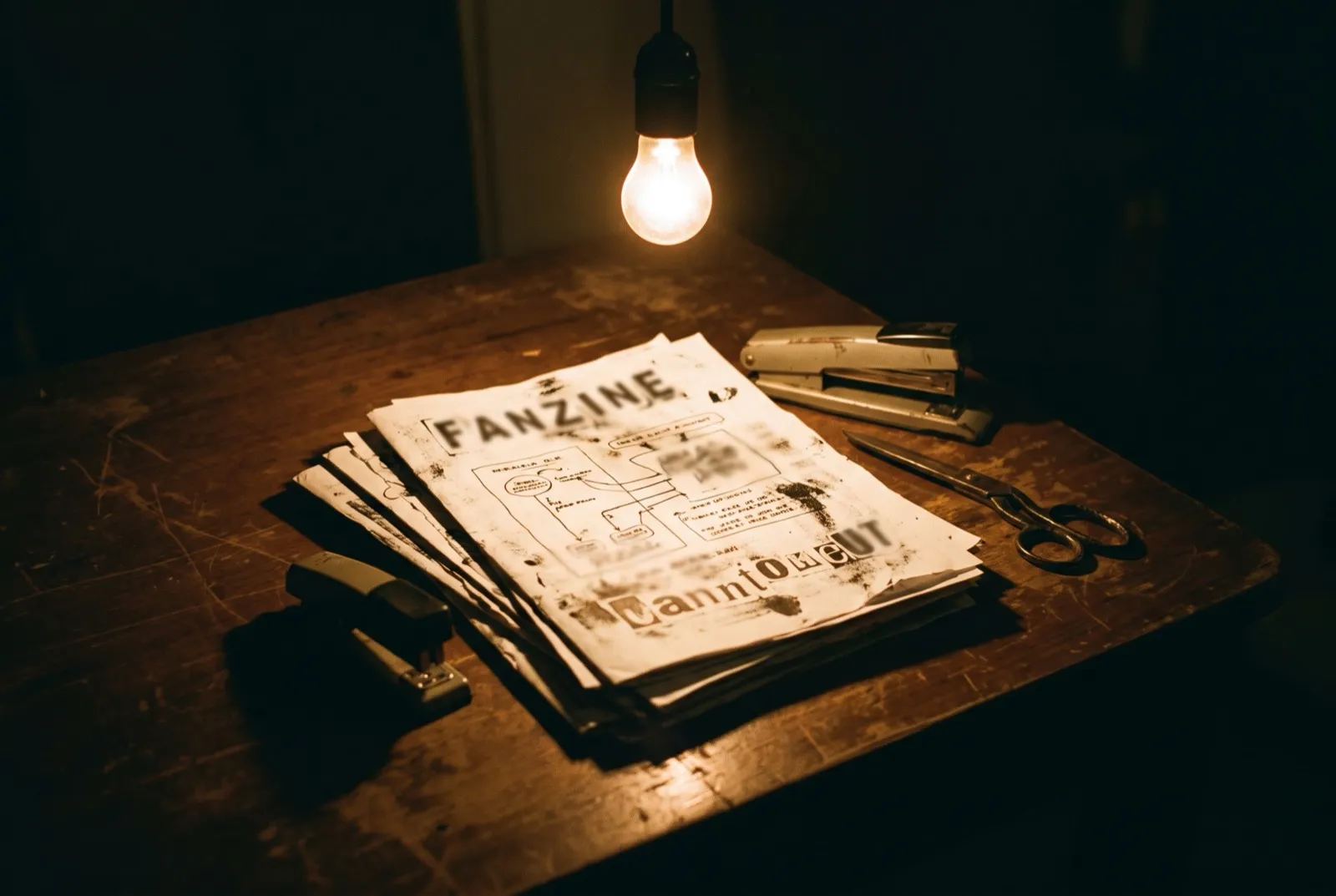
Ilustración: Rebobinados
In 1976, an English fanzine called Sideburns printed a diagram that sums up this story better than any encyclopaedia: three chords drawn by hand and one instruction. "This is a chord. This is another. This is a third. Now form a band." At Rebobinados we believe that photocopied page is one of the most important artistic manifestos of the twentieth century.
The enemy was shaped like a dinosaur
To understand punk you have to understand what it was born against. By the mid-seventies, rock had become the very thing it once rebelled against: twenty-minute solos, double concept albums, expensive tickets and stars who travelled by private jet while their fans queued in the rain. The distance between the stage and the street had never been greater. We cover it in detail in progressive rock and in the decade of excess: two magnificent genres that, seen from an unheated flat in 1976, looked like they came from another planet.
The answer arrived from two cities at once, and the credit should be given in order. New York came first: in a filthy Bowery bar called CBGB, four guys from Queens in leather jackets with identical fringes decided no song needed to last more than two minutes. The Ramones released their first album in April 1976: fourteen songs in twenty-nine minutes, recorded for a little over six thousand dollars.
It remains one of the most perfect statements of principle ever committed to tape. And the figure deserves underlining, because it is the whole argument: six thousand dollars when an ambitious rock record cost a hundred times that. Punk wasn't only an aesthetic. It was, first of all, a demonstration that the budget was never the problem.
London burns
In July 1976, the Ramones played London. In the audience were the future members of The Clash and the Sex Pistols, taking notes. What was aesthetic in New York turned political in England: the country was piling up unemployment, strikes and a generation with no visible future. English punk gave that anger a soundtrack.
The Sex Pistols lasted barely three years and one studio album, but their passage was seismic. "Anarchy in the U.K.", the televised insult that scandalised a nation, "God Save the Queen" banned by the BBC during the Queen's jubilee and outselling everyone anyway. Malcolm McLaren understood before anyone that scandal was a means of production.
The Clash took the other road: if the Pistols wanted to destroy everything, Joe Strummer wanted to build something. London Calling (1979) proved punk could absorb reggae, rockabilly and soul without losing its urgency. They were called "the only band that matters" and, for a few years, it was literally true.
What punk actually invented
Here is our position, and it is firm: reducing punk to a musical genre is to have understood nothing. Punk was a redistribution of power. Before 1976, making a record required an industry's permission; afterwards, anyone with a photocopier, a rehearsal room and an independent label could exist. Do-it-yourself wasn't a slogan: it was an infrastructure.
And that infrastructure had concrete parts. Labels that financed themselves on the sales of the previous record, like Rough Trade in London or Dischord in Washington, the latter with a low-price policy it kept for decades. Mail-order distribution. Photocopied fanzines doing the job of the music press. Small venues booking bands with no record out. None of that existed as a system before '76, and all of it still works the same way today, with the internet in place of labels and post.
Out of it came everything that followed: post-punk, hardcore, indie, the local scenes in every city in the world that we celebrate on this blog. And also, coming full circle, the rediscovery of those sixties garage bands who had already done the same thing without knowing it: we tell that story in What Is Garage Rock?.
The truth, half a century on
Did punk age? Its records, perhaps. Its question, never. Every time music becomes too expensive, too distant, too comfortable, somebody asks the question of '77 again: who is this for?
There's a final irony worth not dodging. Leather jackets now sell in luxury shops, "God Save the Queen" turns up in adverts, and the Ramones are a T-shirt worn by people who couldn't name a song. The system absorbed the aesthetic with astonishing efficiency. But it couldn't absorb the other thing: you still don't need anyone's permission to make a record, and one generation won that in three years.
Music's living memory needs guardians, but it also needs arsonists. Punk was both at once: it burned the house down and, in the ashes, left the blueprints for building another. Three chords are still enough. All you need is the truth.
Keep rewinding
80s
punk
Billy Idol
His two anthems failed when they came out
"Rebel Yell" came out on 12 January 1984 and reached no. 46 on the Hot 100 and no. 62 in the United Kingdom; "White Wedding" got no further than no. 36 and did not chart in the United Kingdom in 1982. The two of them only reached no. 6 in Britain in the 1985 reissues, and "Dancing with Myself" never entered the Hot 100. His only no. 1 was a live "Mony Mony" from 1987 that knocked off Tiffany, whose hit was another Tommy James cover.
90s
punk
Fiskales Ad-Hok
The world tour started with them
On 13 September 1992 the Ramones made their debut in Chile, at the Velódromo, the cycling arena inside the Estadio Nacional grounds, and that date was not just another stop: it was the first night of the Mondo Bizarro world tour. It was opened by Fiskales Ad-Hok, a band from the Santiago underground born in 1986 and still without a record. Then came their own label C.F.A. in 1997, "Fiesta" (November 1998) at number 42 in Rolling Stone Chile, and the indefinite hiatus of February 2025.
00s
punk
Avril Lavigne
Six years with no album
Between her 2013 album and Head Above Water, of 15 February 2019, Avril Lavigne released no records because she was seriously ill with Lyme disease: diagnosed in December 2014, she told it on the cover of People in April 2015. The comeback album is about that, and Love Sux (2022) returned her to pop-punk on Travis Barker's label.
Rewind with us
Comments · 0
No one has commented yet. Open the conversation.