
What Is Garage Rock?
By Rebobinados · Published on July 28, 2026
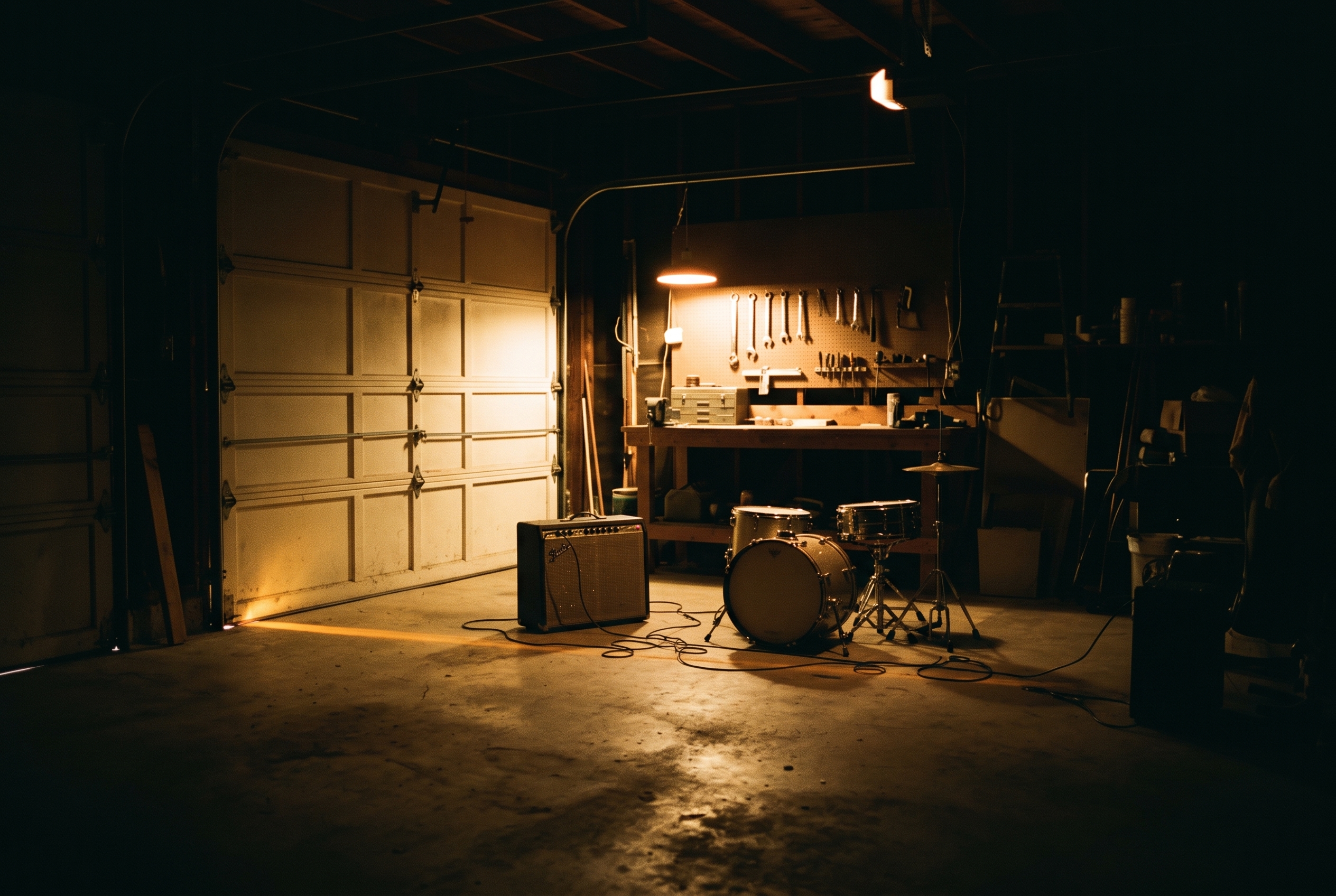
Ilustración: Rebobinados
And why it matters far more than its name suggests
Let's begin with a paradox that tells you almost everything you need to know: garage rock did not exist while it was happening.
Through the 1960s, while hundreds of teenage bands were cutting raw, urgent rock records all over the United States, nobody called it garage rock. It wasn't a genre. It had no name. They were simply kids with guitars making noise in the neighbourhood, most of them destined for one hit and then oblivion. The name — and with it the idea that this was a thing, something with an identity of its own worth remembering — arrived later, once it was nearly all over. It took the critical eye of the early seventies, looking backwards, to discover that inside that despised noise there had been an entire genre.
That's the first key to understanding garage rock: it's music that had to be rescued from oblivion before anyone could see it. And in that rescue there's a lesson about time and worth that deserves unpacking.
The sound: energy over technique
Before the history, the sound. Because if anything defines garage rock it isn't a date or a place, but an attitude.
Garage rock is rock stripped down to its most essential gesture. It was played by young people with little or no formal training — more hunger than craft, more anger than technique. The name comes from something literal: with no access to professional studios, many of these groups rehearsed and sometimes recorded in the family garage. The garage was the only place available, and it ended up naming a whole way of understanding music.
Out of that limitation an aesthetic was born. Dirty, distorted guitars, short and direct songs, an energy that asked nobody's permission. Where more sophisticated rock chased perfection, garage chased impact. Playing well didn't matter; playing truthfully did. That inverted hierarchy — feeling above skill — is the heart of the genre, and it's also why it would keep resurfacing for decades.
Where it came from: children of the British Invasion
Garage rock was born in the United States in the early sixties, and it had one clear trigger: the British Invasion. When the Beatles and the Rolling Stones conquered American radio, they left behind an entire generation of teenagers who all thought the same thing at the same time: I could do that too.
And they did. By the thousand. Groups that took the pop hooks of the British bands and added a rougher edge, more street, more their own. They lacked their idols' polish, and that shortcoming became their signature. Bands like the Kinks and the Zombies showed the way from the British side; in the United States, the answer was hundreds of local groups carrying that same energy with dirt under their fingernails.
Most never got past one hit. Many never got past one town. But together they formed a vast, anonymous scene beating across the whole country, in high-school dances and ballrooms, with no idea they were inventing anything.
The rescue: the compilation that named the gold
Enter the man who changed the story without meaning to. In 1972, a young writer and record-shop clerk from New York, Lenny Kaye — who years later would be Patti Smith's guitarist — gathered twenty-seven of those lost singles into a double album for Elektra. He called it Nuggets.
The title is a statement. Kaye was saying that in this music everyone considered disposable there was gold, and that someone had to stoop down and pick it up before it was lost for good. He was right. A good part of those songs would probably have vanished from memory were it not for Nuggets and the compilations it inspired afterwards. The rescue was, quite literally, what turned a pile of forgotten recordings into a genre with a name and a history.
And in the notes Kaye wrote for that record there's a detail that makes it foundational. To describe the music he didn't use the phrase "garage rock" — he has said himself that the term didn't exist yet — but another one almost nobody had put in print until then: punk rock. He was naming it years before punk existed as a movement. Garage rock was therefore the first music to carry that name. Anyone looking today for the origin of punk, of raw rock, of the do-it-yourself spirit that would define decades of music, always ends up in the same place: these teenagers in garages, rescued by a record-shop clerk who could see gold where others saw trash.
Why it matters
You might think garage rock is a footnote, a curiosity for collectors. It's the opposite. It's one of the roots from which much of the rock that followed grew: punk, hard rock, power pop, and later grunge and the whole alternative wave. Every time rock grew tired of its own sophistication and wanted to return to the essentials, it came back here, to this garage sound. That swing has a story of its own, and we tell it separately in From the Garage to the Stadium.
But there's a deeper reason, and it's the one that makes this story worth knowing even if you're no fan of the genre. Garage rock is proof that the worth of a thing isn't always visible while it's happening. Those kids had no idea they were founding anything. They recorded in a garage because it was all they had, hoping to last a summer. They didn't last a summer: they lasted forever, hidden in the DNA of almost everything we love about rock. It just took someone, years later, to stoop down and look fondly at what everyone else had thrown away.
That is, perhaps, the real lesson of the garage. Not the music alone, but what it teaches about how we look. How much of what we dismiss today as noise will turn out, in time, to have been gold. And how much depends on someone, at some point, having the ear to hear it.
If you want to start listening, we've put together a place to begin in Ten Garage Rock Bands You Have to Hear.
Keep rewinding
00s
garage
The White Stripes
The surname was the drummer's
They said they were brother and sister: Jack repeated it in interviews as "the two youngest of ten". In fact they had married on 21 September 1996 and divorced in March 2000, and when the press exposed it in 2001 they carried on insisting. And the surname was hers: Jack was born John Anthony Gillis and took Meg's when they married.
60s
garage
The Velvet Underground
Thirty thousand bands
Almost nobody bought them, and half the rock that followed came out of them. Brian Eno's line sums it up, even if the figure he quotes is not quite right.

00s
garage
The Strokes
A small amplifier
In 2001 they sounded revolutionary by sounding old. They recorded the vocals through a cheap practice amp on purpose, leaving the good gear unused.
Rewind with us
Comments · 0
No one has commented yet. Open the conversation.