
Ten Garage Rock Bands You Have to Hear
By Rebobinados · Published on July 28, 2026
Ilustración: Rebobinados
Beyond the ones you already know
Searching for garage rock online has a problem: every list looks the same. The same four names, the same two songs, the same safe route that takes you nowhere you hadn't already been. This list tries something else. It starts by acknowledging the essential ones — denying them would be dishonest — but it lingers above all on the ones you probably don't know, which are what make it worth climbing down into the garage at all. Because garage rock, more than a canon of great names, is a territory of hidden treasure. And the best way in is for someone to hand you the ones buried deepest.
If you don't yet know what any of this is about, start with What Is Garage Rock? and come back. Here are ten, from the foundations out towards the oddities.
The foundations: where everyone passes through
The Sonics. If garage rock had a ground zero of sheer intensity, it would be in Tacoma, Washington, in the mid-sixties. The Sonics recorded with a rawness that still sounds violent today, as though the tape could barely hold them. Their first album, from 1965, was cut in Seattle with engineer Kearney Barton on a two-track recorder with a single microphone for the entire drum kit — a technical limitation that, far from holding them back, became their signature: that compressed, red-hot sound, always about to burst. Their singer, Gerry Roslie, didn't sing: he screamed with a throat that sounded broken at the factory. Their songs weren't about holding hands in the park; they were about poison, witches and psychopaths. "Strychnine" — an ode to drinking strychnine for fun — and "Psycho" sounded, to the ears of the day, as if they came from another planet. It's no accident that so many later musicians have cited them as an origin point. Start there and you'll understand immediately what everything else is made of.
The Stooges. With Iggy Pop out front, in Detroit, the Stooges took the garage's rawness and sharpened it into something else. Where other groups still wanted to be liked, they wanted to confront: Iggy rolled around in the audience, cut himself, turned every show into an act of danger. Their sound — repetitive, hypnotic, aggressive — was the direct bridge between the garage of the sixties and the punk that would explode a decade later. They're living proof that one begat the other. Listen to them and you're hearing the future happen in real time, years before the rest of the world was ready for it.
The 13th Floor Elevators. From Austin, Texas, they pushed the garage into territory almost nobody had walked: the psychedelic. Their trademark was an electric jug — yes, a blown, amplified ceramic jug, played by Tommy Hall — burbling underneath like an electronic insect, a sound that resembled nothing else. "You're Gonna Miss Me", which Roky Erickson had written when he was barely more than a boy, is their calling card: two minutes of pure urgency. More hallucinated and philosophical than most of their contemporaries — Hall was the group's ideologue and preached a kind of lysergic mysticism — they proved the garage could do more than hit: it could also fly. What came after is one of the saddest stories in sixties rock: in 1969, facing a marijuana possession charge, Erickson chose to commit himself to a psychiatric hospital rather than go to prison, and there he was given electroshock treatment.
The heart of the list: the ones you should know and don't
The Monks. Here's where it gets good, and with one of the strangest stories in rock. The most mythologised American garage group of its era didn't live in the United States: they were five American soldiers stationed near Heidelberg, in West Germany, in the middle of the Vietnam War. They started playing covers on the bases to kill the boredom, and when they were discharged, instead of going home, they decided to stay and make music. What they created sounded like nothing else in 1966. They shaved tonsures into their scalps like medieval monks, dressed in black with nooses around their necks, and played a brutal, repetitive sound built on distorted electric banjo, shouts and hammering rhythms they themselves called "über-beat". Their only album, Black Monk Time, came out in Germany alone and was a total commercial failure: audiences weren't ready for something so aggressive and strange. Decades later it would be recognised as one of the secret foundations of punk and krautrock, and their list of latecomer admirers is dizzying: Jack White, Iggy Pop, Jello Biafra, the Beastie Boys, Nirvana's Krist Novoselic. The Fall loved them enough to cover them on their 1990 album Extricate. A band that sounded like the future, and that the present didn't know how to hear.
The Standells. "Dirty Water" is theirs — a filthy, sarcastic anthem to Boston that became a classic almost in spite of itself. The irony is that no Bostonian wrote it: it was signed by Ed Cobb, the band's Californian producer, after someone tried to mug him one night in the city — hence that line about lovers, muggers and thieves. The Standells represent the garage at its most contagious: instant hook, insolent attitude, and that teenage swagger that can't be faked. Over the years the song became Boston's unofficial anthem, and it still plays in the ballpark every time the Red Sox or the Bruins win at home. Proof that a garage nugget can outlive its own authors and become the property of an entire city.
The Seeds. With "Pushin' Too Hard", Sky Saxon's group distilled the garage down to its purest formula: essentially two chords, a teenage complaint, and an urgency that doesn't let up for two and a half minutes. Nothing more was needed. The Seeds understood before almost anyone that in the garage repetition was a virtue, not a shortcoming: hammer the same idea until it turns hypnotic. Saxon, with his theatrical lysergic-prophet persona, would become a cult figure. Listening to them is understanding how much can be said with how little, and why that economy would be the lesson punk learned by heart.
The Count Five. "Psychotic Reaction" is one of those songs that single-handedly justify the existence of an entire compilation: a riff, a frenzy, a burst of fuzz and harmonica without a wasted second. These young men from San Jose, who took the stage in Bela Lugosi-style vampire capes, left barely a trace beyond that one flash of genius. They're the perfect example of the garage as a one-hit phenomenon: bands that burned once, brilliantly, and went out. The critic Lester Bangs devoted a whole essay to them in 1971, "Psychotic Reactions and Carburetor Dung", which is itself a masterpiece of mythmaking: in it he reviews in loving detail four later albums by the group, each more refined than the last. None of them existed. Bangs had invented them.
The Shadows of Knight. From the suburbs of Chicago, they took British rhythm and blues — the Yardbirds', Them's — and sent it back across the Atlantic rawer and more direct than it had left. Their version of "Gloria", Van Morrison's classic, became a manual for how American garage digested the British and spat it back transformed: simpler, more urgent, built so any neighbourhood band could play it at a party. They explained it better than anyone themselves: the Stones, the Animals and the Yardbirds had taken Chicago blues and given it an English interpretation; they took that English version of the blues and put the Chicago back into it. That raw round-trip translation is, at bottom, the story of garage rock itself.
The Electric Prunes. "I Had Too Much to Dream (Last Night)" opens the legendary Nuggets compilation, and rightly so: it's the garage knocking on psychedelia's door, one foot in the basement and the other in the clouds. The use of fuzz and studio effects — guitars running backwards, textures that shiver — is still startling in how far ahead it was. The Electric Prunes were, in a way, victims of their era and their industry: in 1968 they ended up entangled in Mass in F Minor, a psychedelic mass sung in Latin and Greek, written and arranged by David Axelrod, which proved so difficult to record that the producers replaced them halfway through with another band and session musicians. They were displaced from their own album. But that first single remains one of the genre's most perfect moments, the exact point where the garage began to dream.
The Knickerbockers. With "Lies", from 1965, they pulled off something close to impossible: sounding more like the Beatles than the Beatles' own imitators, yet with a nervous energy of their own that made it more than a copy. For years, unsuspecting listeners swore it was a lost Lennon–McCartney song. This band from Bergenfield, New Jersey — who came up through the dance circuit and could genuinely play — is proof that the garage's anonymous scene held not only furious amateurs but also fine craftsmen capable of brushing against the masters they admired. Their guitarist told it without any solemnity: they were desperate to write something that sounded like the British Invasion, and "Lies" came out in under half an hour. The garage had its goldsmiths too.
Where to keep digging
These ten are a door, not a complete map. The real territory of garage rock lies in the compilations that set out to rescue it from oblivion: Nuggets, the one Lenny Kaye assembled in 1972 and which gave all of this its name, is the obligatory starting point. But if you get hooked, Pebbles and Back From the Grave keep digging deeper, unearthing bands still more obscure, still rawer, still more lost.
And there lies the beauty of this genre: you never finish exploring it. For every band on this list there are ten more waiting in some forgotten groove, some single by a group that existed for one summer in a town nobody remembers. Climbing down into the garage means accepting that there will always be one more nugget further down. The only way to find them is to keep listening.
Keep rewinding
00s
garage
The White Stripes
The surname was the drummer's
They said they were brother and sister: Jack repeated it in interviews as "the two youngest of ten". In fact they had married on 21 September 1996 and divorced in March 2000, and when the press exposed it in 2001 they carried on insisting. And the surname was hers: Jack was born John Anthony Gillis and took Meg's when they married.
60s
garage
The Velvet Underground
Thirty thousand bands
Almost nobody bought them, and half the rock that followed came out of them. Brian Eno's line sums it up, even if the figure he quotes is not quite right.
00s
garage
The Strokes
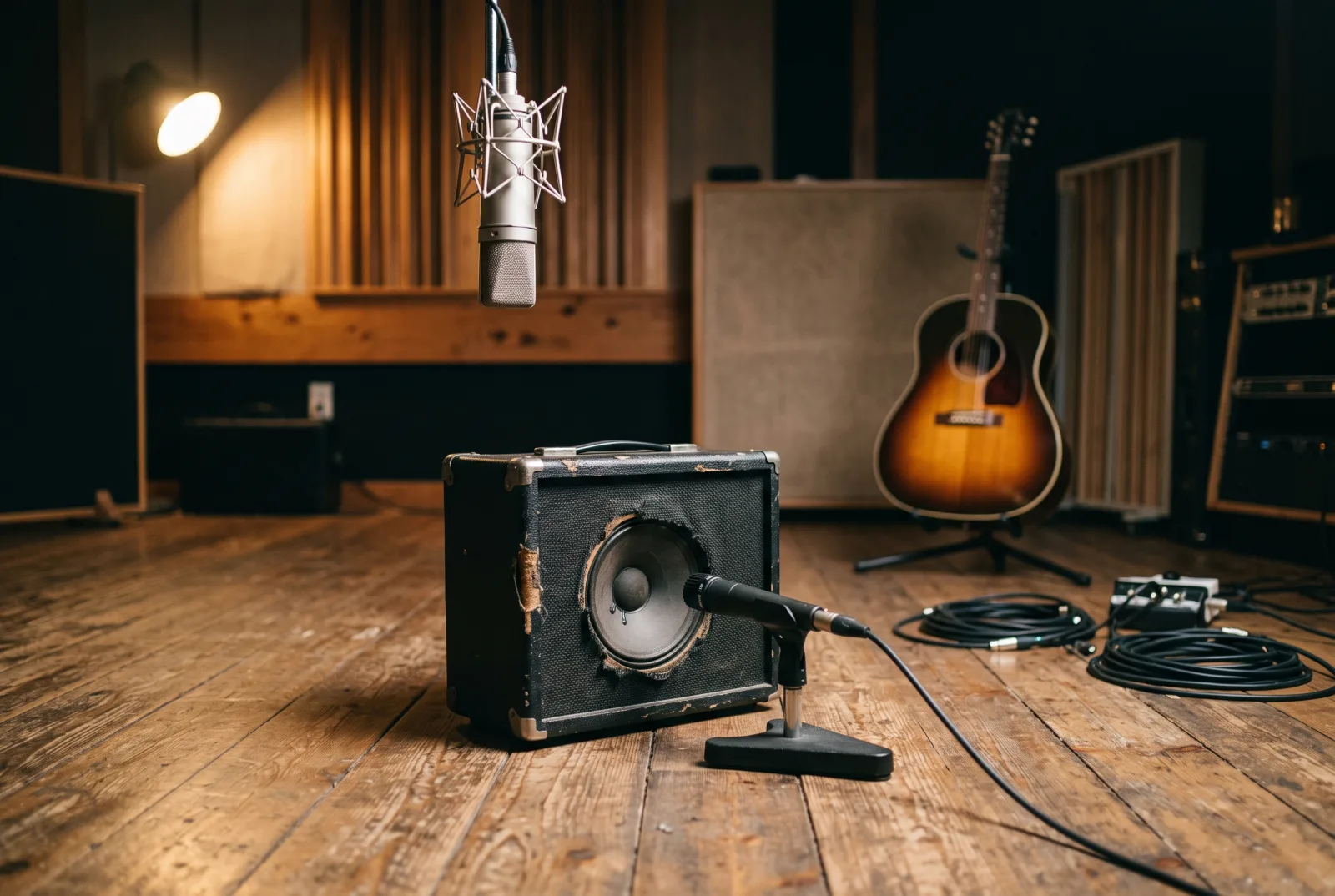
A small amplifier
In 2001 they sounded revolutionary by sounding old. They recorded the vocals through a cheap practice amp on purpose, leaving the good gear unused.
Rewind with us
Comments · 0
No one has commented yet. Open the conversation.