
From the Garage to the Stadium
By Rebobinados · Published on July 28, 2026
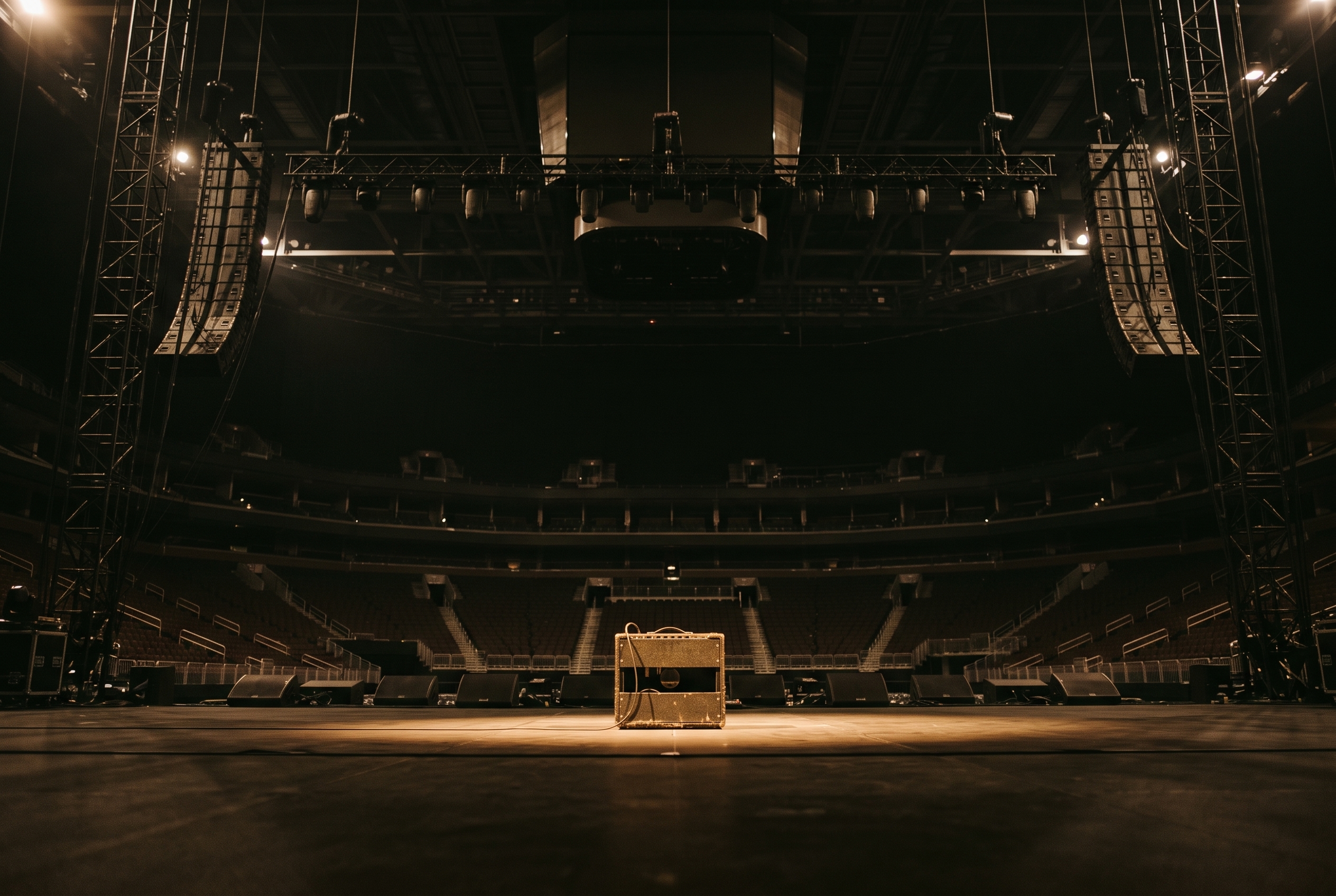
Ilustración: Rebobinados
How an amateur sound became rock's backbone
Watch for a scene that repeats every fifteen or twenty years, almost like a season coming round again. Rock has grown big. The records sound perfect, the solos run eight minutes, the productions cost fortunes and the musicians play like surgeons. Everything is immaculate. And then, from some basement, from some garage, a handful of kids appear who can barely play and who make a dirty, short, urgent noise that suddenly sounds more alive than all the rest. People hear them and feel something they had forgotten. Rock, once again, goes home.
That home is the garage. And this article isn't about any one of those returns in particular, but about the mechanism: why rock's humblest sound — the sound of amateurs recording in garages because they had no access to a studio — is the place rock goes back to whenever it needs reminding what it's made of.
The starting point
It's worth clearing up first where all this comes from. Through the sixties, while hundreds of teenage bands were cutting these raw singles across the United States, garage rock didn't exist as a genre: it had no name and nobody recognised it as a distinct thing. It was given one in 1972, by a young critic called Lenny Kaye, who gathered twenty-seven of those lost singles into the compilation Nuggets and, in describing them, used a term almost nobody had written down before: punk rock. We tell that story in full in What Is Garage Rock?.
What matters here is what came after that rescue. Because once the sound had a name, it began to work as a reserve rock would return to again and again. What follows is the map of those returns.
First return: punk
In the late sixties, while rock was growing ever more ambitious and symphonic, some bands pushed in the opposite direction. In Detroit, Iggy Pop's Stooges and groups like Question Mark and the Mysterians took the garage's rawness and sharpened it into something new. It was the sound of simplicity as a statement of principle: fewer notes, more urgency.
What was germinating there bloomed fully in the punk explosion of the late seventies. Garage rock was its direct precursor — but not only its. From the same trunk grew hard rock, power pop and glam. The music of those forgotten amateurs turned out, seen with hindsight, to be a starting point.
Second return: the ones who went back on purpose
Here the story takes its first conscious turn. After the punk explosion, in the early eighties, a second generation of bands appeared that no longer arrived at the garage by accident, but on purpose. Groups like the Chesterfield Kings and the Lyres deliberately decided to go back to that sixties sound, to recover it, to revive it. They knew what they were doing: they were returning to a source.
Out of that return came a fusion, garage punk, which combined the dirty fuzztones of the original garage with the tempo and attitude of the punk the garage itself had helped beget. The circle was starting to close: the son went looking for the father, and from that meeting something new was born. It's the first time we see the pattern clearly. It won't be the last.
Third return: the echo in grunge
Move on to the eighties and nineties. Garage rock, that three-chord music, is still alive as an underground influence, and now it feeds the harshest and noisiest strains of alternative rock. Grunge — Nirvana, Mudhoney — drinks from that same raw source. The deliberate dirt, the rejection of virtuosity, energy over technique: they're the garage's genes resurfacing in a generation that perhaps didn't even know where they came from.
Kaye himself would put it in a phrase that works as the thesis of this whole story: it's the spirit of reinvention. That was punk, and that was grunge afterwards. Every so often, someone cuts away the excess and goes looking for the root of what makes people move.
Fourth return: the stadium
And we arrive at the climax, in the early 2000s, with the most beautiful irony in the whole story. A new generation — The White Stripes, The Strokes, The Hives — went back to the garage once more and took it somewhere the original garage rock had never been: massive, global, stadium-sized success. How that happened and why it worked is something we cover in Garage Rock: The Eternal Return.
What's interesting here is the arithmetic of it. Those sixties bands were, for the most part, one-hit phenomena, forgotten until somebody rescued them from a crate. And half a century later, their sound — the poorest, the humblest, the least professional in rock — was the one filling the biggest venues on the planet. The grandchildren filled stadiums playing what their grandparents had recorded in garages nobody remembered.
Why rock always goes home
The underlying question remains, the one that gives meaning to everything above. Why? Why does each generation rediscover garage rock? Why does this very simple music refuse to die and return over and over, each time from a different basement?
The answer, perhaps, is that garage rock is rock laid bare. It's rock reduced to its essential gesture, stripped of all ornament: energy over technique, feeling over perfection, urgency over craft. It's what's left when you take away from rock everything that isn't indispensable.
And that's why, every time rock becomes too polished, too professional, too sure of itself, someone feels the need to go back to the garage. Not to copy a style, but to remember what this music was made of before it learned to behave. The garage is rock's childhood, and like every living form, rock needs to return periodically to its childhood so as not to die of adulthood.
Those sixties teenagers had no idea they were founding anything. They recorded in a garage because it was all they had, with more anger than technique, hoping to last a summer. They didn't last a summer. They lasted forever, hidden in the DNA of every band that, tired of the shine, decided to go back to the essentials. The gold somebody picked out of oblivion was still gold. All it took was for them to stoop down and look.
And every generation, sooner or later, stoops.
Keep rewinding
00s
garage
The White Stripes
The surname was the drummer's
They said they were brother and sister: Jack repeated it in interviews as "the two youngest of ten". In fact they had married on 21 September 1996 and divorced in March 2000, and when the press exposed it in 2001 they carried on insisting. And the surname was hers: Jack was born John Anthony Gillis and took Meg's when they married.

60s
garage
The Velvet Underground
Thirty thousand bands
Almost nobody bought them, and half the rock that followed came out of them. Brian Eno's line sums it up, even if the figure he quotes is not quite right.

00s
garage
The Strokes
A small amplifier
In 2001 they sounded revolutionary by sounding old. They recorded the vocals through a cheap practice amp on purpose, leaving the good gear unused.
Rewind with us
Comments · 0
No one has commented yet. Open the conversation.