
Steppenwolf
The motorcycle was a Ford Falcon
By Rebobinados · Published on October 7, 2026
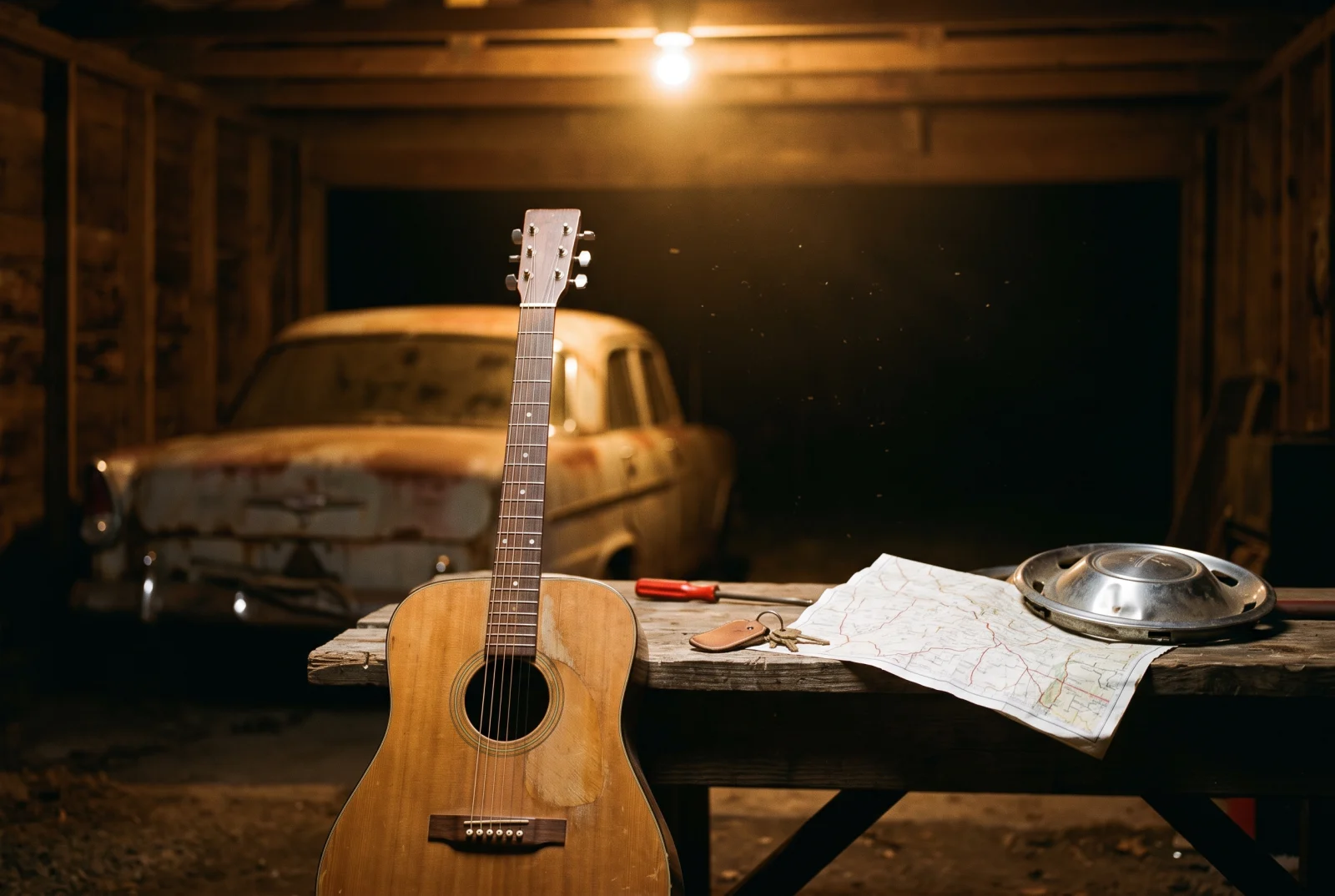
Ilustración: Rebobinados
The best-known biker anthem in the world was written by a man who had never been on a motorcycle, and he wrote it as a slow folk ballad about his first car: a beat-up Ford Falcon. His name was Mars Bonfire, the stage name of Dennis Eugene McCrohan, and by the time "Born to Be Wild" was recorded he was no longer in the band—he had left in June 1967—and the band wasn't even called Steppenwolf yet. He was the drummer's older brother, he signs the song alone and with no co-writers, and the motorcycle everybody hears in there isn't his doing: it was put there by someone else's arrangement and by the edit of a film that wasn't his either.
Oshawa, 1964, and the drummer's brother
Steppenwolf did not come out of nowhere in California at the end of the sixties. The group had been running since early 1964 in Oshawa, Ontario, as Jack London and the Sparrows, with a singer named Dave Marden who called himself Jack London; when Marden left they carried on as The Sparrows and later as Sparrow. John Kay joined in September 1965, and in November 1966 the group moved to California, first to West Hollywood and then to San Francisco. In June 1967 Dennis Edmonton—the McCrohan brothers had changed their surname to Edmonton in the early sixties—left the band to pursue a solo career under the name Mars Bonfire, and guitarist Michael Monarch came in to take his place. His younger brother, Jerry Edmonton, stayed on drums.
The name wasn't a literary nod from the group either. It was suggested by their producer, Gabriel Mekler, born on December second, 1942 in Mandatory Palestine, a classically trained pianist and a staff producer at Dunhill, who had just finished reading Steppenwolf, the novel Hermann Hesse published in 1927. Kay hadn't read it. The Mekler quote preserved in the singer's archive is anything but reverential: "Well look, how about Steppenwolf? I think it's a word that looks good in print, and it denotes a certain degree of mystery and power and you guys are kind of rough and ready types." That is how a demo tape came to be labeled in late 1967, in Los Angeles, and that is what the lineup that recorded the debut was called: John Kay on vocals and rhythm guitar, Michael Monarch on lead guitar, Rushton Moreve on bass, Goldy McJohn on organ and Jerry Edmonton on drums and second vocals.
The dark glasses were a diagnosis
John Kay was born Joachim Fritz Krauledat on April twelfth, 1944 in Tilsit, East Prussia, a city that is now called Sovetsk and sits in Kaliningrad Oblast, in Russia. His father, Fritz Krauledat, born in 1913, was killed at the front roughly a month before he was born. In early 1945 his widowed mother fled with the baby from the advancing Red Army; the train was left stranded near Arnstadt, in what ended up being the Soviet occupation zone, and in the late forties they crossed into the British zone and settled in Hanover. In 1958, at fourteen, he arrived in Toronto, and there he turned "Joachim" into "John K" because his teachers couldn't pronounce it. In 1963 he moved to Buffalo, in New York State, and became a naturalized American citizen.
The dark glasses he never took off, the most recognizable piece of wardrobe the band had, weren't wardrobe. Kay has congenital achromatopsia, plus an astigmatism in his left eye he was born with, and together they leave him legally blind. He explains it himself with a precision that admits no decoration: "I have what is known as achromatopsia, a birth defect. There are about forty thousand of us in North America. It comes in two flavors: one, extreme light sensitivity, hence the dark glasses; and two, total color blindness." And he caps it off: "My whole world is essentially black-and-white photography." He wore the glasses in daytime because of the photophobia and simply didn't take them off under the stage lights, even when it made the neck of the guitar hard to see. That was why he was classified 4-F, unfit for military service. The flip side of the coin is that at night he sees better than a person with normal vision, like a nocturnal creature.
A sign that said "Born to Ride"
The song was born in a shop window. Bonfire saw a sign in a Hollywood store that said "Born to Ride", and what he wrote from there was a slow folk ballad about life on the road, inspired by his first car, a Ford Falcon in bad shape. He had never ridden a motorcycle. Kay confirms it: when Bonfire first played it for him, that is what it was, a folk ballad. The band sped it up and turned it into hard rock under Mekler's production, and the biker anthem the world knows is entirely the work of that arrangement, not of the intention of the man who signed it.
What Bonfire took with him was the entire writing credit. He appears alone in the credits, with no co-writers, so that the songwriting royalties on Steppenwolf's biggest hit belong to someone who was no longer part of Steppenwolf when the record came out. He recorded two solo albums, Mars Bonfire in 1968 and Faster Than the Speed of Life in 1969, never had another comparable hit, and the band recorded at least five more of his compositions. In Southern California he became known for something else: as a leader of hiking groups, with the Hundred Peaks Section list completed twenty-five times. On June twenty-second, 2015 SOCAN gave him the Cultural Impact Award for "Born to Be Wild".
The debut, Steppenwolf, came out in January 1968 on Dunhill/ABC and reached number six on the Billboard 200, with an RIAA gold record on November twenty-seventh, 1968. The single entered the Hot 100 the week of July thirteenth, 1968 at number seventy and peaked at number two: what kept it off the top was "People Got to Be Free", by The Rascals. In Canada it was number one on the RPM chart dated September second, 1968, with one week at the top, and in the United Kingdom it reached number thirty, while a 1999 reissue climbed to eighteen. It went gold as a single on September nineteenth, 1968, placed at number one hundred twenty-nine on Rolling Stone's five hundred greatest songs in 2004 and at twenty-nine on the American Film Institute's list of songs.
Of the three songs the band is remembered for, only one carries its signature, and only half of it. "The Pusher" is by Hoyt Wayne Axton, born on March twenty-fifth, 1938 in Duncan, Oklahoma, who wrote it around 1963 in the wake of a friend's fatal overdose; his mother, Mae Boren Axton, was a co-writer of "Heartbreak Hotel" along with Tommy Durden, with the added credit for Elvis Presley that was standard practice at the time, and she resisted at first releasing "The Pusher" because of the biblical-curse language of the lyric. The social conscience of that song belongs to Axton; what belongs to the band is the decision to open its debut with it, recorded in the autumn of 1967 at American Recording Co., in Calabasas. "Magic Carpet Ride" is signed by Kay, along with Rushton Moreve—real name John Rushton Morey—and it was born out of a three-note bass riff of Moreve's own: it entered the Hot 100 on September twenty-ninth, 1968 at number eighty-six, reached number three on November twenty-fourth and spent sixteen weeks on the chart.
The film wasn't theirs, and neither was the genre
In Easy Rider the song went in as temporary music and stayed. Peter Fonda originally wanted Crosby, Stills & Nash to do the soundtrack; during the edit, Dennis Hopper and editor Donn Cambern cut the road sequences against the records they had on hand, and almost all of those temp tracks survived into the finished film. Hopper told it without ceremony: "I didn't cut the film to the music. But later, when I put 'Born To Be Wild' on there, it just worked, man." The film premiered at Cannes on May thirteenth, 1969 and opened commercially in New York on July fourteenth. The soundtrack album, from August 1969, opens with "The Pusher" and "Born to Be Wild" in that order: the only two Steppenwolf songs on the record, and neither of the two written by Steppenwolf. Mekler, the producer who christened the group and sped up the ballad, died in a motorcycle accident in September 1977.
There remains the other legacy, the one that gets told worse. In the second verse of "Born to Be Wild" the words "heavy metal" appear, and it is probably the first time they are heard inside the lyric of a rock song. But they don't name a genre there: they describe a motorcycle. The expression came out of literature—William Burroughs had already christened a character "the Heavy Metal Kid" in The Soft Machine, from 1961, as a metaphor for the drug—and a rock record had used it as a title, Featuring the Human Host and the Heavy Metal Kids, by Hapshash and the Coloured Coat, in November 1967, two months before the Steppenwolf single came out. The ones who turned it into the name of a genre were the critics: Mike Saunders in Rolling Stone in November 1970 and in Creem in 1971, with parallel claims from Lester Bangs and Sandy Pearlman. Steppenwolf did not christen heavy metal; it put the phrase into circulation.
There isn't even agreement among the critics. Saunders contradicted himself on the record: in one correspondence he denied being the inventor and pointed to Bangs, and in a 2001 interview he claimed paternity for his review of Kingdom Come, by Sir Lord Baltimore. Bangs is credited with an earlier use in a review of Canned Wheat, by The Guess Who, other Canadians, but he preferred to talk about "downer rock" for bands like Black Sabbath, which weakens the claim. Academic research treats all of these accounts with skepticism: Deena Weinstein reviewed them in Rock Music Studies in November 2013 and concluded that "the term, in part and as a whole, was in the cultural air of the times". When heavy metal finally had a name, it wasn't a band that gave it one: it was an editorial office.
What to remember
The band split up for the first time on February fourteenth, 1972, came back in 1974, fell apart again in the early autumn of 1976 and regrouped in 1980 to bill itself from then on as John Kay & Steppenwolf; the last concert was on October fourteenth, 2018, in Baxter Springs, Kansas. Three of the five who recorded the debut are gone: Rushton Moreve died on July first, 1981, at thirty-two, in a traffic accident in California whose location and whose vehicle the sources cannot agree on; Jerry Edmonton, on November twenty-eighth, 1993, at forty-seven, in a car accident in Santa Ynez; Goldy McJohn, on August first, 2017, at seventy-two, of a heart attack at home. John Kay and Mars Bonfire are still alive. In 2018 the Rock and Roll Hall of Fame inducted "Born to Be Wild" in the singles category: the song is in and the band is not, which sums the matter up fairly well.
Steppenwolf was a genuinely Canadian band, with two gold records in thirteen months and a second album, Steppenwolf the Second, which reached number three on the Billboard 200 and was the highest they ever got. But the monument they carry wasn't built by them alone, and it is worth saying so without softening it: the writing belongs to a former member who was thinking about a car, the arrangement belongs to the group and to its producer, and the mythology belongs to an edit put together with temporary music. When that riff kicks in on an empty highway, there is no motorcycle in there: there is a beat-up Ford Falcon from Oshawa, a sign in a Hollywood shop window and a man who had already left the band.
Sources
Steppenwolf was a hard rock band formed in Los Angeles in late 1967, with a Canadian prehistory: Jack London and the Sparrows (Oshawa, Ontario, early 1964), then The Sparrows and Sparrow. John Kay joined in September 1965; the group moved to California in November 1966. Dennis Eugene McCrohan, later Dennis Edmonton and artistically Mars Bonfire (b. April 21, 1943, Oshawa; alive, 83 years old), older brother of drummer Jerry Edmonton, left the band in June 1967 and was replaced by Michael Monarch. The name was suggested by producer Gabriel Mekler (b. December 2, 1942, Mandatory Palestine; died in a motorcycle accident in September 1977), after "Steppenwolf" (1927) by Hermann Hesse. Debut lineup: John Kay (vocals, rhythm guitar), Michael Monarch (lead guitar), Rushton Moreve (bass), Goldy McJohn (organ) and Jerry Edmonton (drums and second vocals). John Kay was born Joachim Fritz Krauledat on April 12, 1944 in Tilsit, East Prussia (today Sovetsk, Kaliningrad Oblast, Russia); his father Fritz Krauledat (b. 1913) was killed at the front around a month before his birth; the family fled in 1945, was left stranded near Arnstadt and settled in Hanover after crossing into the British zone in the late 1940s (sources disagree between 1948 and 1949); he emigrated to Toronto in 1958 and was naturalized as an American citizen in 1963 after moving to Buffalo. Kay has congenital achromatopsia and congenital astigmatism in his left eye, a condition that leaves him legally blind and explains the permanent use of dark glasses; he was classified 4-F. "Born to Be Wild" was written alone by Mars Bonfire as a folk ballad about his first car, a Ford Falcon in bad shape, starting from a sign reading "Born to Ride" seen in a Hollywood shop window; its author had never ridden a motorcycle. "The Pusher" is by Hoyt Wayne Axton (b. March 25, 1938, Duncan, Oklahoma), written around 1963; his mother, Mae Boren Axton, was a co-writer of "Heartbreak Hotel" (1956) with Tommy Durden, with an added credit for Elvis Presley. "Magic Carpet Ride" was signed by John Kay and Rushton Moreve (real name John Rushton Morey). The album "Steppenwolf" (January 1968, Dunhill/ABC) reached No. 6 on the Billboard 200 and was certified Gold by the RIAA on November 27, 1968; "Steppenwolf the Second" (1968) reached No. 3 and was Gold on February 12, 1969. "Born to Be Wild" entered the Billboard Hot 100 in the week of July 13, 1968 at No. 70 and peaked at No. 2, blocked by "People Got to Be Free" by The Rascals; No. 1 in Canada (RPM, chart of September 2, 1968, one week), No. 30 in the United Kingdom in 1968 and No. 18 on the 1999 reissue; RIAA Gold as a single on September 19, 1968; No. 129 on Rolling Stone's 500 Greatest Songs (2004) and No. 29 on AFI's 100 Years…100 Songs (2004); inducted into the Rock and Roll Hall of Fame in 2018 in the singles category, without the band itself being inducted. "Magic Carpet Ride" entered the Hot 100 on September 29, 1968 at No. 86, reached No. 3 on November 24, 1968 and stayed 16 weeks on the chart; RIAA Gold on March 25, 1969. "Easy Rider" premiered at Cannes on May 13, 1969 and commercially in New York on July 14, 1969; its soundtrack (August 1969, ABC/Dunhill, No. 6 on the Billboard 200) opens with "The Pusher" and "Born to Be Wild"; the road tracks were edited by Dennis Hopper and editor Donn Cambern as temporary music. The expression "heavy metal" comes from "The Soft Machine" (1961) by William S. Burroughs, not from "Naked Lunch", and had already titled the record "Featuring the Human Host and the Heavy Metal Kids" by Hapshash and the Coloured Coat (November 1967, Minit Records), two months before the Steppenwolf single; its consolidation as the name of a genre is attributed to the critics between 1970 and 1971, with claims from Mike Saunders (Rolling Stone, November 12, 1970; Creem, May 1971), Lester Bangs and Sandy Pearlman, and is critically reviewed by Deena Weinstein in Rock Music Studies 1:1, November 2013. The band split up on February 14, 1972, reunited in 1974, dissolved in the early autumn of 1976 and reorganized in 1980 as John Kay & Steppenwolf; its last concert was on October 14, 2018 in Baxter Springs, Kansas. In 1977 Nicholas Kassbaum (Nick St. Nicholas) paid 17,500 dollars for a license on the name, and the resulting litigation ended in Kassbaum v. Steppenwolf Productions, Inc., 236 F.3d 487 (9th Circuit), decided on December 29, 2000 against Kay's side. Deaths: Rushton Moreve, July 1, 1981, 32 years old, traffic accident in California (sources disagree between a car in Sun Valley and a motorcycle in Santa Barbara); Jerry Edmonton, November 28, 1993, 47 years old, car accident in Santa Ynez, California; Goldy McJohn, August 1, 2017, 72 years old, heart attack. John Kay (82 years old) and Mars Bonfire (83 years old) are alive. On June 22, 2015 SOCAN gave Mars Bonfire the Cultural Impact Award for "Born to Be Wild"; Bonfire recorded the solo albums "Mars Bonfire" (1968) and "Faster Than the Speed of Life" (1969) and completed the Hundred Peaks Section list 25 times as a hiking leader in Southern California. Profile compiled for Rebobinados with fact-checking; interpretations of the meaning of the work are offered as the author's reading. No song lyrics are reproduced, for copyright reasons. Information drawn from Wikipedia, American Songwriter, Songfacts, uDiscoverMusic, Louder Sound, Ultimate Classic Rock, the American Film Institute catalog, achromatopsia.info, phrases.org.uk, CBC News, Justia and CourtListener, Find a Grave and Rock Music Studies.
Keep rewinding
90s
hard rock
Lenny Kravitz
He doesn't play that guitar
The riff of "Are You Gonna Go My Way" (9 March 1993) is not played by him: the guitar is Craig Ross's, the song is co-written with him and the Academy nominated them both for Best Rock Song in 1994. "Always on the Run" was written by Slash for Guns N' Roses. And one of his four straight male rock Grammys, the one of 23 February 2000, he won with "American Woman", by The Guess Who, from which he removed the guitar solo.
00s
hard rock
Thirty Seconds to Mars
The seven-year law
In August 2008, EMI sued them for thirty million dollars for breaching a 1999 contract they had signed before releasing a single record. They defended themselves with a Californian employment law that voids contracts of more than seven years, closed a settlement on 28 April 2009 and signed with the same label again. The Guinness record they ended up with is not a box-office one: it is three hundred and nine concerts on a single tour.
00s
hard rock
Queens of the Stone Age
The desert went through Seattle
Kyuss broke up in 1995 and Josh Homme went to Seattle as touring guitarist for Screaming Trees: there he met Mark Lanegan, a full member of Queens of the Stone Age between 2001 and 2005 and the second voice of Songs for the Deaf (2002), the album Dave Grohl played on. Nick Oliveri, also from Kyuss, was sacked in 2004. The band has nine Grammy nominations and no statuette.
Rewind with us
Comments · 0
No one has commented yet. Open the conversation.