
Editorial
The Voice Buried in a Cassette
By Rebobinados · Published on July 24, 2026
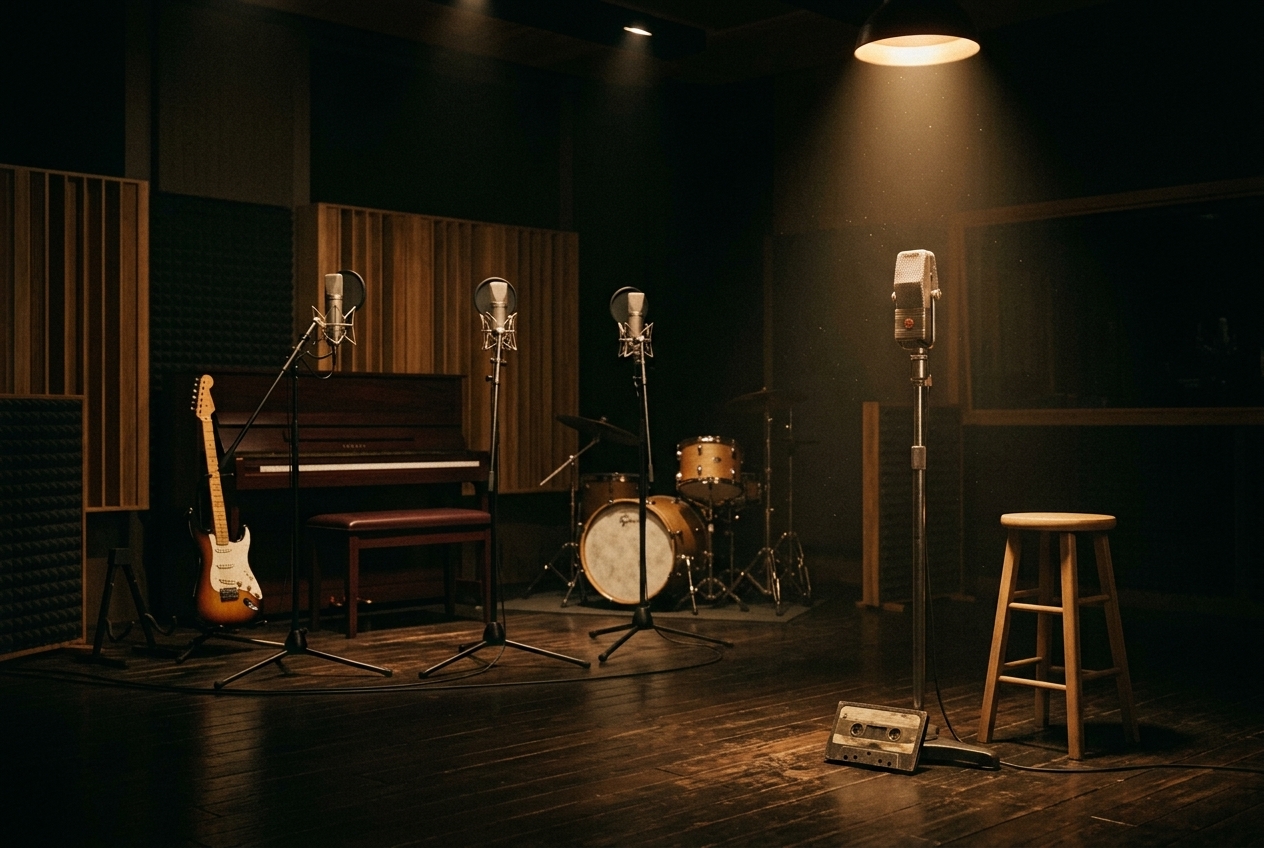
Ilustración: Rebobinados
What artificial intelligence can do to a song, and what it can't
Sometime in the late seventies, John Lennon sat down at the piano in his apartment at the Dakota, set a tape recorder on top of the instrument, and sang a half-finished song. It was called Now and Then. A home demo, the kind you record so you won't forget the idea: voice and piano coming through the same microphone, hopelessly tangled, the hum of the machine underneath.
In 1995, when Paul, George and Ringo came together for the Anthology project, Yoko Ono handed them that cassette. Free as a Bird and Real Love came out of it. Now and Then did not. Lennon's voice was welded to the piano; raise the vocal and you raised the piano too, with its living-room tuning and its rough-draft timing. George Harrison called the recording unusable, and that was that. George died in 2001. The song stayed in a drawer for nearly thirty years.
And then, in 2023, a machine managed to do it.
Separating is not composing
Peter Jackson's team had built a tool for the Get Back documentary: a machine learning system trained to recognise, inside a tangled recording, which part of the sound is a human voice, which part a guitar, which part the noise of the room. They needed it because in the 1969 tapes the Beatles talked over each other while the instruments played on top, and none of it was intelligible.
That same tool was turned on the Dakota cassette. And it worked: Lennon's voice came out clean, lifted off the piano, free of the hum. Paul and Ringo recorded around it, the guitar parts George had laid down in 1995 were folded back in, and on 2 November 2023 Now and Then was released as the last Beatles song. It went to number one in the United Kingdom, more than half a century after the first one.
It's worth pausing on what the machine actually did, because everything else follows from it. It composed nothing. It invented no melody, imitated no Lennon, filled in none of the missing verses. All it did was separate: take the piano off a voice that was already there, sung by a real man, on a real day, in a room in New York. It is closer to restoring a painting — lifting the darkened varnish so the original colour shows again — than to painting a new one.
That's why Now and Then moves people rather than unsettling them. What we hear happened. The technology only moved aside what was covering it.
The other side of the mirror
Six months earlier, in April 2023, another song had appeared online: Heart on My Sleeve, with Drake and The Weeknd trading verses over a contemporary beat. It was convincing. Within days it was everywhere.
Neither Drake nor The Weeknd had ever set foot in a studio to record it. An anonymous user had cloned their voices with artificial intelligence. The label had it pulled from the platforms, but the message had already landed: anyone can now manufacture a performance that never took place, in the voice of whoever they like.
And there is the line that seems to me the only one that matters in this argument. In one case, the machine rescued a real performance that was about to be lost. In the other, it manufactured a performance that never happened. Both draw on the same family of technology. They are not remotely the same thing.
What's being decided right now
As I write this, the industry is settling the matter in court, and it's worth knowing where things stand.
In June 2024, the three major labels — Sony, Universal and Warner — sued Suno and Udio, the two platforms that generate complete songs from a written prompt. The charge: training their models on millions of copyrighted recordings without asking permission or paying for the privilege.
Then came the interesting part. In October 2025, Universal reached an agreement with Udio; in November, Warner settled with both. And these weren't ordinary settlements: they came bundled with licences and a commitment to launch legal platforms, using the voices and songs of artists who opt in, with credit and with payment. Suno also agreed to retire the models trained on unlicensed music.
Sony didn't sign. It chose to stay in court and pursue a ruling, and that fight is still live in the United States, with key hearings this year. In Germany, the collecting society GEMA is running its own case against Suno. And in June 2026 a telling new front opened up: the American Federation of Musicians sued Universal and Warner, alleging that the money from those settlements isn't reaching the session musicians whose recordings were used to train the models.
That last detail says a great deal. The major labels negotiated their share. Independent artists and session players — the people who played bass on a thousand records and never made it onto a sleeve — are still waiting for someone to remember them.
The honest objection
It would be comfortable to stop here, with the machine in the dock. But there is an objection that deserves respect, and it is the entire history of popular music.
Every time a new machine appeared, someone declared that it wasn't music. They said it about the electric guitar, which "wasn't a real instrument". They said it about multitrack recording, which let you assemble a song no band could play in one take. They said it about the synthesiser, the drum machine, Auto-Tune. And they said it, with particular venom, about the sampler: when hip hop began building songs out of pieces of other people's records, the courts and much of the press treated it as theft. Nobody now disputes that one of the most fertile musical languages of the century came out of it.
So suspicion of the new guarantees nothing. The question can't be "is a machine involved?", because the answer has been yes since Les Paul started stacking tape.
The only question that matters
Walter Benjamin wrote an essay in 1935 that reads today like a prophecy. He argued that a work of art carries an aura: the weight of existing here and now, once only, and that mechanical reproduction — photography, the record, cinema — was dissolving it. When you can hear the same performance a thousand times, something of the unrepeatable character of that one night is lost.
Benjamin was half right, and his idea can be pushed a step beyond where he left it. A record reproduces something that happened: the orchestra played, somebody hit record. However far the copy sits from the original, there is an original. What today's generators do is something else: they produce a performance that has no first time. There is no night to remember, no room, nobody who fluffed the second bar and kept it because it sounded better that way.
So the question isn't whether a machine is involved. It's whether there is someone behind it, and whether that someone is credited and paid.
Now and Then passes that test comfortably: the voice is John's, the decision was Paul's and Ringo's, and the machine did a restorer's work. Heart on My Sleeve fails it: nobody sang, nobody decided, nobody was paid. And the platforms now rearranging themselves under legal pressure are trying, precisely, to move to the right side of that line — with licences, credits and opt-in participation — even if the queue of people still receiving nothing remains a long one.
There's something in all this that leaves me at peace. The best thing artificial intelligence has done with music so far wasn't inventing a new song. It was giving us back an old one: pulling a voice out from under a piano, on a demo written off for thirty years, and letting us hear a man singing in his apartment on an ordinary afternoon in the seventies, with no idea we were waiting for him.
Sources: the account of Now and Then draws on public statements by Paul McCartney and Peter Jackson's team regarding the audio separation system developed for The Beatles: Get Back (2021); the song was released on 2 November 2023. Heart on My Sleeve circulated in April 2023 and was removed from platforms at the label's request. The RIAA lawsuits against Suno and Udio were filed in June 2024; Universal settled with Udio in October 2025 and Warner with both platforms in November 2025, while Sony's claims remain active. The Benjamin essay cited is The Work of Art in the Age of Mechanical Reproduction (1935).
Keep rewinding
70s
folk
Florcita Motuda
Forty-nine years without a reissue
With "Brevemente… geeente" he won the best Chilean performer prize at Viña 1977, and he won it in the international competition because the folk one was not held that year. The album that contains it, released in 1977 on APRI —Antonio Prieto's label—, spent 49 years without a reissue: never on CD or streaming until it came back on vinyl in April 2026 and on digital on 11 July, the day he returned to the stage. The record for the longest title at the OTI is his, but it is from 1978 and not 1998.
70s
progresivo
Jean-Michel Jarre
Twenty-five times in his whole life
His father was Maurice Jarre, three Oscars for "Lawrence of Arabia", "Doctor Zhivago" and "A Passage to India", and he left home when the son was 5: "we saw each other twenty or twenty-five times in our whole lives". *Oxygène* came out in December 1976, recorded in the former kitchen of his flat with a broken Mellotron, and sold some 18 million. Of his father's inheritance he received nothing: the European Court of Human Rights dismissed the case on 15 February 2024.
70s
folk
Piero
The old man wasn't his
Piero sang "Mi viejo" in 1969, but the words are José Tcherkaski's and the father it portrays was his own: Mario Tcherkaski, a Russian street hawker who died at 52, eight years before the song. CBS released it with Father's Day in mind after several labels turned it down, and the first pressing passed 600,000 copies. Piero died on 7 October 2026, aged 81.
Rewind with us
Comments · 0
No one has commented yet. Open the conversation.