
Piero
The old man wasn't his
By Rebobinados · Published on October 8, 2026
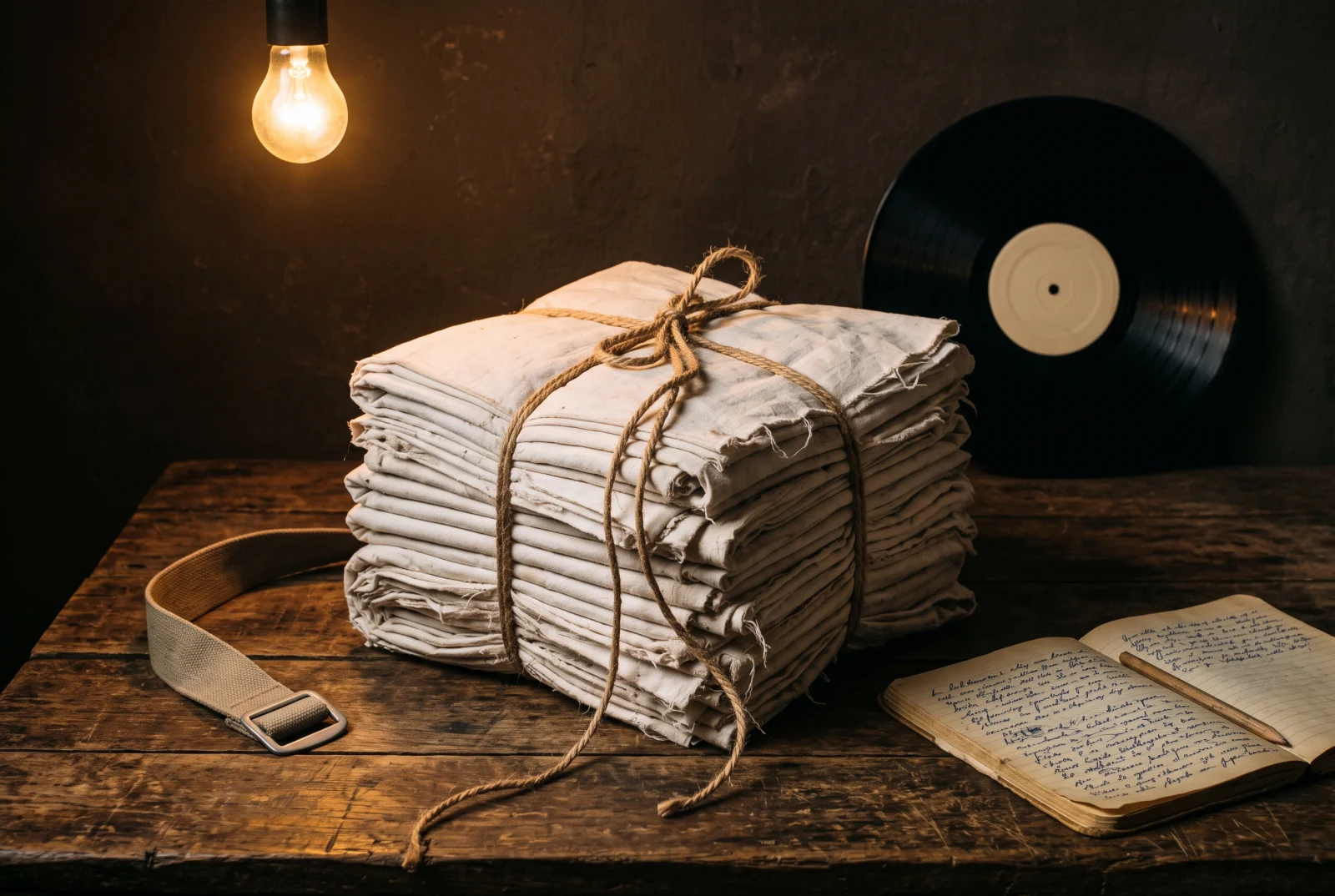
Ilustración: Rebobinados
There is a song that half a continent sings to its father, and the father it speaks of was not the father of the man who sang it. "Mi viejo" — my old man, in Argentine Spanish — came out in 1969 with Piero's voice and Piero's music, and so for fifty-seven years it was told as the story of an Italian son watching his father grow old. The lyrics are not his. They belong to José Tcherkaski, and the man they portray was somebody else: a street vendor who walked Buenos Aires with bedsheets over his shoulder and who had been dead for eight years when the song was written. Piero died on the seventh of October, 2026, at eighty-one, and it is worth starting there, because it is the loveliest misunderstanding in Argentine popular music.
The old man in the song sold bedsheets
Mario Tcherkaski was Russian, from a Jewish family, one of those who lost everything in the Russian Revolution and ended up in Argentina starting from nothing. He married Berta, of Polish descent, and made his living as a street vendor. He died at fifty-two, when his son José was fourteen.
At twenty-two, José Tcherkaski was a journalist at the magazine Siete Días and had written a poem about his father called "El ambulante". The lyrics came out of that. He told it himself without any embellishment: he had never thought about writing a song, and what he had was a sense of abandonment carried since he was fourteen. Piero put the music and the voice to it.
What happened next has less of the miracle about it and more of the commercial trade. Several companies turned it down. It was the CBS executive Héctor Techeiro who saw the business in it, and he released it aiming at Father's Day. The first pressing passed six hundred thousand units.
And from there it never stopped: it was sung by Vicente Fernández, Lucho Gatica, Nicola Di Bari and Leo Dan; Iva Zanicchi recorded it in Italian in 1970; it turned up in the Mexican dub of Los Simpson and in the Amazon series about Maradona. The Spanish language's hymn to fathers was written by an orphaned boy about a Russian immigrant, and it was made popular by an Italian whose own father sold radios and record players in Patagonia.
From Gallipoli to a radio shop in Allen
Piero Antonio Franco De Benedictis was born on the nineteenth of April, 1945 in Gallipoli, in the Italian region of Apulia, and reached Argentina in 1948, aged three. The family settled first in Banfield and in 1951 moved to Allen, in the province of Río Negro, where his father opened a shop selling radios and record players and where he went through primary school and made his first attempts at the piano. Then came two seminaries, in Viedma and in Villa Devoto: he wanted to be a priest before he wanted to be a singer.
He made his debut in 1964 on Canal 9, on Roberto Galán's program, and in 1969 he won First Prize at the Festival de la Canción de Buenos Aires with "Cómo somos". The following year came the record almost nobody mentions: with "Pedro Nadie", also with lyrics by Tcherkaski, he won the international round of the Festival Internacional da Canção in Rio de Janeiro, the first time Argentina had taken that stage of the contest.
That is the partnership that explains his work. Piero supplied the music and almost never the words, and for years the lyricist was Tcherkaski: "Mi viejo", "Pedro Nadie", "Para el pueblo lo que es del pueblo", "Que se vayan ellos", "El pibe Ramón". The voice was his; the words, somebody else's.
The song the dictatorship put in writing on a list
In 1973 he recorded live, at the Teatro de Luz y Fuerza in Buenos Aires, the album Para el pueblo lo que es del pueblo, released the following year. It is his political record and that is not a metaphor: it is dedicated to Víctor Jara, murdered in September of that same year, and it includes his "Te recuerdo Amanda". In those years his songs circulated inside what was called the Cancionero de la Liberación, the repertoire of revolutionary Peronism, and a militant from Córdoba summed it up by saying that those songs circulated far more than the Cantata Montonera.
After the coup of 1976, the song that gave that album its title ended up in writing on the COMFER's lists of banned songs, some two hundred songs across seven pages that only became publicly known in 2009, with Horacio Guarany, Alfredo Zitarrosa and Jara himself on the same list. The album stayed banned until 1983.
He left in 1976. The press still repeats today that there was a kidnapping attempt, and Piero expressly denied it in 2017: somebody called it that and the name stuck. What there was was his name on a military list, an ex-boyfriend of his sister Gabriela who saw it and went to warn her, and a suitcase she packed for him in tears while he refused to believe it because all he did was sing and he bothered nobody. He went to a friend's house, they climbed up to the terrace of a fourteenth floor from which his own home was visible, and ten minutes later they watched two Ford Falcons with no license plates pull up. He spent four years in Spain — in an old mill in the village of Utande, in Guadalajara, with a vegetable garden — and close to one in Bogotá. He came back in 1981.
The other anthem he did not write
The comeback album was Calor humano, recorded live at the Teatro Fénix in 1981, and on it he premiered "Soy pan, soy paz, soy más", which is today his most international song. The lyrics are not his either, nor Tcherkaski's: they are by the Uruguayan poet Luis Ramón Igarzábal, a rural schoolteacher. The music, a crossing of chacarera with Paraguayan guarania, is.
What turned it into a continental anthem happened in Madrid. Piero sang it where Mercedes Sosa was living in exile, and Sosa recorded it on a walkman right there; her guitarist Omar Espinosa put an arrangement together and the next day they premiered it at a concert at the Universidad de Madrid. In February 1982, with the dictatorship still in power, Sosa played eleven sold-out shows at the Teatro Ópera in Buenos Aires — from the eighteenth to the twenty-eighth — and the album that came out of those nights opens its side A with "Soy pan, soy paz, soy más". Among the guests on those nights were León Gieco and Charly García.
His own explanation of the turn that followed was that he had traded songs of protest for songs of proposal. In 1982 he brought the yoga teacher Indra Devi to Buenos Aires, who stayed on to live in the city and with whom he recorded an album in 1993; he put together an electric band called Prema, which Alejandro Lerner passed through on keyboards, and in the summers at Villa Gesell he set up a giant tent he called the Carpa de las Buenas Ondas. In 2021 he recorded "Soy pan, soy paz, soy más" again alongside León Gieco and Víctor Heredia, this time for peace in Colombia.
Colombian by decree
The Colombian business was not affection: it was a passport. In October 1994 President Ernesto Samper handed him Colombian nationality and the title of Ambassador of Peace. The link came out of the exile: in Bogotá he had stayed at the home of the journalist Daniel Samper Pizano, brother of the future president. Piero told that he received the nationality that night and flew back to Argentina that same night, against everybody's expectations. And he left it on record that being Colombian mattered more to him than receiving a Grammy.
What he did with it was work on the ground: free concerts in Urabá, in the north of Cauca and in Meta, a presence at the peace talks in San Vicente del Caguán, the Manifiesto por la Paz launched in Santander de Quilichao in 2012, meetings with FARC spokesmen in Havana and with the ELN in Medellín, and public support for the "Yes" in the plebiscite of 2016. In 1999 he recorded a live album in Colombia with Pablo Milanés. Around twenty-five albums and, according to the Latin Recording Academy when it gave him the Musical Excellence Award in 2016, more than three million records sold.
And he did not retire. On the nineteenth of April, 2026 he turned eighty-one on a stage in Bogotá, reviving La sinfonía inconclusa en la mar, the children's work he had recorded in 1975. Six days before he died he was publicly celebrating that Saint Laurent had chosen his voice to open the show for its summer 2027 collection in Paris, with "Io vengo", the Italian version of one of his early songs about humble origins.
What to remember
Piero died on the morning of the seventh of October, 2026, at the Hospital Italiano in Buenos Aires, at eighty-one, after several days in hospital. The family did not report the cause, and it is worth putting it exactly that way: several outlets wrote "pneumonia" in the conditional, recycling an emergency hospitalization he had had in Ecuador in 2023. He was buried on the ninth of October in the Cementerio de la Recoleta.
What he leaves behind is a body of work built on a paradox that honors him more than it diminishes him: the two songs that made him immense — the hymn to the father and the hymn to dignity — were written by other people. An orphaned journalist of fourteen and a Uruguayan rural schoolteacher. What was Piero's was the music, the voice and the decision about what to sing: winning a festival in Rio, dedicating a record to Víctor Jara the year they killed him, ending up on a COMFER list of banned songs, leaving the country ten minutes before two Falcons with no license plates arrived, and going back to singing.
When somebody hugs their father and remembers "Mi viejo", that is where what he built is. The old man in the song was not his, and that is why he could be everybody's.
Sources
Piero Antonio Franco De Benedictis ("Piero") was born on 19 April 1945 in Gallipoli, province of Lecce, region of Apulia, Italy, and arrived in Argentina in 1948, aged 3. The family settled in Banfield and in 1951 moved to Allen, province of Río Negro, where his father had a radio and record-player shop; he attended seminary in Viedma and in Villa Devoto. He made his debut in 1964 on Canal 9, on Roberto Galán's program. In 1969 he won First Prize at the Festival de la Canción de Buenos Aires with "Cómo somos" and released his debut album on CBS, including "Mi viejo", whose lyrics are by José Tcherkaski and whose music is by Piero; the first pressing passed 600,000 units. "Mi viejo" is written about Mario Tcherkaski, the lyricist's father, a Russian immigrant from a Jewish family and a street vendor, who died at 52 when José Tcherkaski was 14, and it comes from an earlier poem by Tcherkaski himself titled "El ambulante"; the CBS executive Héctor Techeiro released it with Father's Day as the commercial target after several companies had turned it down. The song was recorded by, among others, Vicente Fernández, Lucho Gatica, Nicola Di Bari and Leo Dan, and by Iva Zanicchi in Italian in 1970. In 1970 Piero won the international round of the V Festival Internacional da Canção in Rio de Janeiro with "Pedro Nadie" (music by Piero, lyrics by Tcherkaski), the first Argentine win at that stage of the contest. In 1973 he recorded live at the Teatro de Luz y Fuerza in Buenos Aires the album "Para el pueblo lo que es del pueblo", released in 1974 by CBS, dedicated to Víctor Jara —murdered in September 1973— and including his "Te recuerdo Amanda"; the title track appears on the COMFER's lists of banned songs during the dictatorship, made public in August 2009, and the album remained banned until 1983. His songs circulated between 1972 and 1973 within the repertoire of the so-called Cancionero de la Liberación, linked to revolutionary Peronism. He went into exile in 1976 after the coup d'état: he lived some four years in Spain —in the village of Utande, province of Guadalajara, and in Madrid— and close to a year in Bogotá, and returned in 1981. In a 2017 interview he denied that there had been a kidnapping attempt, a version the press repeats: the documented fact is the appearance of his name on a military list, the warning received through his sister Gabriela and the arrival of two Ford Falcons with no license plates at his home minutes after he left. The comeback album, "Calor humano" (1981), recorded live at the Teatro Fénix for the Buenas Ondas label, includes the premiere of "Soy pan, soy paz, soy más", whose lyrics are by the Uruguayan poet Luis Ramón Igarzábal and whose music is by Piero. Mercedes Sosa came across it in Madrid during her exile, recorded it on a walkman and premiered it the next day at a concert at the Universidad de Madrid with an arrangement by her guitarist Omar Espinosa; Sosa played eleven sold-out shows at the Teatro Ópera in Buenos Aires from 18 to 28 February 1982, and the resulting album, "Mercedes Sosa en Argentina" (Philips), opens its side A with that song. In 1982 Piero brought the yoga teacher Indra Devi to Argentina, with whom he recorded an album in 1993; he formed the band Prema, which Alejandro Lerner passed through, and set up the Carpa de las Buenas Ondas in Villa Gesell. In 2021 he recorded "Soy pan, soy paz, soy más" with León Gieco and Víctor Heredia. In October 1994 the Colombian president Ernesto Samper granted him Colombian nationality and the title of Ambassador of Peace; he took part in the peace talks in San Vicente del Caguán, launched the Manifiesto por la Paz in Santander de Quilichao in 2012 and publicly supported the "Yes" in the plebiscite of 2016. In 1999 he released "Piero & Pablo en vivo desde Colombia" with Pablo Milanés. He received the Diploma al Mérito from the Fundación Konex in 1985 and the Latin Grammy Award for Musical Excellence in 2016, on which occasion the Latin Recording Academy recorded more than three million records sold. On 19 April 2026 he turned 81 performing in Bogotá with "La sinfonía inconclusa en la mar"; around 1 October 2026 he publicly thanked Saint Laurent and its creative director Anthony Vaccarello for opening the Paris show of the summer 2027 collection with his recording "Io vengo". He died on the morning of 7 October 2026 at the Hospital Italiano in Buenos Aires, at 81, after several days of hospitalization; neither the family nor the hospital reported the cause, and the press mentions of pneumonia appear in the conditional, while the documented pneumonia episode corresponds to an emergency hospitalization in Ecuador in April 2023. He was laid out on 8 October at the Sala Velatoria Lázaro Costa in Buenos Aires and buried on 9 October in the Cementerio de la Recoleta. Profile compiled for Rebobinados with fact-checking; interpretations of the meaning of the work are offered as the author's reading. No song lyrics are reproduced, for copyright reasons. Information drawn from Infobae, La Nación, El Tiempo, El Espectador, Diario Río Negro, Prensa Latina, Cadena 3, Semana, Perfil, Rolling Stone en Español and Wikipedia.
Keep rewinding
70s
folk
Florcita Motuda
Forty-nine years without a reissue
With "Brevemente… geeente" he won the best Chilean performer prize at Viña 1977, and he won it in the international competition because the folk one was not held that year. The album that contains it, released in 1977 on APRI —Antonio Prieto's label—, spent 49 years without a reissue: never on CD or streaming until it came back on vinyl in April 2026 and on digital on 11 July, the day he returned to the stage. The record for the longest title at the OTI is his, but it is from 1978 and not 1998.
00s
folk
Natalia Lafourcade
Where it said pumpkin she put flowers
The story says she rescued the son jarocho with reverence on *Un Canto por México*, but "La Bruja" is not on that record: she recorded it on *Cancionera*, on 24 April 2025, and rewrote the lyric. Where the son turns the man into a pumpkin, she sings that she filled him with flowers: "a cancionera is a kind of sorceress". Twenty Latin Grammys, a house rebuilt in Jáltipan and a harpsichordist father who left Chile two days after the coup.
70s
folk
Willie Nelson
Fifty dollars and sixteen million
He sold "Family Bible" for fifty dollars and lost it; "Hello Walls", nine weeks at country no. 1 in 1961, was what turned him into a national songwriter. On 9 November 1990 the IRS seized assets in six states: it claimed 32 million, assessed 16.7 and closed a settlement for some 9 on 2 February 1993. He paid it with a double album sold on television at 19.95 dollars.
Rewind with us
Comments · 0
No one has commented yet. Open the conversation.