
Natalia Lafourcade
Where it said pumpkin she put flowers
By Rebobinados · Published on October 11, 2026
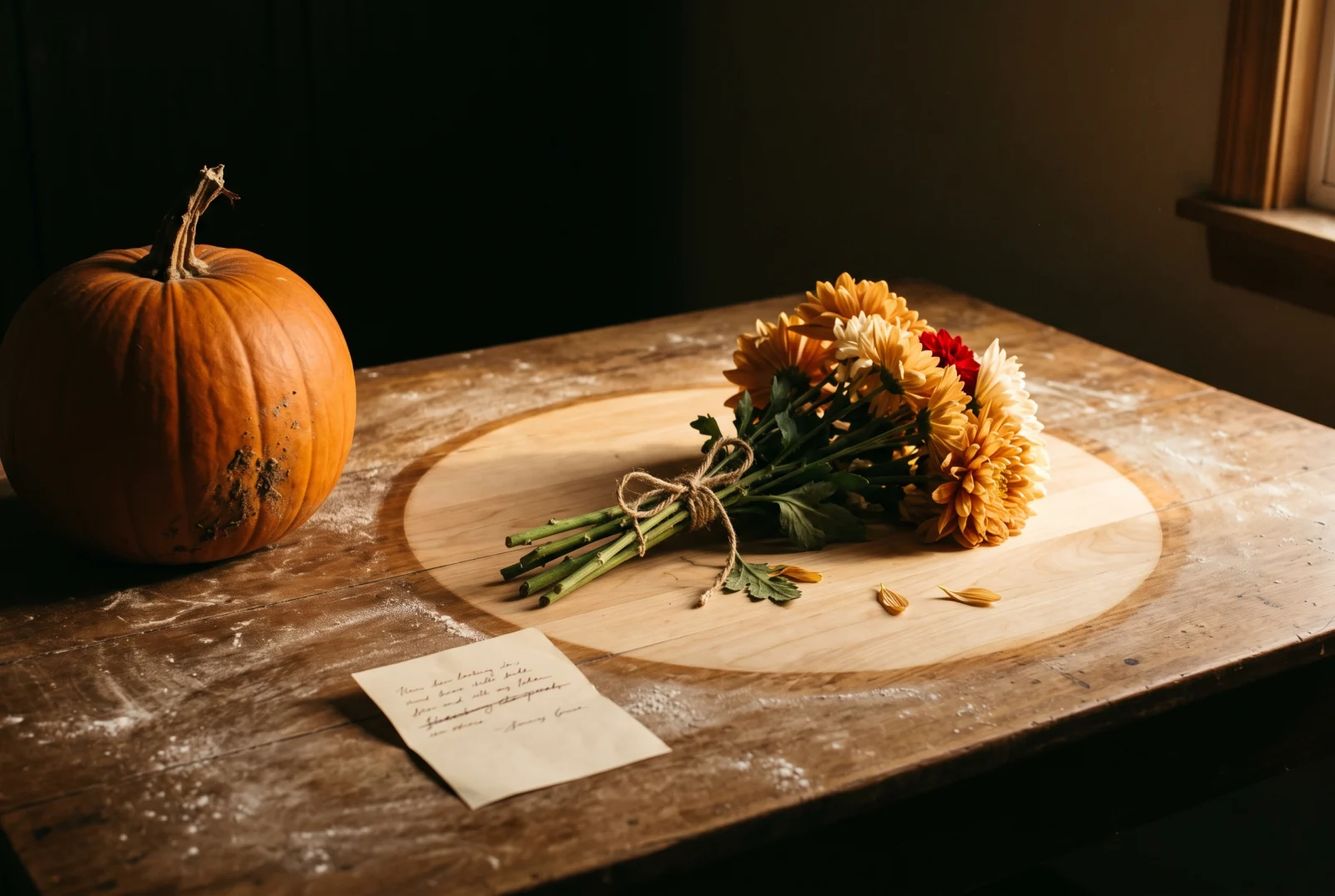
Ilustración: Rebobinados
The usual story about Natalia Lafourcade says she was a Mexican teen pop star who turned around, went into the bolero and the son jarocho and devoted herself to caring for the old songbook with a restorer's reverence. The proof always cited is "La Bruja", the traditional son from the Sotavento region of Veracruz that she supposedly rescued on Un Canto por México. There are two problems with that. The song is not on that record, nor on the second volume, nor on either of the two Musas. And when she finally did record it, years later, she did not leave it as it was: she rewrote the lyric. Where the son says the witch turned the man into a pumpkin, she sings that she filled him with flowers. What she does with tradition is not to guard it. It is to touch it.
A horse, a method and her mother's first pupil
María Natalia Lafourcade Silva was born on the twenty-sixth of February 1984 in Mexico City and grew up in Coatepec, Veracruz, the town where she lives again today. Her mother, María del Carmen Silva Contreras, is a pianist and teacher, and the author of the Método Macarsi, a system of musical development for children. At the age of six Natalia had an accident with a horse, and her mother adapted the method to rehabilitate her with music: she was the first person to be musically educated with it. Her father, the Chilean harpsichordist Gastón Lafourcade Valdenegro, comes into this story later on, and he comes in twice.
She joined Twist, a teen pop group, in 1998, at the age of fourteen, alongside Tabatha Vizuet; the group broke up in 2000. Her first solo record, Natalia Lafourcade, came out on the eighth of July 2002 on Sony Music México, produced by Áureo Baqueiro and Loris Ceroni. It was number one in Mexico and a platinum record, with one hundred and fifty thousand copies sold. And it is worth correcting the detail that almost everybody gets the wrong way round: the first single was "Busca un Problema", and "En el 2000" —which she wrote herself— was the second.
Then she put together Natalia y La Forquetina, a four-piece: her on vocals and guitar, Alonso Cortés on drums, César Chanona on bass and Yunuén Viveros on keyboards. Their only record, Casa, appeared in 2005, produced in essence by Emmanuel del Real, of Café Tacvba. The band announced its break-up on the second of June 2006 and five months later, on the second of November, Casa won the Latin Grammy for Best Rock Album by a Duo or Group: the award arrived when there was no longer anybody to give it to. In March 2008 she went into the MTV Unplugged of Julieta Venegas, and not as a guest but as a member of the band; over the course of the concert she played seven different instruments: vibraphone, banjo, timple, musical saw, cavaquinho, glockenspiel and clavinet.
Hasta la raíz, with another signature alongside
Mujer Divina – Homenaje a Agustín Lara, from the eighteenth of September 2012, was the first record on which she handed herself over entirely to someone else's repertoire: "Mujer divina" is a Lara song, not hers, and so is the rest. It also had a curious and deliberate rule: all the guests were men —Devendra Banhart, Jorge Drexler, Miguel Bosé, Kevin Johansen, León Larregui—, because women had been Lara's main inspiration. It ended up three times platinum plus gold in Mexico and won two Latin Grammys in 2013.
The big turn came with Hasta la Raíz: the single on the sixth of January 2015 and the album on the seventeenth of March. The song that gives it its title is not hers alone: she signs it with Leonel García, formerly of Sin Bandera, who also contributed the huapango riff and co-produced the record with her and with Cachorro López. It won four Latin Grammys on the nineteenth of November 2015 —Record of the Year, Song of the Year, Best Alternative Song and Best Alternative Music Album— and the American Grammy for Best Latin Rock, Urban or Alternative Album on the fifteenth of February 2016. It did not win Album of the Year: that one went to Juan Luis Guerra.
Then came the two Musas, from the fifth of May 2017 and the ninth of February 2018, recorded with Los Macorinos, that is Miguel Peña and Juan Carlos Allende, the two guitarists who had come from accompanying Chavela Vargas on her comeback tour; Peña died on the thirteenth of July 2025, at the age of eighty-seven, and the duo heard on those records no longer exists as it was. And here is where the figure that dismantles the story of the abandoned pop has to go: her most listened-to song comes after the turn towards the roots and arrived by the most commercial route of all. "Nunca es suficiente", from Hasta la Raíz, re-recorded as a cumbia with Los Ángeles Azules on the twentieth of April 2018, reached number one on Regional Mexican Airplay —the group's first since 1999— and the video passed two billion three hundred million views. She did not change lanes: she crossed both.
Jáltipan, the seventh of September and a house
The earthquake that matters in this story is not the one always cited. The one on the seventh of September 2017, magnitude eight point two, at eleven forty-nine at night, with its epicentre in the Gulf of Tehuantepec, left ninety-eight dead and damaged six municipalities in the south of Veracruz. One of the buildings left with serious cracks in its main structure was the Centro de Documentación del Son Jarocho, in Jáltipan de Morelos: a house founded in September 1998, free to enter, with workshops in jarana, marimba, singing, dance and weaving, run by Ricardo Perry Guillén, the same man who founded Los Cojolites. A good part of the press attributes the damage to the earthquake of the nineteenth of September, the Puebla and Morelos one; the correct date is the seventh.
Out of that came Un Canto por México. First a concert at the Auditorio Nacional, on the fourth of November 2019, with Carlos Rivera, Jorge Drexler, Café Tacvba, Mon Laferte, Pepe Aguilar and Los Cojolites, to raise the more than eleven million pesos that rehabilitating the building would cost. Then the records. The Vol. 1, from the eighth of May 2020, won three Latin Grammys on the nineteenth of November that year, among them Album of the Year —she was the third woman to win it as a lead artist, after Shakira and Rosalía— and the Grammy for Best Regional Mexican Music Album. The Vol. 2 came out on the twenty-eighth of May 2021, with Caetano Veloso and Rubén Blades among the guests. What the two volumes took in went to the building work.
The centre reopened on Friday the thirty-first of March 2023, at six in the evening, with her handing the restored building over to the organisation: "This space is yours, it is a community centre for Jáltipan". She is, literally, the godmother of the house. And this is the part the popular story confuses: the sones jarochos on those two records are "El Balajú", "Sembrando Flores" and "Mi Tierra Veracruzana", the last two with Los Cojolites. "La Bruja" is not there. It would arrive five years later, and not to be restored.
Where it said pumpkin
Before that there is a record not to be skipped. De Todas las Flores, from the twenty-eighth of October 2022, was her first entirely original material in seven years: it was produced by Adán Jodorowsky and recorded in full on analogue tape in a town in Texas, near El Paso, with Marc Ribot on guitar, Sebastian Steinberg on bass and Cyril Atef on percussion. She premiered it live at Carnegie Hall on the twenty-seventh of October 2022, a day before releasing it. It won three Latin Grammys in Seville on the sixteenth of November 2023 and the Grammy for Best Latin Rock or Alternative Album on the fourth of February 2024, shared with Juanes's Vida Cotidiana.
Cancionera came out on the twenty-fourth of April 2025, also recorded on tape and in live takes, with eighteen musicians in three weeks: fourteen songs, seventy-six minutes of bolero, ranchera, son jarocho, huapango, cumbia, tango and jazz, and an alter ego, La Cancionera. That is where "La Bruja" is, which is a son tuxtleco of the fandango from the Sotavento region, registered in 1951 in the name of José Luis López Santiago, whose lyric is sung alternating between the man and the witch who sucks his blood and turns him into an object. Lafourcade changed that ending. In her version the witch does not turn him into a pumpkin: she fills him with flowers. And she explained why: "a cancionera is a kind of sorceress, a kind of witch".
It is not a detail of arrangement, it is a statement of method. The traditionalist intervenes in the tradition, and she does it on the record that gave her the most awards in the least time. The figures, as of October 2026, are twenty Latin Grammys from forty-two nominations and five American Grammys from ten. That makes her the most awarded woman in the history of the Latin Grammy, well ahead of Shakira's fifteen, and seventh in the all-time ranking, which is led by Residente and Edgar Barrera with twenty-nine each. The last of those awards, the Grammy for Best Latin Pop Album for Cancionera, on the first of February 2026, was her first win in that category after four attempts; she did not attend the ceremony.
The harpsichordist who left Chile
Gastón Lafourcade Valdenegro was born on the twentieth of July 1935 in Angol, La Araucanía. A harpsichordist, organist, teacher and builder of harpsichords, a populariser of the baroque, he studied at the National Conservatory of the Universidad de Chile and went on to further study in Moscow; he was organist of the Basílica de la Merced in 1962 and founded the Asociación de Organistas y Clavecinistas de Chile in 1970. He is the brother of the writer Enrique Lafourcade, which makes the novelist Natalia's uncle. He left Chile two days after the coup of the eleventh of September 1973 and stayed in Mexico, teaching at the UNAM and, from 1987, in Querétaro. He is ninety-one.
Chile is not a loose surname in her: it is a documented route. "My dad, ever since I was little, used to play me Violeta Parra's music", she told the magazine Ya in April 2014, and she recalled that he would ask her to sit at the harpsichord and sing "Gracias a la vida". In January 2013 she travelled to Chile with him, for almost a month, and met her half-sisters there; in Osorno she wrote songs that ended up on Hasta la Raíz. The trail can be heard on record: "Qué He Sacado con Quererte", by Violeta Parra, is on Musas, Vol. 1. And in December 2020 she premiered Quien me tañe escucha mis voces, a documentary that films her father walking into a recording studio for the first time in his life; it was nominated for the 2021 Latin Grammy and is credited jointly with him. As of 2026 she still has not been to Angol.
The episode nobody tells is the other one. On the twenty-second of March 2022 the #SélvameDelTren video was circulated, with Lafourcade, Eugenio Derbez, Rubén Albarrán and Bárbara Mori, among others, asking for the route of section five of the Tren Maya to be changed because of the damage to the peninsula's system of underground rivers and cenotes. Andrés Manuel López Obrador criticised them from his morning press conference the following day, and on the thirty-first of March Morena filed a complaint against the signatories. On the fifth of April, in a video circulated by the networks of Morena Querétaro, Gastón Lafourcade asked for support for the works and expressed "profound admiration" for the president. On the eighteenth of April she replied that nobody had paid her to give an opinion and that she was not "for or against any political actor". Father and daughter on opposite sides of the same project, without a word out of place between the two of them.
What to remember
Natalia Lafourcade is not the restorer the story needs her to be. She was the first pupil of the method her mother invented to pull her through after an accident, the member of another singer's band who played seven instruments without appearing on the cover, the writer who signs her most famous song with Leonel García beside her and the one who crossed the son jarocho with the cumbia of Los Ángeles Azules without asking anybody's permission.
With her music she rebuilt one specific house in Jáltipan de Morelos, and handed it over. From an exiled harpsichordist she inherited a route towards Violeta Parra and she walked it as far as Osorno. And with the song everybody cites as proof of her reverence she did the opposite of revering it. When "La Bruja" sounds in her voice and the man does not end up turned into a pumpkin but filled with flowers, there is the cancionera: not the one who keeps tradition in a glass case, the one who sits down to write inside it.
Sources
María Natalia Lafourcade Silva (Mexico City, 26 February 1984), Mexican singer-songwriter and multi-instrumentalist raised in Coatepec, Veracruz. Daughter of the pianist and teacher María del Carmen Silva Contreras, creator of the Método Macarsi, and of the Chilean harpsichordist, organist and harpsichord builder Gastón Lafourcade Valdenegro (Angol, 20 July 1935), brother of the writer Enrique Lafourcade (1927-2019); Gastón Lafourcade left Chile two days after the coup of 11 September 1973, was a professor at the UNAM and at the Universidad Autónoma de Querétaro, has lived in Querétaro since 1987, and as of 2026 is alive, aged 91. After an accident with a horse at the age of 6, her mother adapted the Método Macarsi to rehabilitate her, and Natalia was the first person to be musically educated with it. She was a member of the teen pop group Twist from 1998, at the age of 14, alongside Tabatha Vizuet, until it broke up in 2000. Her debut album "Natalia Lafourcade" (8 July 2002, Sony Music México/Epic, produced by Áureo Baqueiro and Loris Ceroni) was no. 1 in Mexico and a platinum record (150,000 copies); her first single was "Busca un Problema" and the second "En el 2000". With Natalia y La Forquetina —Lafourcade (vocals and guitar), Alonso Cortés (drums), César Chanona (bass) and Yunuén Viveros (keyboards)— she released "Casa" (2005, Sony Music México, essential production by Emmanuel del Real); the band announced its break-up on 2 June 2006 and the record won the Latin Grammy for Best Rock Album by a Duo or Group on 2 November 2006. On Julieta Venegas's "MTV Unplugged", recorded on 6 March 2008 at the Estudios Churubusco in Mexico City before 450 people, Lafourcade was a member of the band and played vibraphone, banjo, timple, musical saw, cavaquinho, glockenspiel and clavinet, as well as backing vocals; the credited guests were Gustavo Santaolalla, Marisa Monte, La Mala Rodríguez —who sang the duet on "Eres para mí"—, Juan Son and Jaques Morelenbaum. She released "Hu Hu Hu" (29 May 2009) and "Mujer Divina – Homenaje a Agustín Lara" (18 September 2012, Sony Music México/RCA), no. 3 in Mexico, 3× platinum plus gold (210,000), with exclusively male guests and two Latin Grammys in 2013. "Hasta la Raíz" was released on 17 March 2015, with the title single on 6 January, co-written with Leonel García, who also co-produced the album with Lafourcade and Cachorro López: no. 1 on AMPROFON in Mexico, no. 8 on the Billboard Latin Albums chart, 4 Latin Grammys on 19 November 2015 (Record of the Year, Song of the Year, Best Alternative Song and Best Alternative Music Album) plus an engineering award given to the engineers, and the Grammy for Best Latin Rock, Urban or Alternative Album on 15 February 2016; the Album of the Year of 2015 went to Juan Luis Guerra 4.40. The song "Hasta la Raíz" has accumulated in Mexico 6× diamond plus 3× platinum and gold (≈2,010,000 units) and Latin diamond in the United States; in 2025 Rolling Stone en Español placed it as the 2nd best Spanish-language song of the 21st century. "Nunca Es Suficiente", from that same album and co-written with Daniela Azpiazu and Anthony López, was re-recorded with Los Ángeles Azules on 20 April 2018: no. 1 on Regional Mexican Airplay —the group's first since 1999—, no. 7 on Hot Latin Songs and more than 2.3 billion views of the live video as of May 2026. "Musas, Vol. 1" (5 May 2017) and "Musas, Vol. 2" (9 February 2018) were recorded with Los Macorinos, a duo made up of Miguel Ignacio Peña Tovar and the Argentine Juan Carlos Allende, which came together in 2003 accompanying Chavela Vargas on her comeback tour; the first volume includes "Qué He Sacado con Quererte", by Violeta Parra, and "Tú Me Acostumbraste" with Omara Portuondo, and between them the two volumes took three Latin Grammys (2017 and 2018). Miguel Peña died on Sunday 13 July 2025, at the age of 87. The earthquake of 7 September 2017, at 23:49 local time, magnitude 8.2, with its epicentre in the Gulf of Tehuantepec and a depth of 45 km, left 98 dead and damaged six municipalities in the south of Veracruz, among them Jáltipan; the municipal survey recorded serious cracks in the main structure of the Centro de Documentación del Son Jarocho (Madero 108, Jáltipan de Morelos), founded in September 1998 and run by Ricardo Perry Guillén, founder of Los Cojolites. Attributing the damage to the earthquake of 19 September 2017 (Puebla-Morelos) is a frequent error. The benefit concert "Un Canto por México" was held on 4 November 2019 at the Auditorio Nacional, with Carlos Rivera, Jorge Drexler, Café Tacvba, Mon Laferte, Pepe Aguilar, Aída Cuevas, Ángela Aguilar, Los Cojolites and Panteón Rococó; the press put the cost of rehabilitation at more than 11 million pesos. "Un Canto por México, Vol. 1" (8 May 2020, produced by Kiko Campos) won 3 Latin Grammys on 19 November 2020, including Album of the Year —the third woman to obtain it as a lead artist, after Shakira in 2006 and Rosalía in 2019—, and the Grammy for Best Regional Mexican Music Album on 14 March 2021; its sones jarochos are "El Balajú / Serenata Huasteca", "Sembrando Flores" and "Mi Tierra Veracruzana", the last two with Los Cojolites. "Un Canto por México, Vol. 2" was released on 28 May 2021. The centre reopened on Friday 31 March 2023 at 18:00, with Lafourcade handing over the restored building. "De Todas las Flores" (28 October 2022, produced by Adán Jodorowsky, recorded in full on analogue tape near El Paso, Texas, with Marc Ribot, Sebastian Steinberg and Cyril Atef) was premiered live at Carnegie Hall on 27 October 2022, won 3 Latin Grammys in Seville on 16 November 2023 and the Grammy for Best Latin Rock or Alternative Album on 4 February 2024, ex aequo with Juanes's "Vida Cotidiana". "Cancionera" (24 April 2025) was recorded in late 2024 on analogue tape, in live takes with 18 musicians in three weeks: 14 tracks, 76 minutes, with sound design by Soundwalk Collective. It includes "La Bruja", a son tuxtleco of the fandango from the Sotavento region, published in 1951 with the registration in the name of José Luis López Santiago, whose lyric Lafourcade rewrote in part: where the traditional version turns the man into a pumpkin, hers fills him with flowers. She told NPR on 23 April 2025: "a cancionera is a kind of sorceress, a kind of witch". The album took 2 Latin Grammys on 13 November 2025, from 9 nominations, and the Grammy for Best Latin Pop Album on 1 February 2026, a first win in that category after four attempts, which she did not attend. As of October 2026 she has accumulated 20 Latin Grammys from 42 nominations and 5 American Grammys from 10 nominations, according to the official entries on latingrammy.com and grammy.com: she is the woman with the most Latin Grammys in history, against Shakira's 15, and seventh in the all-time ranking, which is led by Residente and Edgar Barrera with 29 each; she shares with Shakira the female record of 4 awards in a single night (2015). She was named Ambassador of Music for Peace on 20 September 2024 by the Permanent Secretariat of the World Summit of Nobel Peace Laureates, not by UNESCO. In January 2013 she travelled to Chile with her father for almost a month and in Osorno wrote songs that reached "Hasta la Raíz"; her statements about Violeta Parra and her father's harpsichord come from the magazine Ya of El Mercurio, 23 April 2014. The documentary "Quien me tañe escucha mis voces", premiered in December 2020, films Gastón Lafourcade recording in a studio for the first time and was nominated for the 2021 Latin Grammy for Best Long Form Music Video, credited jointly with him. The video of the Colectivo Voluntario de Ciudadanos #SélvameDelTren, with Lafourcade, Eugenio Derbez, Rubén Albarrán and Bárbara Mori among others, was circulated on 22 March 2022 asking for a change to the route of section 5 (Cancún-Tulum) of the Tren Maya; Andrés Manuel López Obrador criticised the signatories from his morning press conferences on 23 and 24 March, and Morena filed a complaint on 31 March. On 5 April 2022, in a video circulated by Morena Querétaro, Gastón Lafourcade asked for support for the works and expressed "profound admiration" for the president; on 18 April, Lafourcade stated that nobody had paid her to give an opinion on the Tren Maya and that she was not "for or against any political actor". There is no record of court cases, convictions, arrests or episodes of addiction associated with Natalia Lafourcade. Profile compiled for Rebobinados with fact-checking; interpretations of the meaning of the work are offered as the author's reading. No song lyrics are reproduced, for copyright reasons. Information drawn from latingrammy.com, grammy.com, NPR, Wikipedia, La Silla Rota, Proceso, Aristegui Noticias, El Universal, Forbes México, El Tiempo, Rolling Stone en Español, the magazine Ya of El Mercurio, CNN Chile, La Jornada, the Enciclopedia de Veracruz of the Universidad Veracruzana and other press coverage.
Keep rewinding

70s
folk
Florcita Motuda
Forty-nine years without a reissue
With "Brevemente… geeente" he won the best Chilean performer prize at Viña 1977, and he won it in the international competition because the folk one was not held that year. The album that contains it, released in 1977 on APRI —Antonio Prieto's label—, spent 49 years without a reissue: never on CD or streaming until it came back on vinyl in April 2026 and on digital on 11 July, the day he returned to the stage. The record for the longest title at the OTI is his, but it is from 1978 and not 1998.

70s
folk
Piero
The old man wasn't his
Piero sang "Mi viejo" in 1969, but the words are José Tcherkaski's and the father it portrays was his own: Mario Tcherkaski, a Russian street hawker who died at 52, eight years before the song. CBS released it with Father's Day in mind after several labels turned it down, and the first pressing passed 600,000 copies. Piero died on 7 October 2026, aged 81.
70s
folk
Willie Nelson
Fifty dollars and sixteen million
He sold "Family Bible" for fifty dollars and lost it; "Hello Walls", nine weeks at country no. 1 in 1961, was what turned him into a national songwriter. On 9 November 1990 the IRS seized assets in six states: it claimed 32 million, assessed 16.7 and closed a settlement for some 9 on 2 February 1993. He paid it with a double album sold on television at 19.95 dollars.
Rewind with us
Comments · 0
No one has commented yet. Open the conversation.