
Willie Nelson
Fifty dollars and sixteen million
By Rebobinados · Published on October 1, 2026
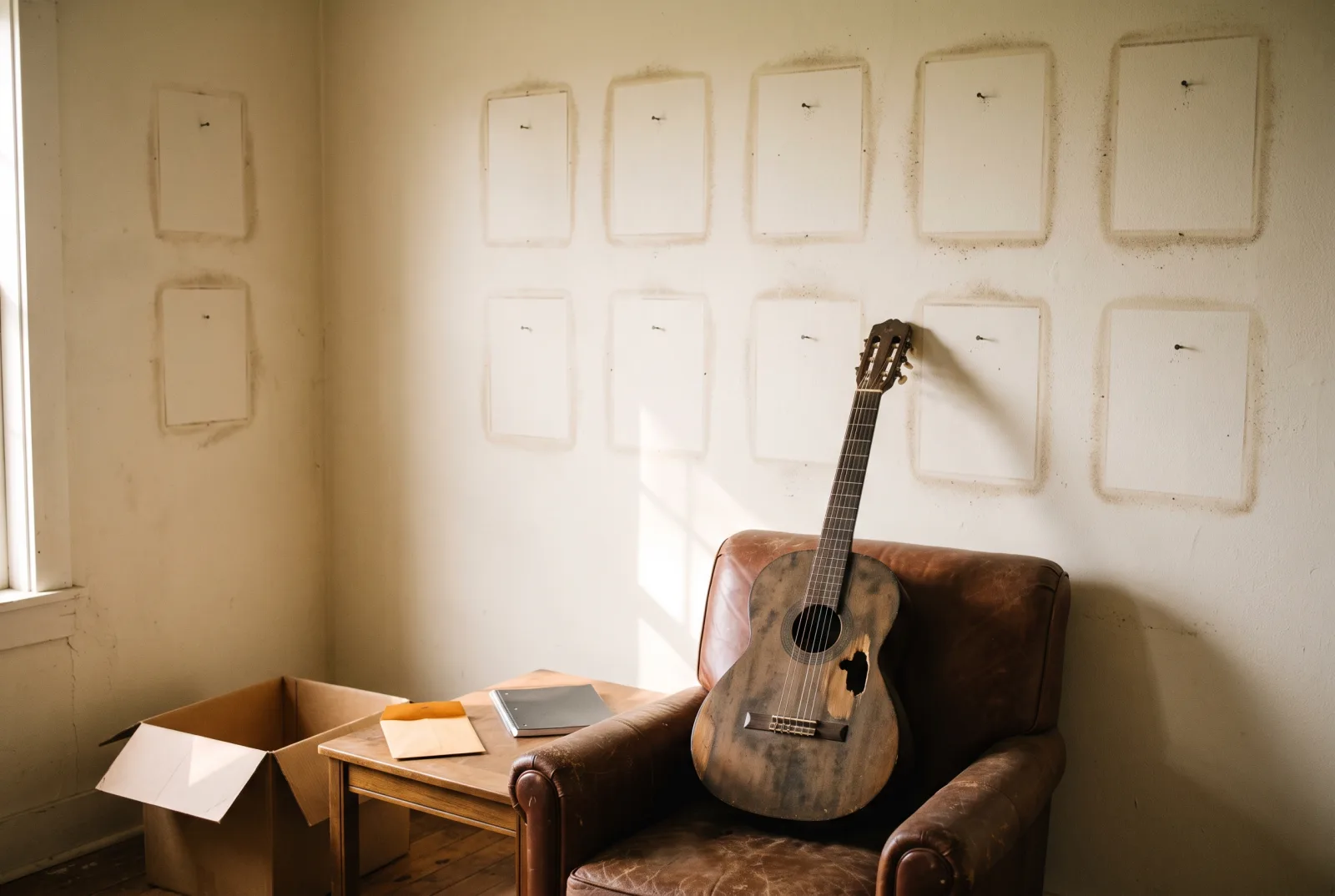
Ilustración: Rebobinados
Before he was an institution, Willie Nelson was a supplier: a songwriter who sold his songs to others because his own, sung by him, were of no use to anyone in Nashville. For "Family Bible" he charged fifty dollars and was left without it. Thirty years later, the US tax authority seized assets in six states and assessed him a debt of 16.7 million dollars. Between those two numbers fits one of the longest careers in popular music: 93 years old as of April 2026, 154 albums and a guitar with a hole in it. Like Carole King, he started out writing other people's hits before anyone let him sing his own. Unlike her, he never stopped going out on the road.
Fifty dollars for "Family Bible"
He was born on 29 April 1933 in Abbott, Texas, a town in the cotton belt, in the middle of the Great Depression. He spent his early years selling whatever he had to hand, and what he had were songs. "Family Bible" was bought by his guitar teacher, Paul Buskirk, for fifty dollars; by the time Claude Gray recorded it and turned it into a hit in 1960, Nelson was no longer the credited author of anything. That hit, all the same, was what opened the door to Nashville for him.
What turned him into a nationally successful songwriter was not "Crazy": it was "Hello Walls". Faron Young recorded it and it spent nine weeks at number 1 on the US country chart in 1961, with a million copies sold. Around the same time he handed "Night Life" to Ray Price. Nelson wrote fast, cheap and better than almost anybody, and Nashville treated him exactly as that: a source of material, not a singer.
"Crazy" came later, and it came as an emblem. He wrote it in Houston in under an hour and it was titled "Stupid". Patsy Cline released it on 16 October 1961 and took it to number 2 on the country chart and number 9 on the Hot 100: a big hit, not a number 1. Its long life came from elsewhere. By 1996 it was the most played song on American jukeboxes, which explains better than any chart position why it is remembered the way it is.
The outlaw, Trigger and the records nobody asked him for
Nelson's problem as a performer was his phrasing. He sings ahead of or behind the beat, like a jazz musician, and in the neat, upholstered country that Nashville was manufacturing in the early sixties that sounded like a mistake. His guitar did not help either: a nylon-string Martin N-20, christened Trigger, with a hole worn open beside the sound hole, which sounds more like a bolero than the Grand Ole Opry.
In the seventies he stopped asking permission. He was one of the faces of outlaw country, the movement of musicians who got around the control of Nashville's producers to record their own way. Red Headed Stranger (1975) is the extreme case: a concept album so bare that the label thought the tracks were demos, and which sold anyway. In 1978 he did the opposite and it worked just as well: Stardust, an album of covers from the American popular songbook, the same repertoire that had made Frank Sinatra great, sung with his crooked phrasing.
It is worth sorting out two classics that usually get sent back to the seventies. "On the Road Again" is from 1980 and came out of the soundtrack of Honeysuckle Rose. "Always on My Mind" is from 1982 and is not his: it was written by Wayne Carson, Johnny Christopher and Mark James, and before him it had been recorded by Brenda Lee and Elvis Presley. His version is the one that stuck, which is different from the song being his.
To that is added a detail that almost never appears in the summaries: the pianist in his band for nearly his whole career was his older sister, Bobbie Nelson, who died in March 2022. And in the eighties he was part of The Highwaymen alongside Johnny Cash, Waylon Jennings and Kris Kristofferson, the supergroup that turned outlaw country into a monument.
9 November 1990
That day the US Internal Revenue Service seized assets of his in six states. It did not only take property: it took master tapes, touring equipment and the gold and platinum records hanging on his walls. It is the most famous chapter of his life outside music, and it is worth telling with the correct figures, because the one in circulation is not the one he paid.
The figure that gets repeated, 32 million dollars, is what the IRS claimed at the outset. The formal assessment was 16.7 million, of which 10.2 were interest and penalties accumulated on tax shelters badly put together by his advisers. On 2 February 1993 he closed a settlement for some 9 million: he had already paid more than 3, and the rest was left in instalments of 2.4 million over three years plus a single payment of 3 million that he completed in 1995.
He paid it by singing. In 1991 he released The IRS Tapes: Who'll Buy My Memories?, a double album of his own recordings sold through television at 19.95 dollars, with a revenue split agreed with the IRS itself: it brought in around 3.6 million. The rest was done by his neighbours. At the auctions of his assets, friends and acquaintances bought whatever they could with rock-bottom bids in order to give it back to him afterwards. The Texas ranch returned to his hands by that route.
What to remember
The causes that summaries tend to call "unconventional" have names. Nelson co-founded Farm Aid in 1985 along with Neil Young and John Mellencamp to support American small farmers, and on 26 September 2026 he played there again, in Virginia Beach. And he was for decades the most visible face of marijuana legalisation in his country, arrests included, long before that was a comfortable position. The awards came anyway: 12 competitive Grammys from 57 nominations, plus a Legend Award in 1990 and a Lifetime Achievement in 2000, the Country Music Hall of Fame in 1993, the Kennedy Center Honors in 1998 and the Rock and Roll Hall of Fame in 2023.
The figure that describes him best is none of those. Oh What a Beautiful World, released on 25 April 2025, is his 77th solo studio album and the 154th of his complete discography. At 93 he is still recording and still climbing onto the bus. The man who sold his first good song for fifty dollars ended up owning a catalogue that will not fit on a shelf, and the lesson he leaves is not about money: it is that sometimes the only way to be allowed to sing your own songs is to outlast the people who told you no.
Sources
Willie Hugh Nelson was born on 29 April 1933 in Abbott, Texas, and turned 93 on 29 April 2026. He sold "Family Bible" for fifty dollars to his guitar teacher Paul Buskirk; Claude Gray recorded it and turned it into a hit in 1960. "Hello Walls", recorded by Faron Young, spent nine weeks at number 1 on the US country chart in 1961 and sold a million copies; he also wrote "Night Life", recorded by Ray Price. "Crazy", written in Houston in under an hour and originally titled "Stupid", was released by Patsy Cline on 16 October 1961 and reached number 2 on the country chart and number 9 on the Billboard Hot 100; by 1996 it was the most played song on American jukeboxes. A central figure of the "outlaw country" movement, he released the concept album "Red Headed Stranger" (1975) and the covers record "Stardust" (1978). "On the Road Again" is from 1980 and belongs to the soundtrack of "Honeysuckle Rose"; "Always on My Mind" is from 1982 and was written by Wayne Carson, Johnny Christopher and Mark James, with earlier recordings by Brenda Lee and Elvis Presley. His guitar is a nylon-string Martin N-20 named Trigger. His sister Bobbie Nelson was the pianist in his band for nearly his whole career and died in March 2022. He was a member of The Highwaymen with Johnny Cash, Waylon Jennings and Kris Kristofferson. On 9 November 1990 the United States Internal Revenue Service (IRS) seized assets of his in six states, including master tapes, touring equipment and gold and platinum records. The figure of 32 million dollars corresponds to the IRS's initial claim; the formal assessment was 16.7 million, of which 10.2 million were interest and penalties. On 2 February 1993 he reached a settlement for some 9 million dollars, with staggered payments completed in 1995. The double album "The IRS Tapes: Who'll Buy My Memories?" (1991) was sold through television at 19.95 dollars with a revenue split agreed with the IRS and brought in close to 3.6 million; at the auctions of his assets, friends and neighbours bought with low bids in order to return them to him. He co-founded the Farm Aid benefit festival in 1985 along with Neil Young and John Mellencamp, and performed at the edition of 26 September 2026 in Virginia Beach. He has won 12 competitive Grammy awards from 57 nominations, plus the Grammy Legend Award in 1990 and the Lifetime Achievement Award in 2000; he entered the Country Music Hall of Fame in 1993, received the Kennedy Center Honors in 1998 and entered the Rock and Roll Hall of Fame in 2023. "Oh What a Beautiful World", released on 25 April 2025, is his 77th solo studio album and the 154th of his complete discography. His book "The Last Leaf" is announced for 10 November 2026. Profile compiled for Rebobinados with fact-checking; interpretations of the meaning of the work are offered as the author's reading. No song lyrics are reproduced, for copyright reasons. Information drawn from Billboard, Wikipedia, AllMusic and other press coverage.
Keep rewinding
70s
folk
Florcita Motuda
Forty-nine years without a reissue
With "Brevemente… geeente" he won the best Chilean performer prize at Viña 1977, and he won it in the international competition because the folk one was not held that year. The album that contains it, released in 1977 on APRI —Antonio Prieto's label—, spent 49 years without a reissue: never on CD or streaming until it came back on vinyl in April 2026 and on digital on 11 July, the day he returned to the stage. The record for the longest title at the OTI is his, but it is from 1978 and not 1998.
00s
folk
Natalia Lafourcade
Where it said pumpkin she put flowers
The story says she rescued the son jarocho with reverence on *Un Canto por México*, but "La Bruja" is not on that record: she recorded it on *Cancionera*, on 24 April 2025, and rewrote the lyric. Where the son turns the man into a pumpkin, she sings that she filled him with flowers: "a cancionera is a kind of sorceress". Twenty Latin Grammys, a house rebuilt in Jáltipan and a harpsichordist father who left Chile two days after the coup.
70s
folk
Piero
The old man wasn't his
Piero sang "Mi viejo" in 1969, but the words are José Tcherkaski's and the father it portrays was his own: Mario Tcherkaski, a Russian street hawker who died at 52, eight years before the song. CBS released it with Father's Day in mind after several labels turned it down, and the first pressing passed 600,000 copies. Piero died on 7 October 2026, aged 81.
Rewind with us
Comments · 0
No one has commented yet. Open the conversation.