
Frank Sinatra
Breathing like someone talking
By Rebobinados · Published on September 4, 2026
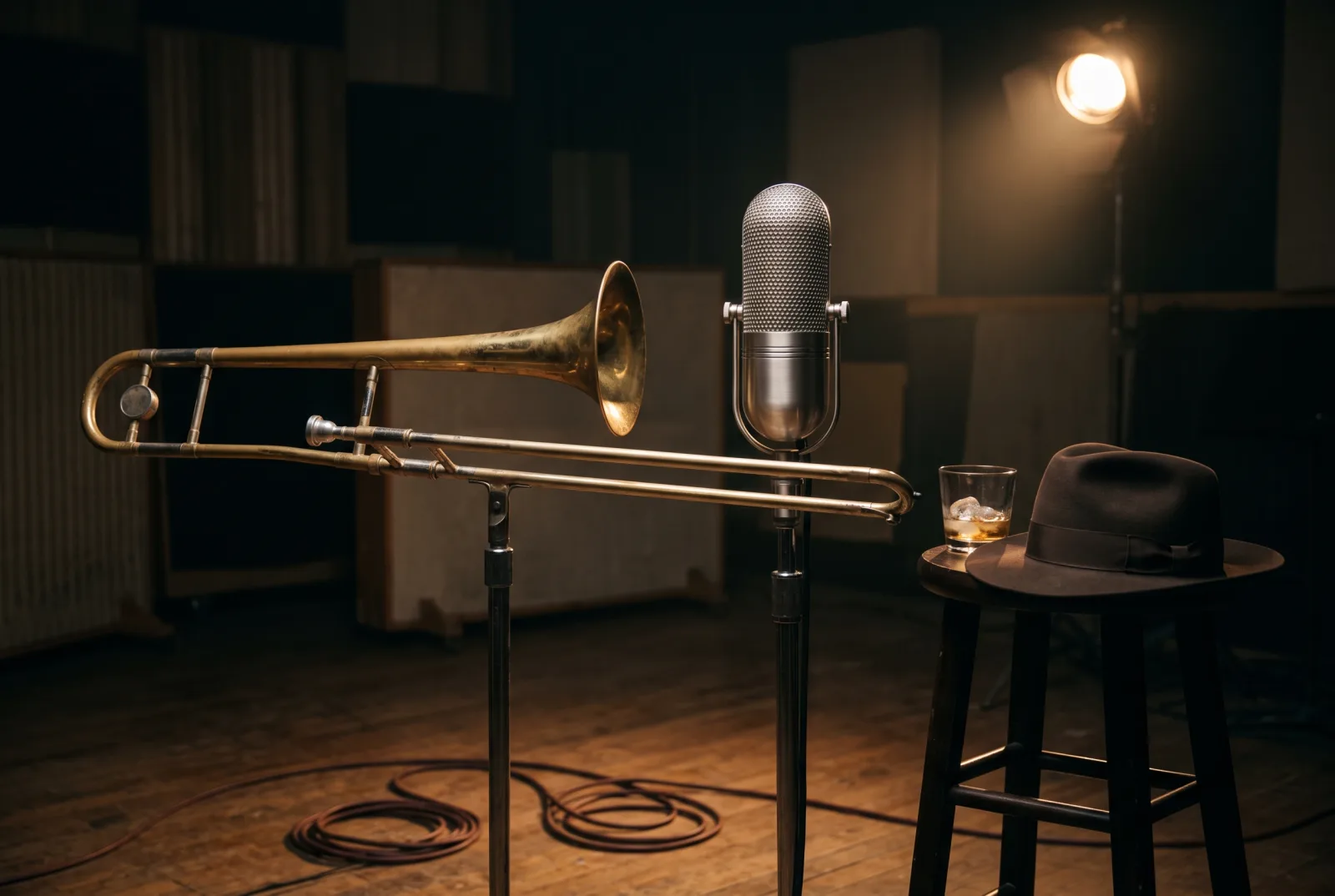
Ilustración: Rebobinados
Frank Sinatra learned to sing by watching a trombone player.
That is not a metaphor. He told the story himself, in an article he wrote for Life magazine in 1965.
He was singing in Tommy Dorsey's orchestra and he spent his nights watching how his bandleader breathed. Dorsey would take a musical phrase and play it whole, eight bars, ten, sixteen, without it showing once that he was taking in air.
Sinatra wanted to know how he did it.
The trick
He worked out that Dorsey was stealing air through one corner of his mouth, in a tiny gesture, invisible from the room.
He copied it. And in order to hold long phrases he took up swimming underwater and running, with the single aim of enlarging his lung capacity.
The result changed what was expected of a singer. Sinatra could carry a phrase all the way to the end without cutting it to breathe, and that made his singing sound like something almost nobody had heard before in a popular song: it sounded like a man speaking.
Not like someone singing well. Like someone telling you something.
Singing the way an actor acts
On top of that technique he built the rest, which was an idea.
He treated every song as a small drama. A text to be acted, not merely intoned.
He put the pauses where an actor would put them. He stressed words according to what they meant, not according to where the bar fell. He changed the colour of his voice according to the emotion.
That is why when he sang a heartbreak ballad you believed him. He did not sound like a singer showing off; he sounded like a man telling you about the worst night of his life.
It is no accident that he was also a real actor: he won the Oscar for best supporting actor for "From Here to Eternity", the 1953 film, at the ceremony in March 1954.
The song that was not his and that he came to hate
"My Way" is, for almost everybody, the Sinatra song.
He did not write it. The English lyric is by Paul Anka, over the French melody of "Comme d'habitude", by Jacques Revaux. Sinatra recorded it on 30 December 1968, in a single take.
And two things that get repeated endlessly are worth undoing.
The first: that it was his epitaph. It was not. His headstone at Desert Memorial Park read "The Best Is Yet to Come".
The second: that it was played at his funeral. It was not. At the Church of the Good Shepherd, in 1998, what was heard was "Put Your Dreams Away", the "Ave Maria", "In the Wee Small Hours of the Morning" and "Moonlight in Vermont".
It is also documented that he came to detest it. He found it self-congratulatory. His daughter Tina has said so.
It is one of the most requested songs at other people's funerals, mind you. Just not at his own.
What he did with what was not music
There is a part of his life story that should be neither dressed up nor hidden.
He had ties to the world of organised crime. The contacts are documented; criminal involvement was never proved. Both things are true at once, and that is how it has to be said.
And on quite different ground he did something that genuinely cost him money: from the nineteen-forties on he refused to perform before segregated audiences. He pressed the Sands hotel in Las Vegas to serve Nat King Cole in the dining room. Together with Sammy Davis Jr. he pushed for the end of segregationist policies in the hotels and casinos of Nevada, around 1961.
A good part of that account comes from Davis's own memoirs, not from independent documentation. But the behaviour is backed by decades of similar episodes.
What to remember
Sinatra is the proof that invisible technique is the technique you notice most.
Put on "In the Wee Small Hours of the Morning", "Fly Me to the Moon" or "One for My Baby" and you will not hear anyone breathe. That is the point. All that naturalness — that impression that he is simply talking — is the result of years of copying a trombone player and swimming underwater.
They called him The Voice. But what changed the popular music of the twentieth century was not the voice: it was what he did with the air.
Remember him like this: not as the man with the hat and the glass, but as the one who discovered that a song is told, and that to tell it you have to learn how not to breathe.
Sources
Frank Sinatra, born in Hoboken, New Jersey, on 12 December 1915, and died in Los Angeles on 14 May 1998. In an article under his own name in "Life" magazine in 1965 he recounted that he learned breath control by watching the trombonist and bandleader Tommy Dorsey, in whose orchestra he sang: he discovered that Dorsey took in air through a corner of his mouth and adopted the technique, supplementing it with underwater swimming and running to enlarge his lung capacity. He won the Oscar for best supporting actor for "From Here to Eternity" (1953), at the ceremony held on 25 March 1954. "My Way" has an English lyric by Paul Anka over the melody of "Comme d'habitude", composed by Jacques Revaux with a French lyric by Claude François and Gilles Thibaut; Sinatra recorded it on 30 December 1968 and it was released in early 1969. Two frequently circulated claims should be corrected, because they are false: it was not his epitaph — his headstone at Desert Memorial Park in Cathedral City bore the inscription "The Best Is Yet to Come", replaced in 2020 — and it was not played at his funeral, held at the Church of the Good Shepherd in Beverly Hills in 1998, where "Put Your Dreams Away", the "Ave Maria", "In the Wee Small Hours of the Morning" and "Moonlight in Vermont" were performed; it is also documented that Sinatra came to express distaste for the song. The nickname "Ol' Blue Eyes" became popular from the album "Ol' Blue Eyes Is Back" (1973), later than his classic period. His contacts with figures from organised crime are documented, without criminal involvement being proved. From the nineteen-forties he refused to perform before segregated audiences and contributed, alongside Sammy Davis Jr., to the end of segregationist policies in the hotels and casinos of Nevada around 1961; part of this account comes from Davis's memoirs. Paul Anka, Nat King Cole and Tony Bennett have profiles of their own in this series. Externally authored text, edited and verified for Rebobinados. Interpretations of the meaning of his work are offered as the author's reading. No song lyrics are reproduced, for copyright reasons. Information drawn from Life magazine, Wikipedia, Palm Springs Life, Songfacts and other coverage.
Keep rewinding

10s
pop
Bruno Mars
Eleven names in the credits
"Uptown Funk" came out on 10 November 2014 with six writers and today it has eleven. In February 2015 The Gap Band's publisher filed a claim over "Oops Up Side Your Head" in YouTube's copyright system —there was never a lawsuit— and on 28 April five names were added, with 17 % of the publishing. It happened weeks after the "Blurred Lines" verdict, and the song had been fourteen weeks at number one.

00s
pop
André Rieu
It was not from the jazz suite
The waltz with which André Rieu reached half the world is not from Shostakovich's Suite for Jazz Orchestra No. 2: it is from the Suite for Variety Orchestra, which the composer did not assemble, and it was born in 1956 as music for a Soviet film about settlers in Kazakhstan. The error comes from a misprint in volume 10 of the complete works (Muzyka, Moscow, 1984), corrected only in 2001. And the title "The Second Waltz" was invented by his wife, because the real one did not sell.

90s
pop
Daniela Mercury
She took the neighbourhood out of the song
"O Canto da Cidade" was written by Tote Gira, a composer from Nordeste de Amaralina who recorded the demo on a borrowed cassette, marking the beat on the door of a refrigerator; Mercury's team almost threw the tape away. She shares the credit because she deleted the references to the Pelourinho so that the song would serve all of Brazil. The album, from 20 September 1992, sold more than 2 million copies and nationalised axé. But she did not invent it: the name was a journalist's insult in 1987.
Rewind with us
Comments · 0
No one has commented yet. Open the conversation.