
Carole King
She wrote half a decade of other people's hits before singing her own
By Rebobinados · Published on September 21, 2026
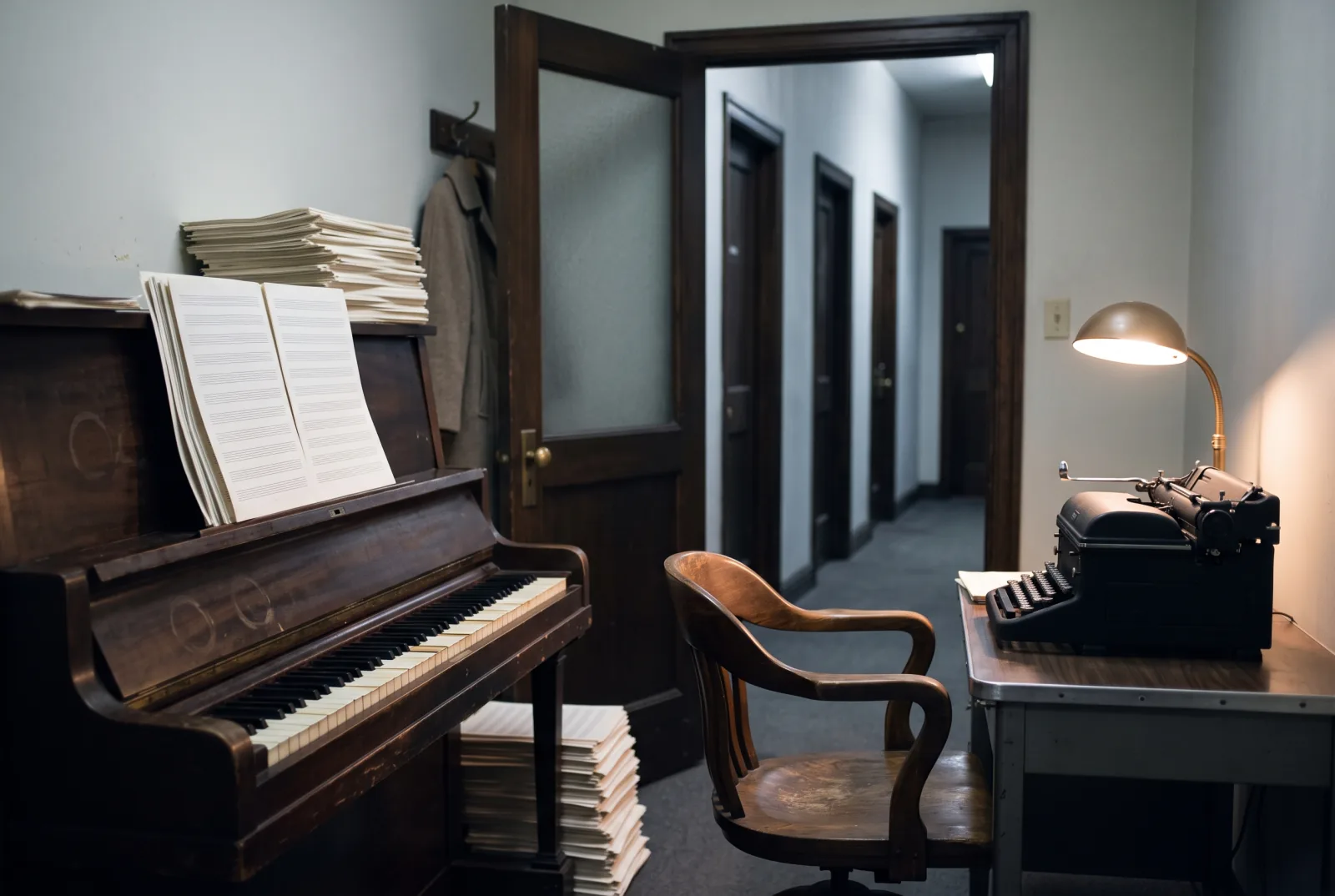
Ilustración: Rebobinados
Before she was Carole King, the voice millions of people put on when they need to feel accompanied, she was an invisible machine for manufacturing hits for other people. Throughout the sixties, shut away in an office in a New York building, she wrote some of the biggest songs of the decade for mouths that were not her own. People sang Carole King without knowing they were singing her. And then, one day, she decided to step out of the shadows and put herself in front of the microphone. What she made then is one of the best-loved records in history.
The song factory
In the Brill Building, the mecca of professional songwriters, Carole King formed with her husband Gerry Goffin one of the most fertile writing partnerships that ever existed. She supplied the music, he supplied the lyrics, and out of that pairing came anthems that defined an era: "Will You Love Me Tomorrow" for the Shirelles, "The Loco-Motion", "Up on the Roof", "(You Make Me Feel Like) A Natural Woman" for Aretha Franklin. Songs everybody knows and almost nobody knew were hers.
Think about it: writing "A Natural Woman" and handing it over to Aretha Franklin so she could make it eternal is an enormous act of generosity, and of humility too. King was the talent behind the talent, the hand that gave anthems to the stars. She spent years being the anonymous author of other people's happiness.
When she stopped giving her songs away
And in 1971 something happened that changed everything. Carole King released "Tapestry", a record where at last she sang her own songs herself, without ornament, almost with the voice of a friend who sits down at the piano in your living room. It was not a diva's voice, and that was precisely its strength: it sounded close, true, imperfect and warm.
"Tapestry" became one of the best-selling records in history, stayed nailed to the charts for years, and won the most important Grammy awards. "It's Too Late", "I Feel the Earth Move", "So Far Away". And "You've Got a Friend", that song about being there for someone, which she wrote and her friend James Taylor also took to number one. Carole King, deep down, set friendship itself to music.
That is where the double greatness lies. She was the hidden songwriter who made others great in the sixties, and she was the voice of her own that defined the seventies. Very few artists have even one of those two careers. She had both, one after the other.
What to remember
Carole King spent the sixties writing, from an office and in anonymity, some of the biggest hits of the decade for other people's voices. And in 1971 she came out of the shadows with "Tapestry", finally sang herself, and made one of the best-loved records there is. She wrote for Aretha, for the Shirelles, for half the world, and then for us.
Remember it like this: there are those who write other people's happiness, and those who sing their own. Carole King did both, in that order, and that is why her name appears twice in history: as the invisible hand of one decade and as the unforgettable voice of the next.
Sources
Carole King (Carol Joan Klein), American singer-songwriter born on 9 February 1942 in Brooklyn, New York; still living. In the sixties, together with her then husband Gerry Goffin, she formed a prolific songwriting partnership in the Brill Building milieu, with hits such as "Will You Love Me Tomorrow" (The Shirelles), "The Loco-Motion" (Little Eva), "Up on the Roof" (The Drifters) and "(You Make Me Feel Like) A Natural Woman" (Aretha Franklin). Her album "Tapestry" (1971) was one of the best-selling of all time, remained on the charts for a long stretch and won the Grammy awards for album, record and song of the year, among others; it included "It's Too Late", "I Feel the Earth Move" and "You've Got a Friend", the latter also taken to number one by James Taylor. Carole King has been inducted into the Rock and Roll Hall of Fame both as a songwriter and as a performer. Aretha Franklin has its own profile in this series. Profile compiled for Rebobinados with fact-checking; interpretations of the meaning of the work are offered as the author's reading. No song lyrics are reproduced, for copyright reasons. Information drawn from Wikipedia, Grammy.com, PBS American Masters, Songfacts and other coverage.
Keep rewinding
70s
folk
Florcita Motuda
Forty-nine years without a reissue
With "Brevemente… geeente" he won the best Chilean performer prize at Viña 1977, and he won it in the international competition because the folk one was not held that year. The album that contains it, released in 1977 on APRI —Antonio Prieto's label—, spent 49 years without a reissue: never on CD or streaming until it came back on vinyl in April 2026 and on digital on 11 July, the day he returned to the stage. The record for the longest title at the OTI is his, but it is from 1978 and not 1998.
00s
folk
Natalia Lafourcade
Where it said pumpkin she put flowers
The story says she rescued the son jarocho with reverence on *Un Canto por México*, but "La Bruja" is not on that record: she recorded it on *Cancionera*, on 24 April 2025, and rewrote the lyric. Where the son turns the man into a pumpkin, she sings that she filled him with flowers: "a cancionera is a kind of sorceress". Twenty Latin Grammys, a house rebuilt in Jáltipan and a harpsichordist father who left Chile two days after the coup.
70s
folk
Piero
The old man wasn't his
Piero sang "Mi viejo" in 1969, but the words are José Tcherkaski's and the father it portrays was his own: Mario Tcherkaski, a Russian street hawker who died at 52, eight years before the song. CBS released it with Father's Day in mind after several labels turned it down, and the first pressing passed 600,000 copies. Piero died on 7 October 2026, aged 81.
Rewind with us
Comments · 0
No one has commented yet. Open the conversation.