
Café Tacvba
Never the same record twice
By Rebobinados · Published on September 22, 2026
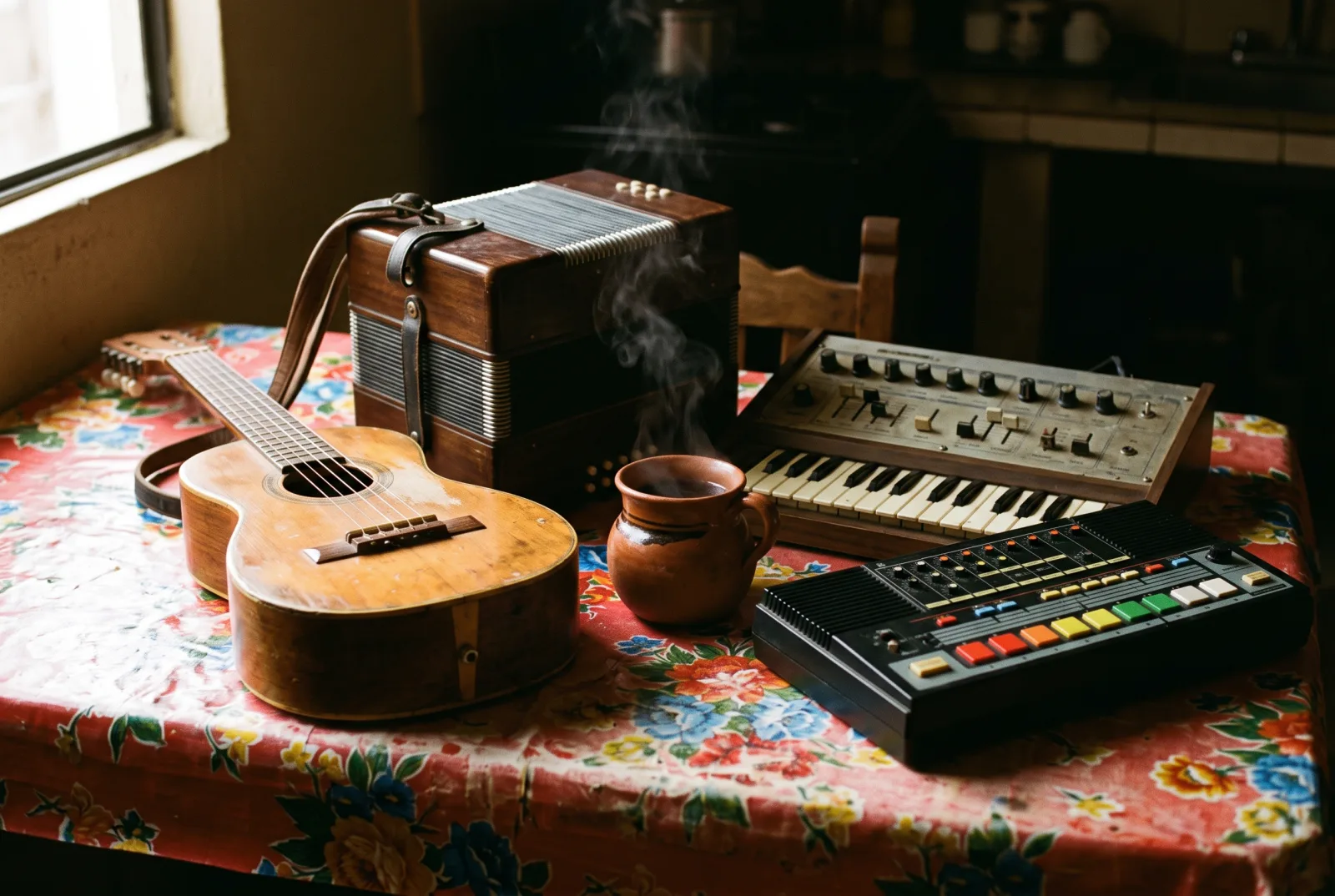
Ilustración: Rebobinados
Café Tacvba are, probably, the most inventive band that rock in Spanish has produced, and one of the hardest to pin down, because that is precisely their trademark: refusing to be pinned down.
These four Mexicans took all the music of their country —bolero, son, norteña, mariachi, huapango— and put it in the blender with rock, punk, ska, electronica, hip-hop, whatever came to hand, and out of that they got a new sound, impossible to mistake, proudly Mexican and at the same time universal.
They have been going for more than thirty years, with the same line-up as always, never repeating themselves.
Everything fits, if you know how to mix it
Café Tacvba formed in 1989 in Ciudad Satélite, on the outskirts of Mexico City, with Rubén Albarrán on vocals, Emmanuel "Meme" del Real, and the brothers Joselo and Quique Rangel.
From the start they did something almost nobody dared to do: instead of copying American or English rock, they looked inwards, towards the immensely rich traditional music of Mexico, and crossed it with everything modern.
In a single song they could go from the most romantic bolero to the most furious punk, from norteña to Jamaican ska, from mariachi to electronica. Albarrán's nasal, unmistakable voice tied all that chaos together.
They made anthems that still play all over Latin America today: "La Ingrata", "Las Flores", "Chilanga Banda" —a mad piece of rap in the street slang of Mexico City, which is in fact a version of a song by Jaime López— and ballads like "Eres", which made half a generation cry.
One clarification about the name: the band started out as Café Tacuba, like the famous restaurant in the centre of Mexico City, and changed the "u" for a "v" to avoid a legal conflict with the establishment. It is worth putting this properly: the fight never actually existed. It was a precaution, not a battle.
The record they called the Mexican White Album
In 1994, Café Tacvba released their second record, the one that made their name and that many consider the best album of Latin American rock: "Re".
It was produced by Gustavo Santaolalla, whom the press came to call "the fifth tacvbo".
And it has two facts worth separating, because one of them is always told wrong.
The first, the title. It is often repeated that it is called that because the songs began on the note re, and that is not true. The real explanation has two layers, and both are better: re is the second note of the scale and this was their second record, and "re-" is also the prefix for everything that is done again.
The second, the important one: "Re" is a record of twenty songs that jump from genre to genre —punk, bolero, norteño, grunge, samba, ska, banda—, an insane journey through every imaginable kind of music.
For that ambition, critics compared it to the Beatles' "White Album", that double record where the Beatles played everything. The New York Times, among others, did exactly that.
That a Mexican band singing in Spanish should be compared to the experimental peak of the Beatles says something about the size of what they achieved.
A singer with a thousand names
And here comes the detail that paints the band's playful, rebellious spirit.
The singer, whom almost everyone knows as Rubén Albarrán, has changed his name on almost every record.
This is no joke. In the "Re" period he called himself Cosme; in the "Avalancha de Éxitos" one, Anónimo; then Nrü, then Élfego Buendía —a tribute to a dead relative—, then Rita Cantalagua during the band's sabbatical year. And there are more: Pinche Juan, Masiosare, Sizu Yantra, Ixaya Mazatzin Tleyotl, Cone Cahuitl, Zopilote.
One of those names, Gallo Gasss, he used on "Vale Callampa", the 2002 EP on which Café Tacvba paid tribute to Los Tres, the Chilean band.
It is his way of refusing to be fixed, of reinventing himself over and over, of refusing to be one single thing. The same thing the band does with its music.
Everything about them resists standing still.
Latin American pride
What makes Café Tacvba great, beyond their talent, is what they represent.
At a time when sounding modern in Latin America meant imitating the Americans, they proved the opposite: that the newest, most avant-garde music could be born from looking towards your own roots, towards the most deeply Mexican thing there is, and mixing it shamelessly with the world.
They taught a whole continent that you did not have to choose between being local and being universal. That being fiercely yourself, with all your roots in place, was the best way to go far.
They sing only in Spanish and they have fans all over the world. In July 2023 they played at the Hollywood Bowl alongside Gustavo Dudamel and the Los Angeles Philharmonic.
What to remember
Café Tacvba are the proof that the avant-garde and the roots are not at odds, and that a band can spend thirty years reinventing itself without ever betraying itself.
If you put on "Eres", "La Ingrata", "Las Flores" or "Chilanga Banda", you are going to hear all the richness of Mexico passed through the freest imagination in rock in Spanish: bolero and punk, mariachi and electronica, tenderness and fury, all jumbled together and all of it making sense.
They are four guys who refused to copy, who looked at their own land and found the future there.
Put them on loud, and dance: it is the whole of Mexico fitting into a song.
Sources
Café Tacvba (originally Café Tacuba), Mexican rock band formed in 1989 in Ciudad Satélite, Naucalpan, State of Mexico, with a stable line-up ever since: Rubén Albarrán (vocals), Emmanuel "Meme" del Real (keyboards, programming, vocals), José Alfredo "Joselo" Rangel (guitar) and Enrique "Quique" Rangel (bass). The group has never had a permanent drummer: Del Real handles drums and programming, and in the studio they have turned to session players such as Joey Waronker and Víctor Indrizzo. They fuse traditional Mexican music —bolero, son, norteño, huapango, mariachi— with rock, punk, ska, electronica and other genres. They adopted the spelling "Tacvba" as a legal precaution in the face of the Café de Tacuba restaurant, in the historic centre of Mexico City, founded in 1912; the legal confrontation never actually took place. Their self-titled debut album is from 1992. "Re" (22 July 1994), their second record, was produced by Gustavo Santaolalla, recorded in Los Angeles and Cuernavaca, and contains twenty songs in very diverse genres; it has been compared to The Beatles' "White Album", among others by The New York Times, and Rolling Stone en Español chose it as the best Latin rock record in history. The title alludes to the fact that "re" is the second note of the scale and this was their second album, and to the prefix "re-" of repetition; the explanation that the songs began on that note has no backing. "Chilanga Banda" is a version of a song by Jaime López, credited together with José Manuel Aguilera, originally released on "Odio Fonky" (1995); Café Tacvba included it on "Avalancha de Éxitos" (5 November 1996), an album entirely of covers also produced by Santaolalla. Rubén Albarrán has adopted a different pseudonym in almost every period: Cosme, Anónimo, Nrü, Élfego Buendía, Rita Cantalagua, Pinche Juan, Masiosare, Sizu Yantra, Ixaya Mazatzin Tleyotl, Cone Cahuitl, Zopilote and Gallo Gasss, the last of these during the EP "Vale Callampa" (2002), a tribute to the Chilean band Los Tres. They have performed at the Hollywood Bowl, among other occasions on 22 July 2023 alongside Gustavo Dudamel and the Los Angeles Philharmonic, and on 5 June 2024 with Caifanes. Externally authored text, edited and verified for Rebobinados. Interpretations of the meaning of their work are offered as the author's reading. No song lyrics are reproduced, for copyright reasons. Information drawn from Wikipedia, Rolling Stone en Español, La Banda Elástica, Infobae, WhoSampled and other press coverage.
Keep rewinding

10s
pop
Bruno Mars
Eleven names in the credits
"Uptown Funk" came out on 10 November 2014 with six writers and today it has eleven. In February 2015 The Gap Band's publisher filed a claim over "Oops Up Side Your Head" in YouTube's copyright system —there was never a lawsuit— and on 28 April five names were added, with 17 % of the publishing. It happened weeks after the "Blurred Lines" verdict, and the song had been fourteen weeks at number one.

00s
pop
André Rieu
It was not from the jazz suite
The waltz with which André Rieu reached half the world is not from Shostakovich's Suite for Jazz Orchestra No. 2: it is from the Suite for Variety Orchestra, which the composer did not assemble, and it was born in 1956 as music for a Soviet film about settlers in Kazakhstan. The error comes from a misprint in volume 10 of the complete works (Muzyka, Moscow, 1984), corrected only in 2001. And the title "The Second Waltz" was invented by his wife, because the real one did not sell.

90s
pop
Daniela Mercury
She took the neighbourhood out of the song
"O Canto da Cidade" was written by Tote Gira, a composer from Nordeste de Amaralina who recorded the demo on a borrowed cassette, marking the beat on the door of a refrigerator; Mercury's team almost threw the tape away. She shares the credit because she deleted the references to the Pelourinho so that the song would serve all of Brazil. The album, from 20 September 1992, sold more than 2 million copies and nationalised axé. But she did not invent it: the name was a journalist's insult in 1987.
Rewind with us
Comments · 0
No one has commented yet. Open the conversation.