
Gustavo Santaolalla
One single note
By Rebobinados · Published on September 9, 2026
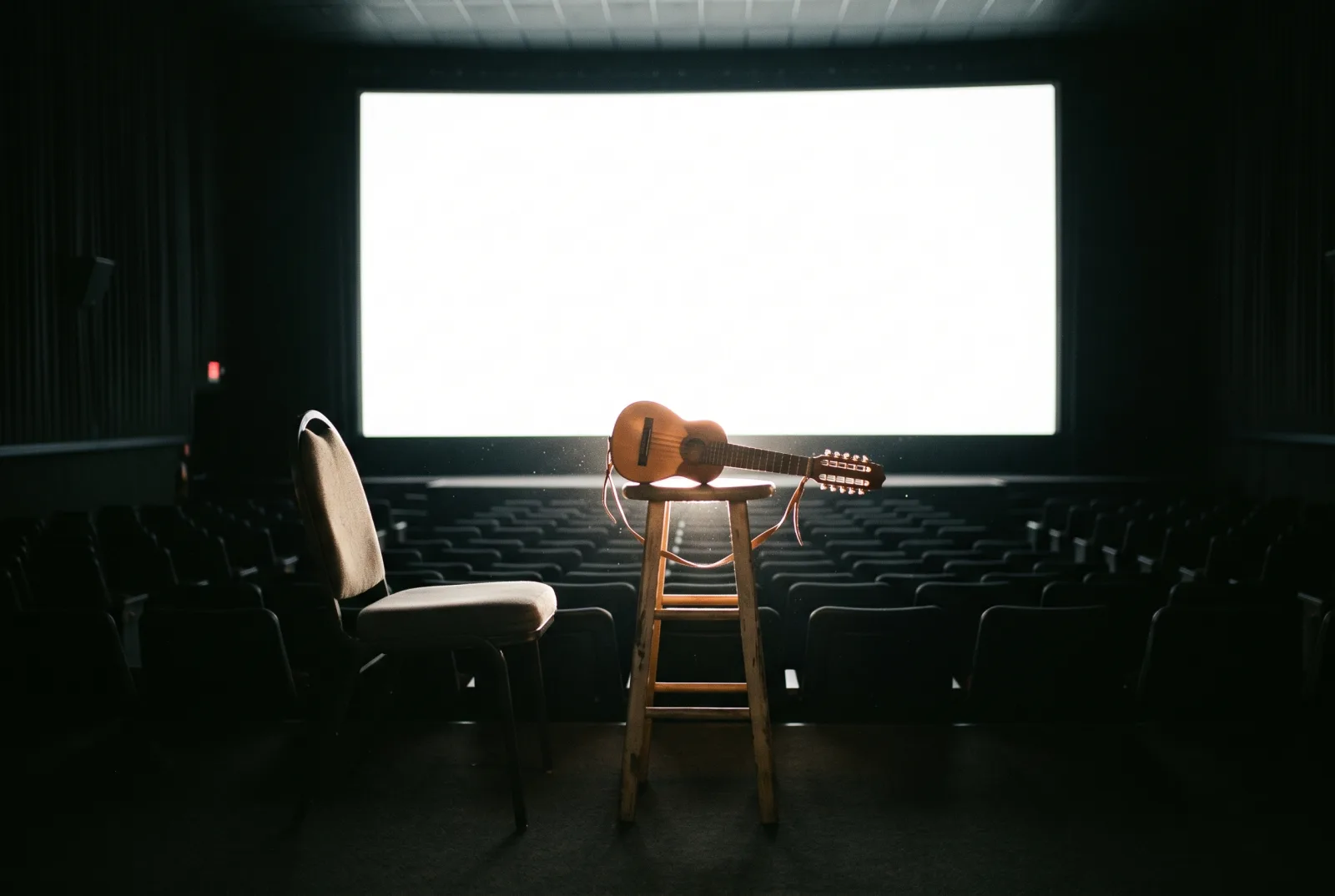
Ilustración: Rebobinados
There is a sound you recognise even without knowing whose it is.
A few notes on a stringed instrument, spaced out by long silences, with an air of high country and of something very old. It shows up in a film and you know at once that something is about to hurt.
That sound belongs to an Argentine who won the Oscar two years running and whom almost nobody would recognise in the street.
Two years running, and a better fact
Gustavo Santaolalla won the Oscar for best original score at the 2006 ceremony, for "Brokeback Mountain", and again at the 2007 one, for "Babel".
It is usually called a feat almost nobody has managed. That needs correcting, because it is not accurate: Franz Waxman did it in 1950 and 1951, and Alan Menken in 1992 and 1993.
But there is one fact that really is his alone, and the usual telling wastes it: he is the first and only Latin American to win that award. And he won it twice in a row.
What he does, which is not doing
His signature is a very strange thing in film, where the norm is to fill.
He does not use grandiloquent orchestras. He uses the opposite: space, silence, a few loaded notes, very often played on instruments with Latin American roots.
The one most associated with him is the ronroco. It is worth saying what that is, because it is almost always described wrongly: it is the baritone member of the charango family, the big one — around eighty centimetres — with ten strings in five pairs. And it is not an ancestral instrument: it was invented in 1968 by the brothers Gonzalo and Wilson Hermosa, of Los Kjarkas, in Cochabamba. Santaolalla was the one who took it out of Bolivia and put it into the cinema of the world.
His discovery is deceptively simple: in a film, a single well-placed note, with the silence around it left to breathe, moves you more than a whole symphony.
You have to know a great deal to dare to put in so little.
The producer of half of rock in Spanish
Before the cinema, and alongside it, he did another enormous thing that almost nobody credits him with.
He started at sixteen in Arco Iris, in 1967. And then, from the studio, he produced a good part of what was heard in Spanish over thirty years.
He produced Café Tacvba, including that "Re" of 1994 that the New York Times compared to the White Album. And Julieta Venegas. And Molotov, Juanes, Bersuit Vergarabat, Divididos, Maldita Vecindad, Juana Molina. And Los Prisioneros, on "Corazones", from 1990.
His usual partner in the studio, Aníbal Kerpel, appears on almost all those credits.
What people say about him as a producer is always the same: he did not impose his style. He drew out what each band already had inside and could not find.
And then, video games
In 2013 he wrote the music for "The Last of Us", a video game.
It might sound like a footnote and it is exactly the opposite. It is one of the best-loved scores in the medium, with the same method as ever — strings, silence, very few notes — applied to a story that is played over twenty hours instead of watched over two.
When the television series arrived in 2023, his music came with it. The same sound that had made people cry in a cinema in 2005 worked all over again in a format that did not exist back then.
He is still working. In 2026 he released an album with Bajofondo and is out on tour with the ronroco.
What to remember
Santaolalla is the proof that in music the hardest gesture is to take away.
Put on the music from "Brokeback Mountain" or from "The Last of Us" and pay attention to what is not there. There is no arrangement, no orchestra, no ornament. There is one string sounding, and then a long silence, and then another.
He is a man who was handed Hollywood's biggest prize twice for resisting what Hollywood asks for, which is to fill everything up.
Remember him like this: not as the Argentine with the Oscars, but as the man who proved that a single note, well placed, weighs more than a hundred.
Sources
Gustavo Alfredo Santaolalla, born in El Palomar, province of Buenos Aires, on 19 August 1951; still alive and active, with Bajofondo's album "Ohm" released in February 2026 and the "Ronroco Tour 2026". He began his career in 1967 with the group Arco Iris. He won the Oscar for best original score at two consecutive ceremonies: the 78th, on 5 March 2006, for "Brokeback Mountain" (2005), and the 79th, on 25 February 2007, for "Babel" (2006). It is worth being precise, because this is often presented as an unprecedented feat, that Franz Waxman won in consecutive years in 1950 and 1951 and Alan Menken in 1992 and 1993; what is genuinely exclusive is that Santaolalla is the first and only Latin American to receive this award. The ronroco is the baritone or bass member of the charango family, around eighty centimetres long with a scale of 44 to 50 centimetres, with ten strings in five courses; it was invented in 1968 by the brothers Gonzalo and Wilson Hermosa, of the group Los Kjarkas, in Cochabamba, Bolivia, and spread during the nineteen-eighties. This is worth noting because it is frequently described, wrongly, as a small or ancestral instrument: the small one in the family is the charango. As a producer, Santaolalla has worked with Café Tacvba ("Re", 1994), Julieta Venegas ("Aquí", "Bueninvento"), Molotov, Juanes ("Fíjate bien", 2000; "Un día normal", 2002), Bersuit Vergarabat, Los Prisioneros ("Corazones", 1990), Divididos, Maldita Vecindad and Juana Molina, usually alongside Aníbal Kerpel. He composed the music for "The Last of Us" (video game, 2013; "Part II", 2020) and for the HBO series that premiered in 2023. Café Tacvba and Julieta Venegas have profiles of their own in this series. Externally authored text, edited and verified for Rebobinados. Interpretations of the meaning of his work are offered as the author's reading. No song lyrics are reproduced, for copyright reasons. Information drawn from the Academy of Motion Picture Arts and Sciences, Wikipedia, AllMusic and other coverage.
Keep rewinding
70s
folk
Florcita Motuda
Forty-nine years without a reissue
With "Brevemente… geeente" he won the best Chilean performer prize at Viña 1977, and he won it in the international competition because the folk one was not held that year. The album that contains it, released in 1977 on APRI —Antonio Prieto's label—, spent 49 years without a reissue: never on CD or streaming until it came back on vinyl in April 2026 and on digital on 11 July, the day he returned to the stage. The record for the longest title at the OTI is his, but it is from 1978 and not 1998.
00s
folk
Natalia Lafourcade
Where it said pumpkin she put flowers
The story says she rescued the son jarocho with reverence on *Un Canto por México*, but "La Bruja" is not on that record: she recorded it on *Cancionera*, on 24 April 2025, and rewrote the lyric. Where the son turns the man into a pumpkin, she sings that she filled him with flowers: "a cancionera is a kind of sorceress". Twenty Latin Grammys, a house rebuilt in Jáltipan and a harpsichordist father who left Chile two days after the coup.
70s
folk
Piero
The old man wasn't his
Piero sang "Mi viejo" in 1969, but the words are José Tcherkaski's and the father it portrays was his own: Mario Tcherkaski, a Russian street hawker who died at 52, eight years before the song. CBS released it with Father's Day in mind after several labels turned it down, and the first pressing passed 600,000 copies. Piero died on 7 October 2026, aged 81.
Rewind with us
Comments · 0
No one has commented yet. Open the conversation.