
Juanes
The shirt Italy read backwards
By Rebobinados · Published on October 1, 2026
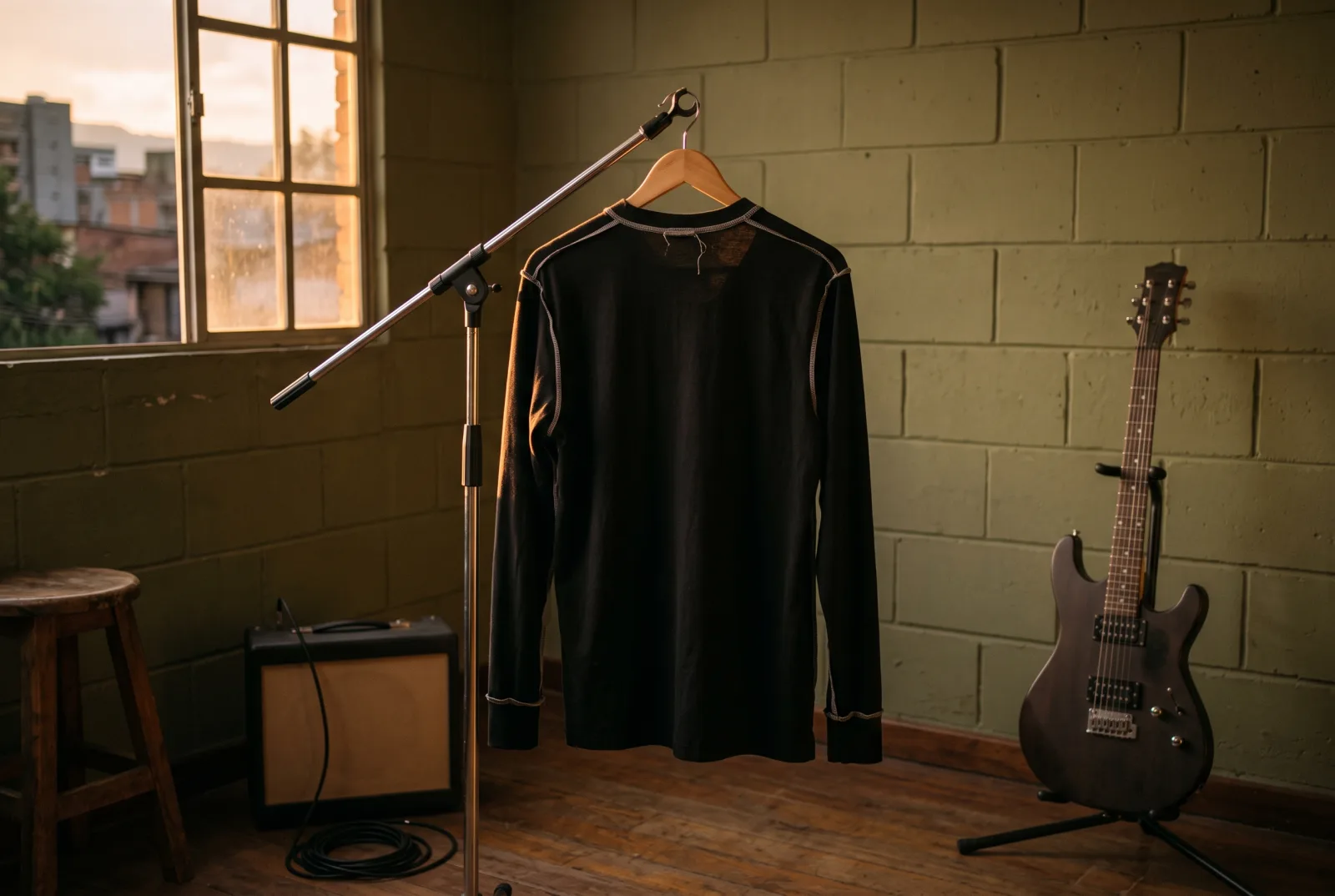
Ilustración: Rebobinados
Juanes came out of Medellín in the years when that city was a synonym for cartels, bombs and homicide figures, and out of that he built a songbook of love, faith and hope that was sung across half the world. That is the easy thesis and it is true, but it leaves out what each decision cost him. The fusion that won him four Grammys is the same one that broke up the band of his adolescence. The concert with which he laid a bridge in Havana earned him a campaign of hostility in Miami. And his biggest European hit ended up being sung in Italian clubs by neo-fascist groups who read the title backwards. Along with Shakira and Carlos Vives he put Colombia on the map of world pop; unlike them, he did it while falling out with his own audience more than once.
Medellín, Carolina del Príncipe and a band that broke apart
Juan Esteban Aristizábal Vásquez was born on 9 August 1972 in Medellín, at the Clínica El Rosario, and spent his childhood between that city and Carolina del Príncipe, his family's town, about a hundred kilometres to the north. The stage name holds no mystery and no label's invention: "Juanes" is the contraction of Juan and the first letters of Esteban, the nickname he had been called at home since he was small.
At fifteen or sixteen he founded Ekhymosis in Medellín with Fernando Andrés García. It was a metal band with one declared influence: Metallica. And the fact that explains a good part of his career is that Ekhymosis existed between 1988 and 1997, exactly the years of the Medellín cartel and of the city's peak in homicides, with Pablo Escobar's death in December 1993 in the middle. It is not a backdrop: it is the neighbourhood where the rehearsals were put together.
What the usual story presents as a discovery of his solo period began inside that band, and it cost him dearly. Already on the 1994 record Ekhymosis turned towards a hard rock with Latin sounds, and that turn set off an internal row; on the self-titled album of 1996 he moved even further from metal. The band broke up in 1997 over disagreements about its direction, after eight records and EPs. The mixture with which he would later fill stadiums is the reason the group he had grown up in fell apart.
A Dios le Pido and the price of bridges
His solo period started in 2000 with a debut that carried "Fíjate Bien", but the continental leap was Un Día Normal, from 2002, with "A Dios le Pido" turned into a collective prayer. Mi Sangre, from 2004, brought "Para Tu Amor" and "La Camisa Negra", and on La Vida... Es Un Ratico, from 2007, he included "Minas Piedras". He has sold more than fifteen million records.
The award figures should be given with a date, because they change. As of October 2026 he has four Grammy awards — for La Vida... Es Un Ratico in 2009, MTV Unplugged in 2013, Origen in 2022 and Vida Cotidiana in 2024 — out of nine nominations, and twenty-five competitive Latin Grammys, to which is added the Person of the Year recognition for 2019, which is not competed for. He is one of the most decorated Latin artists, not the most: ahead of him are Residente and Edgar Barrera with twenty-nine and Juan Luis Guerra with twenty-eight. He won five Latin Grammys in a single night, and he did it twice, in 2003 and in 2008; it is not the record for one night, which belongs to Calle 13 with nine in 2011. And this year he is nominated again, for Juanesteban and as a writer of "Humano", so the count may be out of date within weeks.
The activism is not an appendix to his biography. He saw up close what anti-personnel mines do to the Colombian countryside, sang for the victims and set up the Fundación Mi Sangre to look after them. Out of that came the "Paz Sin Fronteras" concerts, of which there were two and which are not interchangeable: the first, in 2008 in Cúcuta, on the border with Venezuela and in the middle of a diplomatic crisis between the two countries, really was a concert in a conflict zone.
The second was not, and that is why it matters. On 20 September 2009 he played in Havana's Plaza de la Revolución before more than a million people, and Havana was not a war front but politically mined ground of another kind. It cost him a campaign of hostility from the Cuban exile community in Miami, with records destroyed in public and threats. If he is to be praised for laying bridges where others saw walls, then what he was charged for laying them has to be said too.
The shirt Italy read backwards
"La Camisa Negra", from Mi Sangre, did something almost no song in Spanish had done: it reached number one in Austria, Belgium — in the Walloon region — the Czech Republic, France, Germany, Italy and Switzerland. The phrase "number one in half of Europe" holds up literally, chart by chart. It was sung by people who did not understand a word of the text.
And that is where the problem is. In Italy, camisa negra, the black shirt, points to the camicie nere, Mussolini's fascist squads, and Italian neo-fascist groups adopted the song as their own: there were fascist salutes in clubs to the beat of a track about a romantic rejection, and even calls for a boycott from Italian left-wing media. Juanes replied that the song has nothing to do with fascism or with Mussolini and that he supposed people can interpret music in many ways. It is the exact counterpoint to everything above: the man who turned his country's pain into anthems of hope found out that an anthem, once loose, is sung by anyone and means whatever the person singing it wants.
A Gaviota that is not the highest
On 25 February 2026, on the fourth night of the 65th edition of the Festival de Viña del Mar, Juanes opened the evening before the Quinta Vergara and took away the Gaviota de Plata and the Gaviota de Oro. It was his fourth appearance at the festival — he had been there in 2003, 2005 and 2009 — and he was coming back after seventeen years. One thing is worth clarifying, which in Chile everybody knows by heart: the Gaviota de Oro is not the festival's highest honour. Above it is the Gaviota de Platino, and at that same edition it went to Mon Laferte, the sixth artist to obtain it in the whole history of the event.
Mon Laferte was also his guest that night: they sang "Fotografía" together. It was not a chance encounter. In 2017 they had recorded "Amárrame", from La Trenza, a song of hers with him as a guest that won the Latin Grammy for best alternative song at the 18th edition and that was the first Latin Grammy of Mon Laferte's career. Seven months after that night, what is left of the picture is a Colombian and a Chilean sharing out the awards of a festival that both of them reached by routes nobody would have designed that way.
What to remember
Juanes turned a country's pain into songs that were sung in languages he does not speak, and he did it without touching up where he came from. But his story is more interesting than the sunny version: the fusion that made him enormous cost him the band of his adolescence, the most generous concert of his career cost him a hate campaign in Miami, and his biggest European hit ended up in the hands of people who used it for the opposite of what he wanted to say.
None of that made him back off, and that is what counts. When a crowd sings "A Dios le Pido" like a collective prayer it is not celebrating a man with luck, but one who paid every time he decided to mix what was not to be mixed or to play where it was not advisable. With four Grammys, twenty-five competitive Latin Grammys and more than fifteen million records as of October 2026, what defines him best is still the stubbornness.
Sources
Juanes (Juan Esteban Aristizábal Vásquez) was born on 9 August 1972 in Medellín, Colombia, at the Clínica El Rosario, and spent part of his childhood in Carolina del Príncipe, his family's town, about a hundred kilometres from Medellín. His stage name is the contraction of Juan and the first letters of Esteban. He founded the metal band Ekhymosis in 1988 in Medellín, at fifteen or sixteen, with Fernando Andrés García, with a declared influence from Metallica; on its 1994 album the band turned towards a hard rock with Latin sounds, a turn that generated internal controversy, and moved further from metal on the self-titled album of 1996. Ekhymosis broke up in 1997 over disagreements about its musical direction, after eight records and EPs. His solo debut, from 2000, included "Fíjate Bien"; "Un Día Normal" (2002) included "A Dios le Pido"; "Mi Sangre" (2004) included "Para Tu Amor" and "La Camisa Negra"; "La Vida... Es Un Ratico" (2007) included "Minas Piedras". He has sold more than fifteen million records. "La Camisa Negra" reached number one in Austria, Belgium (Wallonia), the Czech Republic, France, Germany, Italy and Switzerland; in Italy it was adopted by neo-fascist groups because of the association of the phrase with the camicie nere of Mussolini's fascism, with episodes of fascist salutes in clubs and calls for a boycott from left-wing media, in response to which Juanes stated that the song bears no relation to fascism or to Mussolini and that music can be interpreted in many ways. As of October 2026 he has four Grammy awards — "La Vida... Es Un Ratico" (2009), "MTV Unplugged" (2013), "Origen" (2022) and "Vida Cotidiana" (2024) — out of nine nominations, and twenty-five competitive Latin Grammys, plus the non-competitive Person of the Year recognition for 2019 from the Latin Recording Academy; he is nominated again at this year's edition for "Juanesteban" and as a writer of "Humano". The artists with the most Latin Grammys are Residente and Edgar Barrera, with twenty-nine, followed by Juan Luis Guerra, with twenty-eight. Juanes won five Latin Grammys in a single night in 2003 and repeated the figure in 2008; the highest number of awards obtained at a single edition belongs to Calle 13, with nine in 2011. He created the Fundación Mi Sangre to care for victims of anti-personnel mines. The "Paz Sin Fronteras" concerts were two: Cúcuta, on the Colombian-Venezuelan border, in 2008, during a diplomatic crisis between the two countries, and Havana's Plaza de la Revolución on 20 September 2009, before more than a million attendees; the latter provoked a campaign of hostility from the Cuban exile community in Miami, with public destruction of records and threats. At the 65th edition of the Festival de Viña del Mar he opened the fourth night, on Wednesday 25 February 2026, obtained the Gaviota de Plata and the Gaviota de Oro and had Mon Laferte as his guest, with whom he sang "Fotografía"; it was his fourth appearance at the festival, after 2003, 2005 and 2009, and he was returning after seventeen years. The festival's highest distinction is the Gaviota de Platino, which at that same edition went to Mon Laferte, the sixth artist to obtain it in the history of the event. "Amárrame" (2017), by Mon Laferte with Juanes, included on the album "La Trenza", won the Latin Grammy for best alternative song at the 18th edition and was the first Latin Grammy of Mon Laferte's career. Profile compiled for Rebobinados with fact-checking; interpretations of the meaning of the work are offered as the author's reading. No song lyrics are reproduced, for copyright reasons. Information drawn from Wikipedia, the Latin Recording Academy, Billboard and press coverage.
Keep rewinding

10s
pop
Bruno Mars
Eleven names in the credits
"Uptown Funk" came out on 10 November 2014 with six writers and today it has eleven. In February 2015 The Gap Band's publisher filed a claim over "Oops Up Side Your Head" in YouTube's copyright system —there was never a lawsuit— and on 28 April five names were added, with 17 % of the publishing. It happened weeks after the "Blurred Lines" verdict, and the song had been fourteen weeks at number one.

00s
pop
André Rieu
It was not from the jazz suite
The waltz with which André Rieu reached half the world is not from Shostakovich's Suite for Jazz Orchestra No. 2: it is from the Suite for Variety Orchestra, which the composer did not assemble, and it was born in 1956 as music for a Soviet film about settlers in Kazakhstan. The error comes from a misprint in volume 10 of the complete works (Muzyka, Moscow, 1984), corrected only in 2001. And the title "The Second Waltz" was invented by his wife, because the real one did not sell.

90s
pop
Daniela Mercury
She took the neighbourhood out of the song
"O Canto da Cidade" was written by Tote Gira, a composer from Nordeste de Amaralina who recorded the demo on a borrowed cassette, marking the beat on the door of a refrigerator; Mercury's team almost threw the tape away. She shares the credit because she deleted the references to the Pelourinho so that the song would serve all of Brazil. The album, from 20 September 1992, sold more than 2 million copies and nationalised axé. But she did not invent it: the name was a journalist's insult in 1987.
Rewind with us
Comments · 0
No one has commented yet. Open the conversation.