
Mercedes Sosa
The poncho on the chair
By Rebobinados · Published on September 7, 2026
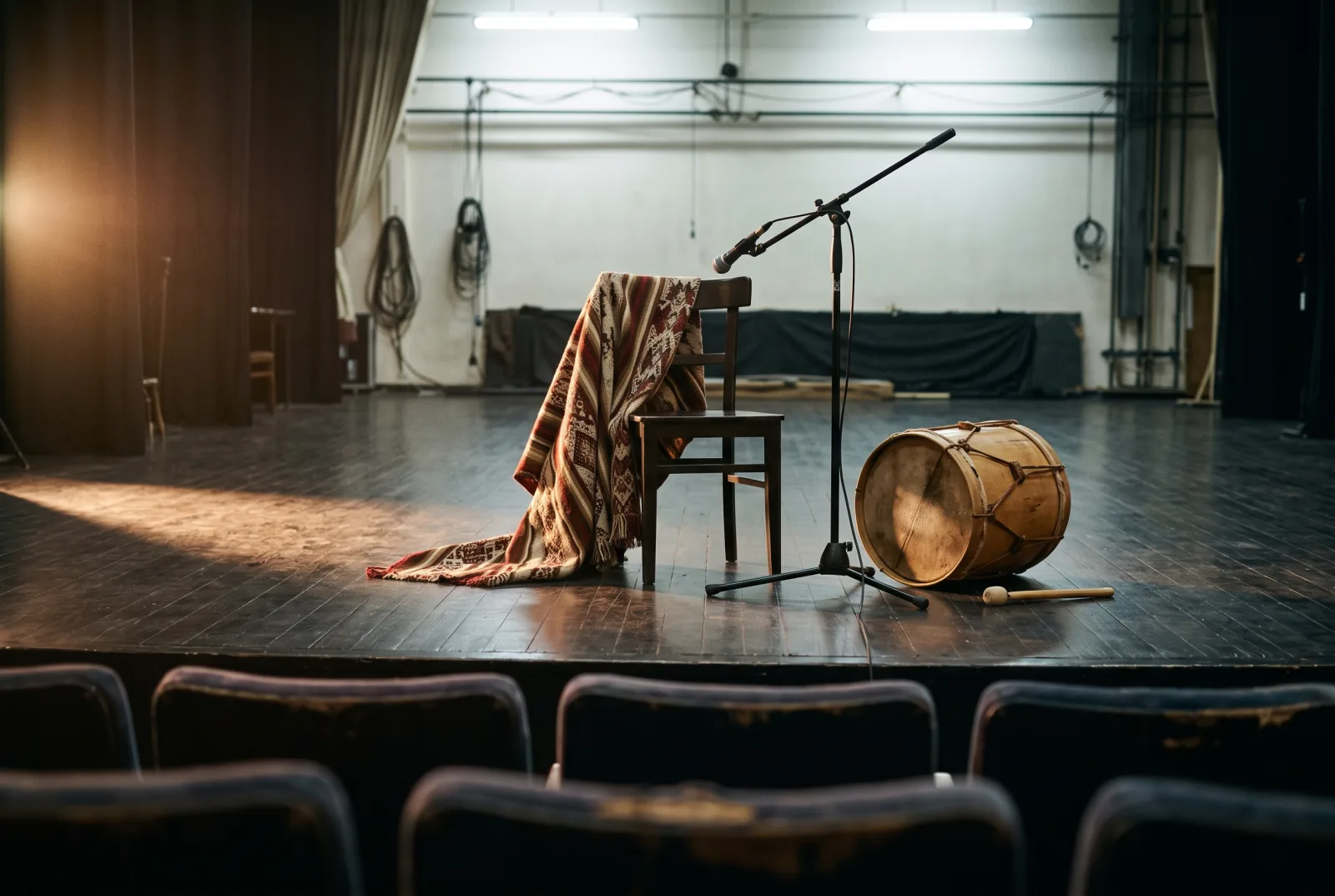
Ilustración: Rebobinados
On the night of 20 October 1978, Mercedes Sosa was singing in a grocery store in La Plata.
It was not a theatre. It was the Almacén San José, a small venue with some three hundred people packed inside.
She sang two encore songs that were banned. The police came in, arrested her in front of everyone, and took the entire audience away too.
What happened that night, precisely
It is worth telling properly, because it is told in many ways and almost all of them soften what took place.
The three hundred people were taken to the Second precinct, then under military control. The audience was released in batches from three in the morning.
She was held for around eighteen hours. She got out the following afternoon, after paying a fine.
And the order of events is worth correcting too, because it tends to be inverted. It was not that she was already banned and so they arrested her. It was the other way around: because of that night, every performance she had booked in the country was cancelled.
That was her last performance in Argentina before exile. She left for Europe in early 1979 and lived between Madrid and Paris.
Why a singer was frightening
She was not a songwriter. She almost never wrote her own songs, and that makes what she provoked stranger still.
She has an album called, precisely, "Yo no canto por cantar". It is from 1966 and the title is a declaration: she sang because she had something to say.
Her gift was that of the great interpreter. She would take somebody else's song and make it so completely her own, fill it with so much truth, that it seemed born out of her own life.
She did that with "Gracias a la vida", by the Chilean Violeta Parra, to the point that for many people that is the version. And with "Alfonsina y el mar". And with "Canción con todos", which ended up as something close to an anthem for the continent.
She was born in 1935 in Tucumán, in the poor north, with Diaguita roots she was proud of. Hence "La Negra", which in her case was never an insult.
She sang for the poor, for indigenous peoples, for workers, for the disappeared. A deep voice saying grave things, without raising its tone.
The return, which was not as it is told either
She came back in February 1982. It is often said that she returned "as the dictatorship was crumbling", and that is not true.
In February 1982 the regime was intact. Galtieri had taken office two months earlier, the Falklands war was two months away, and the dictatorship would not fall until December 1983.
The return was negotiated under military control. Two songs were left out of the repertoire, banned.
She gave thirteen performances at the Teatro Ópera in Buenos Aires, from 18 to 28 February, all sold out. Out of them came the double album "Mercedes Sosa en Argentina", with León Gieco on guitar and harmonica.
For many people it was the first sign that the country could become something else again.
What came afterwards
She kept singing for almost thirty more years, and each time with more people around her.
She recorded with Argentine rock — with Gustavo Cerati, with Luis Alberto Spinetta, with Charly García — and with half the continent. She was a goodwill ambassador for UNESCO and UNICEF.
Her last album, "Cantora", from 2009, is a farewell in the form of duets: Caetano Veloso, Shakira, Serrat, Spinetta, Cerati, Charly García.
She died on 4 October 2009, aged seventy-four. Argentina declared three days of national mourning.
What to remember
Mercedes Sosa is proof that you can be dangerous without uttering a single slogan.
Put on "Gracias a la vida", "Alfonsina y el mar" or "Sólo le pido a Dios" and you will hear a voice that needs no ornament. Deep, wide, still. Someone who is not singing to show off.
That is what frightened a government with tanks: a woman in a poncho singing songs that were not hers, in front of three hundred people in a grocery store.
Remember her this way: not as a symbol, which is what she ended up becoming, but as what she was that night in La Plata — a performer doing her job, so well that they had to come and get her.
Sources
Haydée Mercedes Sosa, born in San Miguel de Tucumán on 9 July 1935 and died in Buenos Aires on 4 October 2009, aged seventy-four, of multiple organ failure; the Argentine government declared three days of national mourning. Of Diaguita roots, she was known as "La Negra". Her album "Yo no canto por cantar" is from 1966. She was arrested on the night of Friday 20 October 1978 during a performance at the Almacén San José in La Plata, together with the roughly three hundred people in the audience and the venue's managers, for breaching music censorship rules with two encore songs; she was held for around eighteen hours and released after paying a fine. Two points that are frequently told wrongly are worth stating precisely: the date, which some sources mistakenly place in 1979, and the order of events, since the cancellation of her performances in the country was a consequence of the arrest and not something that preceded it. That was her last performance in Argentina before exile; she left in early 1979 and lived in Europe, between Madrid and Paris, with sources disagreeing on the order. She returned in February 1982, in the middle of the dictatorship — Leopoldo Galtieri had taken office in December 1981 and the Falklands war would begin in April — with a negotiated repertoire from which two songs were excluded; she gave thirteen sold-out performances at the Teatro Ópera in Buenos Aires between 18 and 28 February, recorded on the double album "Mercedes Sosa en Argentina", with the participation of León Gieco. "Gracias a la vida" is by Violeta Parra. She was a goodwill ambassador for UNESCO and UNICEF, and won the Latin Grammy for best folk album in 2000, 2003, 2006, 2009 and 2011 (posthumous), as well as the Latin Grammy for Musical Excellence in 2004. Her album "Cantora" (2009) includes duets with Caetano Veloso, Shakira, Joan Manuel Serrat, Luis Alberto Spinetta, Gustavo Cerati and Charly García. Externally authored text, edited and verified for Rebobinados. Interpretations of the meaning of her work are offered as the author's reading. No song lyrics are reproduced, for copyright reasons. Information drawn from El Día (La Plata), Infobae, Wikipedia and other coverage.
Keep rewinding

70s
folk
Florcita Motuda
Forty-nine years without a reissue
With "Brevemente… geeente" he won the best Chilean performer prize at Viña 1977, and he won it in the international competition because the folk one was not held that year. The album that contains it, released in 1977 on APRI —Antonio Prieto's label—, spent 49 years without a reissue: never on CD or streaming until it came back on vinyl in April 2026 and on digital on 11 July, the day he returned to the stage. The record for the longest title at the OTI is his, but it is from 1978 and not 1998.
00s
folk
Natalia Lafourcade
Where it said pumpkin she put flowers
The story says she rescued the son jarocho with reverence on *Un Canto por México*, but "La Bruja" is not on that record: she recorded it on *Cancionera*, on 24 April 2025, and rewrote the lyric. Where the son turns the man into a pumpkin, she sings that she filled him with flowers: "a cancionera is a kind of sorceress". Twenty Latin Grammys, a house rebuilt in Jáltipan and a harpsichordist father who left Chile two days after the coup.

70s
folk
Piero
The old man wasn't his
Piero sang "Mi viejo" in 1969, but the words are José Tcherkaski's and the father it portrays was his own: Mario Tcherkaski, a Russian street hawker who died at 52, eight years before the song. CBS released it with Father's Day in mind after several labels turned it down, and the first pressing passed 600,000 copies. Piero died on 7 October 2026, aged 81.
Rewind with us
Comments · 0
No one has commented yet. Open the conversation.