
Caetano Veloso
Devouring the world
By Rebobinados · Published on September 17, 2026
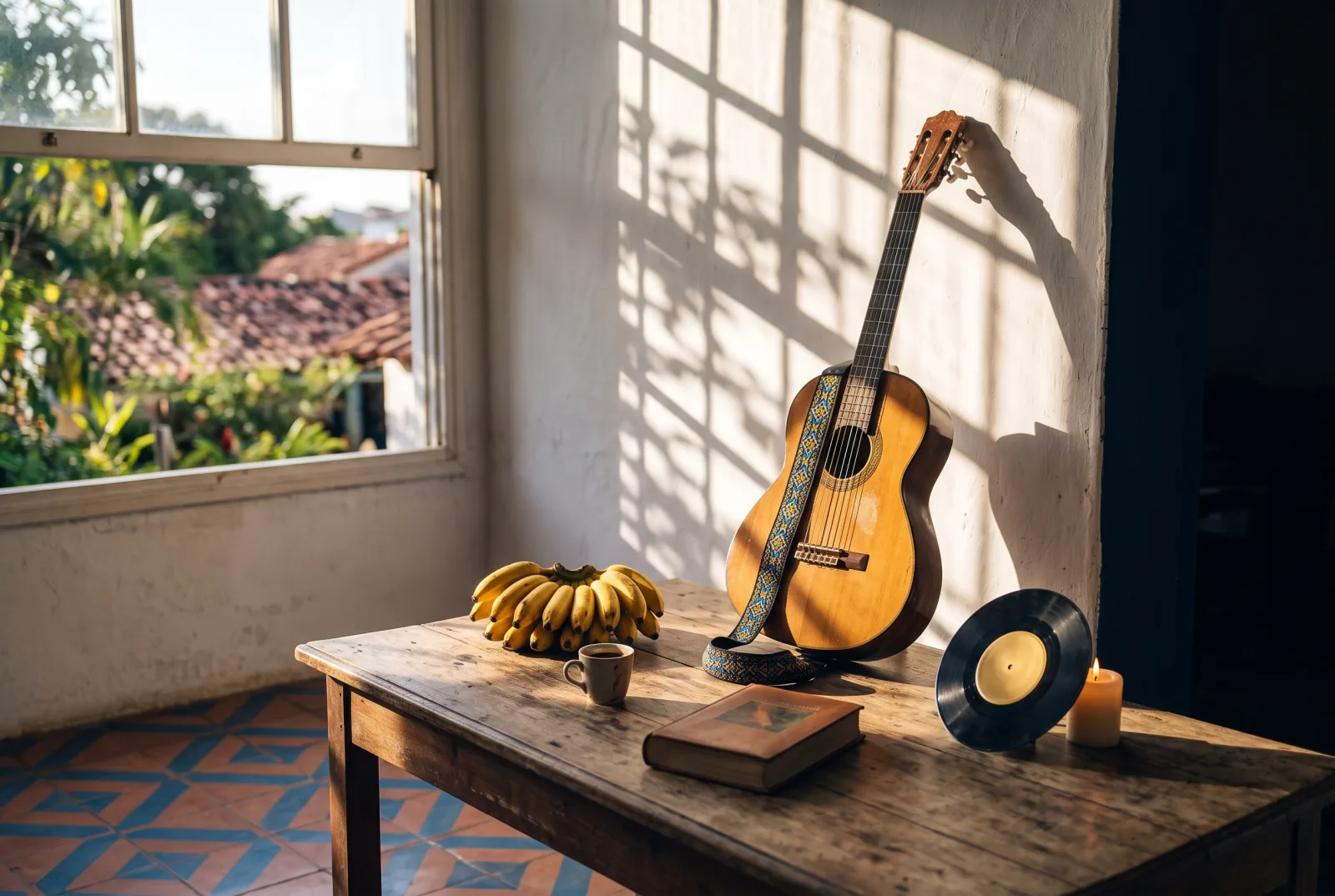
Ilustración: Rebobinados
Caetano Veloso is one of the most important artists the Americas have produced, and that is no exaggeration.
Poet, thinker and musician, he reinvented the music of an entire country, was jailed and exiled for doing it, and came back to become a living monument who never stopped experimenting.
His story is that of a man who understood, before almost anyone else, that opening up to the whole world could be the most revolutionary and the most dangerous act of all.
Bahia, philosophy and bossa
He was born in 1942 in Santo Amaro, a small town in Bahia, in the north-east of Brazil, brother of the equally enormous singer Maria Bethânia.
He enrolled to study philosophy at the Federal University of Bahia, a degree he left unfinished when the military coup of 1964 arrived. He was dazzled by João Gilberto's bossa nova.
And in the late sixties, together with Gilberto Gil—the other brain behind the whole thing—with the poets Torquato Neto and José Carlos Capinam, the arranger Rogério Duprat, and with Gal Costa, Tom Zé, Nara Leão and Os Mutantes, he shaped the movement that would change everything: Tropicália.
The idea was bold. Take Brazilian music—bossa, the regional rhythms—and mix it without hang-ups with rock, psychedelia and the avant-garde, with everything coming in from outside.
They drew on an old idea from Brazilian modernism, Oswald de Andrade's "antropofagia", cannibalism: devour foreign culture and digest it until it becomes something deeply your own.
The collective album "Tropicália ou Panis et Circencis", from 1968, was their manifesto. Even the sleeve said so: a group portrait that crossed a nod to the Beatles' "Sgt. Pepper's" with a parody of the Brazilian middle-class family photo.
Why it was dangerous
And here is the heart of why Caetano matters so much.
At that moment, Brazil was under a military dictatorship that exalted a closed nationalism. And Tropicália, without shouting a single slogan, said something deeply subversive: that Brazil could open itself to the whole world—to rock, to the Beatles, to the foreign—and go on being, more strongly than ever, Brazil.
That openness was, in itself, a political act. And it did not only unsettle the generals: it also unsettled a good part of the nationalist left, which saw in electric guitars a surrender to the empire.
On 15 September 1968, in the theatre of the Catholic University of São Paulo, Caetano came out to sing "É proibido proibir" with Os Mutantes, dressed in plastic and cables. The student audience, hostile to rock, booed him and threw everything they had at him.
He stopped the song and hurled at them a harangue that has lasted for ever: that they were not understanding a thing, absolutely nothing, and that if they were in politics the way they were in aesthetics, they were done for.
Prison and exile
On 27 December 1968, two weeks after the decree that hardened the dictatorship, Caetano and Gil were arrested.
They spent some fifty-four days in custody, in barracks in Rio. When they arrived their long hair was shaved off. They came out in February 1969 into house arrest in Salvador, and in July that year they left for exile in London.
He could not settle in his own country again until January 1972. His songs were censored and banned over and over.
The dictatorship did everything it could to silence him.
They did not manage it
Caetano came back from exile and became one of the central figures of MPB, Brazilian popular music, and in the eighties and nineties a star known all over the world.
Across six decades he made dozens of records, won endless prizes, and wrote songs that are part of the national heritage: "Sampa", his love letter to São Paulo; "Sozinho"; "O Leãozinho"; "Terra".
His version of "Cucurrucucú Paloma"—the huapango by Tomás Méndez—which Almodóvar used in "Hable con ella", made half the world cry without understanding a word.
He also wrote one of the great books about music and politics, "Verdade Tropical".
The foreign press has compared him again and again with Bob Dylan. It is a label that circulates without an author and that he himself would look at wryly: it took him years to appreciate Dylan, and he ended up singing, half in jest, that he was not interested in his Christian guts.
What to remember
Caetano Veloso is the proof that a musician can be a revolutionary without raising a single fist: it is enough to widen what is possible.
Tropicália did not only change Brazilian music. It insisted, against a nationalist dictatorship and also against part of the nationalist left of its time, that a country has the right to devour the whole world and go on being itself.
That was his idea, and for that idea they put him in prison.
If you put on "Sozinho", "Sampa", "Terra" or "Cucurrucucú Paloma", you are going to hear a man who turned openness into art and art into resistance.
They tried to silence him and they failed, because you can imprison a person but not an idea. And his—that we all have the right to eat up the whole world and go on being who we are—is still as alive as he is, a man in his eighties who still climbs onto a stage to sing it.
Sources
Caetano Emanuel Viana Teles Veloso (Santo Amaro, Bahia, Brazil, 7 August 1942), singer, composer, writer and central figure of Brazilian music; brother of the singer Maria Bethânia. He enrolled in Philosophy at the Federal University of Bahia around 1963 and left without graduating after the military coup of 1964; in 1998 the UFBA itself awarded him an honorary doctorate. Around 1967-1968 he shaped Tropicália together with Gilberto Gil, with the poets Torquato Neto and José Carlos Capinam, the arranger Rogério Duprat and the designer Rogério Duarte, and with the decisive participation of Gal Costa, Tom Zé, Nara Leão and Os Mutantes; the movement fused Brazilian popular music and bossa nova with rock, psychedelia and the avant-garde, inspired by the "antropofagia" of Oswald de Andrade's Cannibalist Manifesto (1928), which Caetano came to through the concrete poet Augusto de Campos, and by Hélio Oiticica's penetrable "Tropicália" (1967), which gave the movement its name. The collective album "Tropicália ou Panis et Circencis" (1968), with a sleeve by Rubens Gerchman over a photograph by Olivier Perroy, is its manifesto and crosses the reference to "Sgt. Pepper's" with the parody of the middle-class family portrait. On 15 September 1968, in the TUCA theatre of the PUC in São Paulo—in the São Paulo qualifying round of the festival, not in the Rio final—Caetano was booed while performing "É proibido proibir" with Os Mutantes and answered with a celebrated harangue to the audience; sources disagree about how the song fared in the competition. Under the military dictatorship, hardened by Institutional Act No. 5 of December 1968, Veloso and Gil were arrested on 27 December 1968 and were held for some 54 days, until February 1969, in barracks in Rio, where their hair was shaved; house arrest in Salvador followed and, in July 1969, exile in London, from which he returned permanently in January 1972, after an authorised one-month visit in January 1971. His songs were frequently censored. He returned to establish himself as one of the greatest figures of MPB and achieved international renown in the 80s and 90s. Among his songs: "Sampa", "Sozinho", "O Leãozinho", "Terra" and his version of "Cucurrucucú Paloma", a huapango by Tomás Méndez, included in Pedro Almodóvar's "Hable con ella" (2002), where he appears on camera. He published the memoir "Verdade Tropical" (1997). The comparison with Bob Dylan is a commonplace of the foreign press with no identifiable author; in Brazil the nickname "the Brazilian Bob Dylan" is popularly associated with Belchior. Externally authored text, edited and verified for Rebobinados. Readings of the meaning of his work are offered as the author's interpretation. No song lyrics are reproduced, for copyright reasons. Information drawn from Wikipedia, Memorial da Democracia, Memórias da Ditadura, Britannica, Senses of Cinema and other press coverage.
Keep rewinding

70s
folk
Florcita Motuda
Forty-nine years without a reissue
With "Brevemente… geeente" he won the best Chilean performer prize at Viña 1977, and he won it in the international competition because the folk one was not held that year. The album that contains it, released in 1977 on APRI —Antonio Prieto's label—, spent 49 years without a reissue: never on CD or streaming until it came back on vinyl in April 2026 and on digital on 11 July, the day he returned to the stage. The record for the longest title at the OTI is his, but it is from 1978 and not 1998.
00s
folk
Natalia Lafourcade
Where it said pumpkin she put flowers
The story says she rescued the son jarocho with reverence on *Un Canto por México*, but "La Bruja" is not on that record: she recorded it on *Cancionera*, on 24 April 2025, and rewrote the lyric. Where the son turns the man into a pumpkin, she sings that she filled him with flowers: "a cancionera is a kind of sorceress". Twenty Latin Grammys, a house rebuilt in Jáltipan and a harpsichordist father who left Chile two days after the coup.

70s
folk
Piero
The old man wasn't his
Piero sang "Mi viejo" in 1969, but the words are José Tcherkaski's and the father it portrays was his own: Mario Tcherkaski, a Russian street hawker who died at 52, eight years before the song. CBS released it with Father's Day in mind after several labels turned it down, and the first pressing passed 600,000 copies. Piero died on 7 October 2026, aged 81.
Rewind with us
Comments · 0
No one has commented yet. Open the conversation.